Where did this month go? It seems just yesterday that it was April. At the end of each month, we dedicate a blog entry just to recap what’s gone on with EXAIR during the month.
May 13 – We announced that our Chip Trapper was chosen as a finalist for a Design News “Golden Mousetrap” award (in addition to Plant Engineering “Product of the Year”)
May 14 – Two new EXAIR Super Air Nozzles in PEEK became available
May 17 – EXAIR Air Knives, Air Wipes and Air Amplifiers became CE compliant
May 19 – Visit from our distributor in Denmark
May 28 – We posted our first ever tribute to fallen military veterans for Memorial Day on our Facebook page, including a couple of mentions that are personal for employees at EXAIR
Also in May, we began stocking filter bags with different micron ratings for our award-winning Chip Trapper.
Professor Penurious was curiously quiet in May, but we expect that to change in June.
And of course the oil disaster in the Gulf of Mexico (come on, BP!) dominated the news.
As you can see, it’s been another very busy month. We are working hard every day, every week and every month to give customers the information, products and services that they need to save money, save time and improve their operations.
June shapes up to be just as busy as April and May. Two more international distributors are set to visit EXAIR and yet another round of new products announcements are coming up.
Stay tuned for more news. You can catch the latest on Twitter at twitter.com/exair
In my spare time (yeah, right!), I coach youth sports. For basketball, I help out with a YMCA team. For baseball, I help with a local recreational league team. I began coaching when my son played in those leagues, and I have been fortunate enough to be asked back by various coaches even though my son has moved on to high school sports. The last few years, I’ve been involved with teams that fall into the 13 to 15 year old range for both basketball and baseball. At those ages, there aren’t any co-ed teams, so these teams consist of 13-15 year old teenage boys. And yes, you read that correctly, I did return voluntarily.
The baseball team plays in a league that is special to me. It’s in the neighborhood where I grew up, and it’s where I played baseball as a kid. Back then, it was a lower-middle class neighborhood. Today, let’s just say the “middle” has faded quite a bit. Many of these kids come from less than ideal family situations, and in a lot of cases, their fathers aren’t around to help. Transportation to and from practices and games is usually a problem. The facilities need a lot of work. And equipment provided by the league is pretty much non-existent because they just don’t have the money. But I’m glad to help these coaches and these kids, because learning baseball (and inherent lessons like “teamwork”, “preparation”, “discipline” and “commitment”) can help long after you are no longer a player.
Take a second to think about the situation. How difficult do you think it would be to get a dozen teenage boys on the same page, working in the same direction? If you don’t have teenage kids, feel free to ask someone who does. Now add in the economic and family situations of these particular kids. Does this seem like a task you would undertake? Does it sound very difficult or nearly impossible?
You’re dead wrong. Let me tell you what happened last week.
Last Wednesday, we had practice scheduled in the evening as usual. Our local high school had the audacity to schedule fall sports physicals on the same day in the late afternoon. So of the dozen players on the team, half were getting their sports physicals and wouldn’t be able to make it to practice. During the afternoon, I got a text message from the team manager that said he had to work late and wouldn’t be able to make it. He asked me if I could handle practice that night, and I replied “no problem”. It was a busy day at work and I wasn’t able to leave on time. And traffic was terrible (the park is on my way home, but still over 20 miles from work). I realized that I was going to be really late getting to practice, and that nobody else had team equipment or even baseballs to run practice. It turns out I was half an hour late getting there. I expected that the remaining players would have left by the time I arrived, with no coaches, no equipment and only half the team there anyway.
What I found was six kids practicing hard using what they had to work with, namely their gloves and one old baseball. Without any coaches around, they had warmed up, stretched and ran around the field just as we always have them do before practices or games. Then they organized a drill that involved six players and one baseball to work on throwing, catching and situational decisions (which base do I throw to, etc.).
All on their own.
They could have simply left, and nobody could have blamed them. They could have just “hung out” and not practiced at all until I arrived. They could have complained that we coaches left them high and dry that day. But they didn’t. Half a dozen, low income, disadvantaged teenage boys knew what needed to be done and they did it without supervision or direction. Even when they didn’t have the tools they needed. Even with no one there see it happen.
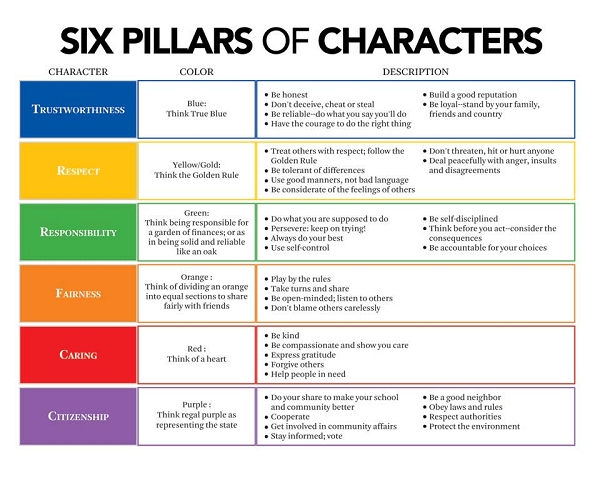
Character (and integrity) is sometimes described as “doing the right thing even when no one is watching”. People have character. A person’s character is pervasive. It shapes their behavior and the decisions they make, in work and in life. Good character helps you in just about every aspect of your life, no matter your profession. Poor character follows you wherever you go, no matter how hard you might try to escape it. And, like it or not, each person’s character is apparent to those they interact with on any regular basis.
Companies don’t have character, they are incapable. Each company has an inherent culture built on the character of its people. A strong company culture built upon high character people results in a business that will do the right thing, to the best of its ability, even when no one is watching. A culture like that, built by people who understand the importance of good character, is one of the most valuable assets that any business can hope to possess. And that culture is nearly impossible to buy or replicate.
For a little more insight into honesty and character, please enjoy this clip from the movie “The Big Kahuna”. It’s worth five minutes of your time, I promise.
A common question from our customers is “what kind of air do I need to provide into the EXAIR product?” or ” is instrument air OK for this product?”. Some sources of debris in compressed air could be the intake air of the compressor or scale from the piping system. I can tell you that we simply ask for “clean, dry air”; let me explain further.
ISO 8573-1 is the International Standard for Air Quality Classes. It lays the ground rules for allowable levels of solids, moisture and liquid condensate, and lubricants in the compressed air source.
Though the standard has very specific values for maximum particle size, maximum pressure dew point and maximum oil content for different industries and/or environments we can generalize a bit and express the levels of air quality like this: Plant Air – general plant compressed air used for air tools, nozzles etc. Instrument Air – found in laboratories, paint and powder coat booths, used for climate control. Process Air – used in food and pharmaceutical applications, electronics applications. Breathing Air – used for breathing respirators, breathing tanks and hospital air systems.
Achieving the different levels of air quality can be done with 3 basic types of filtration. 1. Particulate – a filter element removes particles larger than the opening in the filter material. Typically done with particles greater than 1 micron. 2. Coalescing – use different methods to capture the particles; 1) direct interception – works like a sieve, 2) Inertial impaction – collision with filter media fibers, 3) Diffusion – particles travel in a spiral motion and are captured in the filter media. 3. Adsorption – the filter element holds the contaminants by molecular adhesion.
The cleaner your air needs to be the more of these filtration methods you will use. adsorption will remove more and finer particles than a simple particulate filter. And many applications will use a combination of these methods, especially if you are using a lubricated air compressor to generate your compressed air.
EXAIR products, all of which need a source of “clean, dry air” will operate very well utilizing a source of plant air and only a particulate filter. Your process, environment or type of compressor will dictate if you need to supply additional filtration methods or better air quality. If you are using a lubricated compressor or have lubricant in your compressed air lines from another source, you will want to use a coalescing oil removal filter.
EXAIR stocks 5 micron particulate filters which are properly sized for each individual product as an option for our customers if they choose. We also stock coalescing oil removal filters for customers who may need to remove oil from the air. Replacement filter elements are also available and should be replaced at least twice a year, depending on the quality of your air.
Remember to ask about filtration if you have any concerns about your air quality. We can assist in sizing up the proper filters to get the air quality we recommend for proper operation and longevity of our products.
When I was a boy, we played a simple game called “king of the mountain”. One person was the king and all the rest had to do what they could to knock the king off the mountain or in our simple version to get the king to fall down or roll down the hill. It was a simple enough game that young boys played for fun. But there were a lot of other things going on in the background that we probably didn’t’ even know at the time. One was the development of a certain pecking order that became apparent. The older boys who were bigger pretty much ran the game. Even though the younger, lesser experienced boys would try to gang up on the older boys and apply their strategies, they would fail just because they were so far behind in strategy and life experience in general. No matter what they tried, desperate as it may seem, the older boys always had a counter for the ensuing attack.
Fast forward 35 years later and here we are in this game again. Only it’s not a bunch of neighborhood boys trying to pull the king off the hill, it is the competition. Armed with nothing more than a few statements like ” better pricing without sacrificing quality”, ” better product at a better price”, we’ll “ship” you our equivalent model for “free” (whoop dee doo) , these guys are trying to go after the market leader with a bunch of cliché marketing statements.
You rarely hear about an original application that was not a re-cap of one that we worked on 15 years ago or a copy of an application blog from EXAIR written 15 minutes prior. You never hear a detailed discussion on how the investment that the customer made paid itself back in a good time frame. You never hear about some new, original product that was released by these guys that has not already been an established part of the EXAIR product line for 18 – 24 months. But then again, that’s what happens when your product development cycle consists of reverse engineer and copy, reverse engineer and copy. Now that’s applying the KISS (keeping it simple stupid) method. Yep, your daddy taught you well!
EXAIR Corporation is a problem solving company. We have the vision, leadership, experience and worldwide network to continue delivering new and innovative products and work them into solutions that our customers need right now.
Notice, we rarely talk about price or being the low-cost solution. We know when we make a recommendation to a client, they will get the original cost of their investment back (usually only within a few months) and the investment continues to pay them in energy savings over the life of the application. Top notch customer service with the end goal of being easy to do business with is how we operate and customers appreciate this method. This is not to say we are not competitive on price as well. We certainly are. You don’t get to be the market leader without price competitiveness being one of the things you pay attention to on a daily basis.
Our imitators seem to think that if they put their product price a few bucks under ours and change its color, that makes them assertive and technically competent. They also operate on the premise that if they put their prices just a little bit below ours and their product specifications just a little bit better than ours ( honesty factor – out the window) that they position themselves for success. Solid people, original ideas, well applied strategy and hard work are the ingredients for success, not marketing campaigns reminiscent of a couple of ten year olds running a lemonade stand.