
Catching Static

Winter months can create the perfect conditions for static electricity, especially in colder climates. When the air is dry and cold, it becomes harder for electricity to move. This can lead to a buildup of static charge on our bodies and everyday objects. When we touch something metal or another person, we may feel a small shock. Understanding how winter affects static electricity can help us manage and reduce these annoying shocks during the cold months, and also address any issues static may cause in your industrial application.

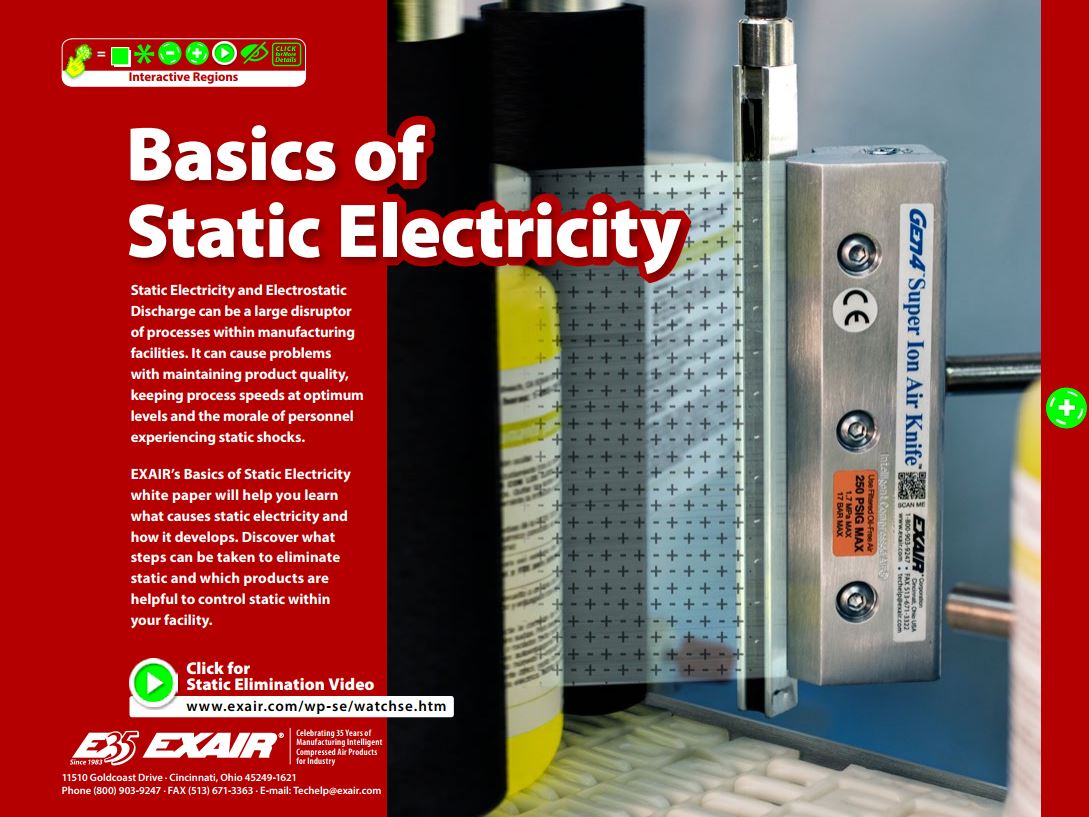
Static electricity occurs when there is an imbalance of electric charges on an object. This imbalance happens when two insulating materials rub against each other, causing one to gain electrons while the other loses them. As a result, one object becomes negatively charged, while the other becomes positively charged. The static charge stays on the surface of the material until it can either flow away as an electric current, or be released through a spark or discharge. This phenomenon is commonly experienced when touching metal objects after walking on carpet, which can create a small shock.

A powerful blast of static eliminating ionized air, literally at your fingertips.

To reduce static electricity in an industrial setting, controlling humidity is essential. Using humidifiers can help maintain a higher moisture level in the air, which reduces static buildup. Additionally, bonding equipment to Earth ground, helps to safely drain any static electricity that may accumulate. Implementing anti-static additives in materials, or using ionization systems can further minimize static issues. By combining these strategies, companies can create a safer and more efficient working environment.

Regardless of the nature of the application, if you’ve got a static problem, EXAIR has a solution!

The static eliminator product line from EXAIR provides effective and active solutions to remove static electricity from surfaces without any physical contact. This is especially useful for products with complex shapes, where traditional methods may fall short. With EXAIR’s Gen4 products, users can direct ionized airflow to reach every part of a target item, ensuring thorough static elimination. This technology helps to improve product quality and reduce the risk of damage during handling. Overall, EXAIR’s static eliminators are a practical choice for maintaining a static-free environment in various industries.

If you would like to discuss static eliminating products by EXAIR, please do not hesitate to contact an Application Engineer. We are always happy to help!

Jason Kirby
Application Engineer
Email: jasonkirby@exair.com
Twitter: @EXAIR_jk

EXAIR Press Release: Intellistat Ion Air Nozzles New Patent

The Intellistat Ion Air Nozzle has been used in clean room applications, most commonly to keep contaminants away from packaging and labeling areas. The Intellistat Ion Air Nozzle has a clean room classification: ISO 14644-1 Class 5, operational. And has recently acquired a new patent.

The +/- 30V offset allows you to achieve a very low residual charge at impressive static decay rates, reducing 1000V down to 100V in just 0.6 seconds. We’ve taken the same engineered nozzle technology used in our line of Super Air Nozzles to ensure the nozzle operates well below the OSHA standards for both noise exposure (29 CFR 1910.95(a)) and dead-end pressure (OSHA 1910.242(b)). The nozzle is also very efficient, minimizing compressed air usage compared to open tubes or pipes commonly used in blowoff applications. At a pressure of 80 PSIG, the Intellistat Ion Air Nozzle consumes just 5.8 SCFM of compressed air.

The nozzle assembly is constructed from durable dissipative polycarbonate to assure its usefulness in applications that require non-conductivity such as circuit boards or electronics manufacturing. It provides ionized airflow useful for removing dust, static, or particulate contaminants in sterile environments such as clean rooms, laboratories, or scientific testing.

In processes that require operators to have both hands free for packaging, testing, or assembly of small parts and products, the Intellistat Ion Air Nozzle is the ideal solution. It includes a 6mm push-in air connection and incorporates red and green LED lights to indicate proper functionality and performance.

EXAIR’s line of Intellistat products is UL listed and CE compliant, following suit with EXAIR’s complete line of Gen4 Static Eliminators. Take a look at our wide range of available solutions offered to ship same-day from stock on our website! If you need help identifying the best solution for your specific application, Application Engineers are standing by to help you via phone, chat, or e-mail. Reach out today!

Jordan Shouse
Application Engineer

Send me an Email
Find us on the Web 
Like us on Facebook
Twitter: @EXAIR_JS

EXAIR Starter Guide Video Series: Gen4 Static Eliminators

This time of year, it is not uncommon to feel a slight shock after walking across a carpeted surface and touching a door knob. This little “jolt” is a result of fast-moving electrons leaping from your body to the door knob, or vice versa. As your feet shuffle across the surface of a rug or carpet, your body will either gain or lose electrons. Touching a conductive surface then causes these electrons to leap from one place to another.

If you notice, this happens to occur much more often during colder winter months. The reason that you experience static shocks more frequently during winter is due to the relative humidity. At colder temperatures, air does not hold as much moisture as it does when it’s warm. Even though you’re heating your house to a similar temperature, the air that is being drawn into your home and heated is still the dry cold air containing less moisture.

If you’re anywhere in the Northern Hemisphere, we’re quickly approaching winter and the increase in issues related to static electricity. EXAIR manufactures a complete line of products designed to help you quickly and reliably neutralize any residual charge on the surface of a part or material. Check out the video below for a brief overview of the options EXAIR offers and how to get started!

Static Eliminator Starting Guide

Tyler Daniel, CCASS

Application Engineer

E-mail: TylerDaniel@EXAIR.com

X: @EXAIR_TD

Gen4 Ion Air Jet Solves Labeling Issue For Pharmaceutical Manufacturer

We’re watching football again on the weekends (and on Monday, and Tuesday, and apparently Friday this year?) which means cooler fall temperatures are quickly approaching.

Static electricity is something that we talk about often here at EXAIR, particularly during the colder winter months. When an atom gains or loses an electron from its outer shell, it becomes electrically imbalanced. A material’s propensity to either gain or lose an electron is “ranked” on a list known as the Triboelectric Series. Static Electricity is generated in a few different ways: contact static build up, detachment static buildup, and frictional static build up.

Detachment static build up occurs when a material is in contact with another and these two surfaces separate from one another. During the separation, not all of the electrons are able to get back to their original molecule. This results in an instantaneous static charge as the electrons are transferred from one object to another in accordance with the Triboelectric Series. Due to the large surface area in most detachment static buildup scenarios, the amount of static generated is typically far greater than contact static buildup.

One of the most common types of detachment static buildup occurs as material separates from a roll. This typically occurs at a high rate of speed and the large surface area across the width of the roll presents an ideal situation for static buildup. This charge can cause the material to stick to itself and not come off the roll properly, creating issues down the line. This was exactly the case for a recent customer pharmaceutical company, manufacturing medicine used in the pet industry.

In many labeling processes, detachment static can build up to the point where it causes issues with label application. The label may not adhere to the container properly or the labels can stick to rollers or itself and cause operators to shut down the machine to fix. This leads to increased downtime, lost production, and excess waste in the process.

The solution was to install one of EXAIR’s Gen4 Ion Air Jets to saturate the labels with static neutralizing positive and negative ions. This quickly eliminates the charge (can neutralize 5kV in as little as 0.3 seconds) and stops the issues they were noticing with production. With much colder temperatures right around the corner, this was a welcome addition as the problem was going to quickly get worse as humidity decreases during winter.

Don’t wait until the problems associated with static return to seek out a solution. Contact an EXAIR Application Engineer for help discussing your process and how we could be of benefit to you.

Tyler Daniel, CCASS

Application Engineer

E-mail: TylerDaniel@EXAIR.com

X: @EXAIR_TD