Entrainment: How It Works, and Why EXAIR Products Use It.

EXAIR Super Air Nozzle entrainment

Because of the large amount of energy required to run an air compressor, the pneumatic system is considered the fourth utility in a manufacturing plant.  And saving this commodity and using it as efficiently as you can, should be a priority.  EXAIR has many products that can save this energy safely and effectively.  And the story behind the efficiency of EXAIR products is Bernoulli’s equation. 

Bernoulli’s principle explains how a high velocity fluid can generate a low pressure.  (You can read more about Bernoulli’s principle HERE.)  Let’s start by looking at Equation 1.

Equation 1:

P + p * V2/2 = C 

P – pressure

p – density of the fluid

V – velocity

C – a constant

As you can see from Equation 1, when the velocity goes up, the pressure must go down.  When we have a lower pressure, then the surrounding fluid will have to fill that void.  Since air is a fluid, this is how we can entrain the free ambient air while only using a small amount of compressed air.  Bernoulli’s Principle can be applied in two ways; as a Coanda and as a Venturi.  EXAIR uses both methods in our products for creating low-pressure effects. 

Compressed air flows through the inlet (1) to the Full Flow (left) or Standard (right) Air Knife, into the internal plenum. It then discharges through a thin gap (2), adhering to the Coanda profile (3) which directs it down the face of the Air Knife. The precision engineered & finished surfaces optimize entrainment of air (4) from the surrounding environment.

The first way is from a Coanda profile.  Coanda, named after Henri Coanda, noticed that a fluid would “hug” a curved surface.  (You can read more about Henri Coanda HERE.)  The high velocity air going around the curved surface will generate a low pressure above it.  We use this with our Full Flow and Standard Air Knives, our Air Wipes, and our Air Amplifiers.  With a Coanda profile, the low pressure will entrain the surrounding air to add mass to the air stream.  We can get an amplification ratio up to 30:1, which means that for every 1 part of compressed, 30 parts of ambient air are entrained.  We are able to create an efficient air moving (blow-off) device by using the Coanda profile. 

Generating even lower pressures can be accomplished with a Venturi.  This phenomenon is named after Giovanni Venturi, who discovered that by increasing the velocity through an orifice, the surrounding fluid will move with it, generating a lower pressure.  (You can read more about Giovanni Venturi HERE.)  Remember the higher the velocity, the lower the pressure.  We use the Venturi effect on our Super Air Knives, E-Vacs, Line Vacs, and Super Air Nozzles.  When compared to our Full Flow and Standard Air Knives, the Super Air Knives can generate an amplification ratio of 40:1.  We were able to engineer the product to increase the air entrainment efficiency even further. 

EXAIR has been manufacturing Intelligent Compressed Air® products since 1983.  We provide solutions that are efficient, effective, and safe for air moving and blow-off systems.  Consider the following analogy; homemade air movers and blow-off devices are the equivalent to incandescent light bulbs. EXAIR products are the equivalent to LED light bulbs.  More efficient design leads to lower operating cost, higher efficiency and a higher level of effectiveness. Entrainment of free ambient air can save you a lot of money and increase your mass flow with your compressed air use to generate higher forces on your targets.  If you would like to discuss solutions to use less compressed air, an Application Engineer is available to help.    

John Ball
Application Engineer
Email: johnball@exair.com
Twitter: @EXAIR_jb

People of Interest: Giovanni Battista Venturi March 15, 1746 – April 24, 1822

Giovanni Battista Venturi was born in 1746 to an affluent family in Reggio, Italy. An aspiring student, Giovanni was ordained as a priest and a professor by the age of 23. An avid historian of science at the University of Modena, he was the first to emphasize Leonardo da Vinci as a scientist rather than just an artist as he’s more commonly known. Despite his love for history, it wasn’t long before the University of Modena became aware of his talents in mathematics where they appointed him as professor of geometry and philosophy in 1774. During his tenure at the University of Modena, Giovanni was promoted to the Professor of Experimental Physics, served as the Duke of Modena as the State engineer and auditor, later serving diplomatic roles in both France and Switzerland.

Giovanni is most well-known for his work in developing what is now known as the venturi effect. In 1797, he published a study on the flow of water through short cylindrical tubes. It wasn’t until 1888 that Venturi’s design was applied to something practical when a man named Clemens Herschel received a patent for the first commercial venturi tube. The original purpose of the venturi tube was to measure the amount of water used in individual water mills and is still used to this day as a means of measuring fluid flows.

Venturi tube.jpg
Venturi Tube

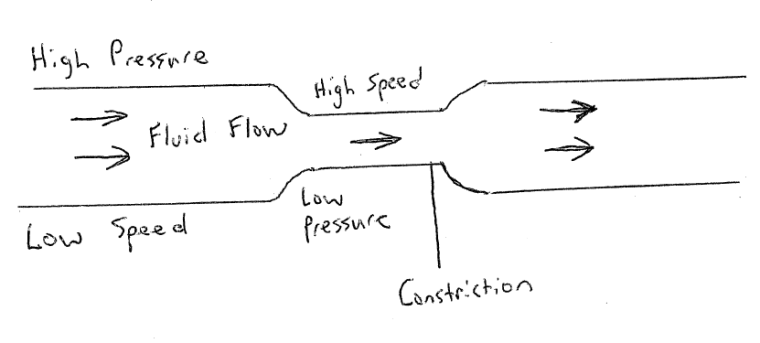
The venturi effect is a principle in fluid dynamics and states that a fluid’s velocity must increase as it passes through a constricted pipe. As this occurs, the velocity increases while the static pressure decreases. The pressure drop that accompanies the increase in velocity is fundamental to the laws of physics. This is known as Bernoulli’s principle. Below is an illustration of how the venturi effect works inside of a constricted tube.

venturi

In everyday life, the venturi principle can be found inside of many small engines such as lawn mowers, gas powered scooters, motorcycles and older style automobiles. Inside the carburetor, there is a small tube through which filtered air flows from the intake. Inside of this tube is a short narrowing. When the air is forced to constrict, its velocity increases and creates a vacuum. This vacuum draws in fuel and mixes with the air stream causing it to atomize.  As the throttle valve is opened further, more fuel is forced into the engine. This increases the RPM and creates more power.

inlineworks
In-Line E-Vac

This principle is also applied to EXAIR’s line of E-Vac products to create vacuum. The .gif below illustrates how an In-Line E-vac works. (1) Compressed air flows through the inlet (2) and is directed through a nozzle, constricting the flow of air. (3) As the air stream exhausts, it expands causing a decrease in pressure and an increase in velocity prior to passing through the venturi. (4) A vacuum inlet tangential to the primary airflow is located at the suction point between the orifice and the venturi. (5) The airflow that is drawn through the vacuum inlet mixes with the primary airstream, then exhausts on the opposite end.

The venturi effect is used in a variety of other EXAIR products used for cooling, drying and cleaning, in addition to the vacuum generators. If you have a process in your facility that may benefit from an Intelligent Compressed Air solution, give us a call. We’d be happy to discuss your application and implement a solution to both reduce your compressed air costs and improve worker safety.

Tyler Daniel
Application Engineer
E-mail: TylerDaniel@exair.com
Twitter: @EXAIR_TD

Photo: Venturi Tube with labels by ComputerGeezer an Geof.  GNU Free Documentation License