Entrainment: How it Works and Why EXAIR Products are Engineered to Use it.

EXAIR Super Air Nozzle entrainment

Because of the large amount of energy required to run an air compressor, the pneumatic system is considered the fourth utility in a manufacturing plant.  And saving this commodity and using it as efficiently as you can, should be a priority.  EXAIR has many products that can save energy by using less compressed air.  And the story behind this is entrainment explained by Bernoulli’s equation. 

Bernoulli’s principle explains how a high velocity fluid can generate a low pressure.  (You can read more about Bernoulli’s principle HERE.)  Let’s start by looking at Equation 1.

Equation 1:

P + d * V2/2 = C 

P – pressure

d – density of the fluid

V – velocity

C – a constant

As you can see from Equation 1, when the velocity goes up, the pressure must go down.  When we have a lower pressure, then the surrounding fluid will fill that void.  Since air is a fluid, we can use high velocity to entrain the surrounding ambient air.  The free air will add to the compressed air to give the airstream mass for a hard-hitting force.  This ratio of ambient air to compressed air is called entrainment.  The higher the entrainment, the more efficient the product.  Bernoulli’s Principle can be applied in two ways; as a Coanda and as a Venturi.  EXAIR uses both methods in our products for creating low-pressure effects. 

Compressed air flows through the inlet (1) to the Full Flow (left) or Standard (right) Air Knife, into the internal plenum. It then discharges through a thin gap (2), adhering to the Coanda profile (3) which directs it down the face of the Air Knife. The precision engineered & finished surfaces optimize entrainment of air (4) from the surrounding environment.

The first way is from a Coanda profile.  Coanda, named after Henri Coanda, noticed that a fluid would “hug” a curved surface.  (You can read more about Henri Coanda HERE.)  The high velocity air going around the curved surface will generate a low pressure above it.  You can imagine an airplane wing generating that low pressure to fly.  We use this with our FullFlow and Standard Air Knives, our Air Wipes, and our Air Amplifiers.  With a Coanda profile, we can get an amplification ratio up to 30:1, which means that for every 1 part of compressed air, 30 parts of ambient air is entrained.  We are able to create an efficient blow-off device by using the Coada profile. 

To generate even lower pressure, this can be done by a Venturi.  This phenomenon is named after Giovanni Venturi, who discovered that by increasing the velocity through an orifice, the surrounding fluid will move with it, generating a lower pressure.  (You can read more about Giovanni Venturi HERE.)  Remember the higher the velocity, the lower the pressure from Equation 1 above.  We use the Venturi effect on our Super Air Knives, E-Vacs, Line Vacs, and Super Air Nozzles.  As compared to our FullFlow and Standard Air Knives, the Super Air Knives can generate an amplification ratio of 40:1.  As an engineered product, we were able to increase efficiency even further. 

EXAIR has been manufacturing Intelligent Compressed Air® products since 1983.  We can provide solutions that are efficient, effective, and safe for blow-off systems.  In comparison, the other blow-off devices are like incandescent light bulbs, while EXAIR products are like LED light bulbs.  Entrainment of free ambient air can save you a lot of money when using your compressed air system.  If you would like to discuss solutions to use less compressed air and improve your bottom dollar, an Application Engineer at EXAIR is available to help.   

John Ball
Application Engineer
Email: johnball@exair.com
Twitter: @EXAIR_jb

Entrainment: How It Works, and Why EXAIR Products Use It.

EXAIR Super Air Nozzle entrainment

Because of the large amount of energy required to run an air compressor, the pneumatic system is considered the fourth utility in a manufacturing plant.  And saving this commodity and using it as efficiently as you can, should be a priority.  EXAIR has many products that can save this energy safely and effectively.  And the story behind the efficiency of EXAIR products is Bernoulli’s equation. 

Bernoulli’s principle explains how a high velocity fluid can generate a low pressure.  (You can read more about Bernoulli’s principle HERE.)  Let’s start by looking at Equation 1.

Equation 1:

P + p * V2/2 = C 

P – pressure

p – density of the fluid

V – velocity

C – a constant

As you can see from Equation 1, when the velocity goes up, the pressure must go down.  When we have a lower pressure, then the surrounding fluid will have to fill that void.  Since air is a fluid, this is how we can entrain the free ambient air while only using a small amount of compressed air.  Bernoulli’s Principle can be applied in two ways; as a Coanda and as a Venturi.  EXAIR uses both methods in our products for creating low-pressure effects. 

Compressed air flows through the inlet (1) to the Full Flow (left) or Standard (right) Air Knife, into the internal plenum. It then discharges through a thin gap (2), adhering to the Coanda profile (3) which directs it down the face of the Air Knife. The precision engineered & finished surfaces optimize entrainment of air (4) from the surrounding environment.

The first way is from a Coanda profile.  Coanda, named after Henri Coanda, noticed that a fluid would “hug” a curved surface.  (You can read more about Henri Coanda HERE.)  The high velocity air going around the curved surface will generate a low pressure above it.  We use this with our Full Flow and Standard Air Knives, our Air Wipes, and our Air Amplifiers.  With a Coanda profile, the low pressure will entrain the surrounding air to add mass to the air stream.  We can get an amplification ratio up to 30:1, which means that for every 1 part of compressed, 30 parts of ambient air are entrained.  We are able to create an efficient air moving (blow-off) device by using the Coanda profile. 

Generating even lower pressures can be accomplished with a Venturi.  This phenomenon is named after Giovanni Venturi, who discovered that by increasing the velocity through an orifice, the surrounding fluid will move with it, generating a lower pressure.  (You can read more about Giovanni Venturi HERE.)  Remember the higher the velocity, the lower the pressure.  We use the Venturi effect on our Super Air Knives, E-Vacs, Line Vacs, and Super Air Nozzles.  When compared to our Full Flow and Standard Air Knives, the Super Air Knives can generate an amplification ratio of 40:1.  We were able to engineer the product to increase the air entrainment efficiency even further. 

EXAIR has been manufacturing Intelligent Compressed Air® products since 1983.  We provide solutions that are efficient, effective, and safe for air moving and blow-off systems.  Consider the following analogy; homemade air movers and blow-off devices are the equivalent to incandescent light bulbs. EXAIR products are the equivalent to LED light bulbs.  More efficient design leads to lower operating cost, higher efficiency and a higher level of effectiveness. Entrainment of free ambient air can save you a lot of money and increase your mass flow with your compressed air use to generate higher forces on your targets.  If you would like to discuss solutions to use less compressed air, an Application Engineer is available to help.    

John Ball
Application Engineer
Email: johnball@exair.com
Twitter: @EXAIR_jb

How EXAIR Uses Fluidics To Make Efficient, Quiet, and Safe Compressed Air Products

EXAIR Intelligent Compressed Air Products incorporate several distinct principles of fluidics into our engineered designs. To be clear, these principles aren’t exclusive to making quiet and efficient compressed air products. I personally have used them all for business and pleasure over the years. In the Navy, for example, the air ejectors that pulled vacuum on the main condensers where our turbines dumped their ‘used’ steam were basically great big Venturis – they restricted the diameter through which a fluid (steam, in this case) flowed, gradually increased that diameter, and doing so, changed the velocity so that a low pressure area (or vacuum) developed in the throat:

Graphic representation of the Venturi effect.

EXAIR E-Vac Vacuum Generators use the Venturi effect to draw vacuum of up to 27″Hg. They’re typically used with Vacuum Cups for pick-and-place material handling applications.

Here are a few examples of Mr. Venturi’s discovery, implemented in modern industry.

I first learned about the Bernoulli principle on a grade school field trip to the National Air Force Museum at Wright Patterson Air Force Base, about an hour from where I grew up. See, this Bernoulli guy discovered that when there is an increase in the speed of a fluid, a simultaneous decrease in fluid pressure occurs at the same time. That’s why airplane wings are shaped like they are – flat on the bottom and curved on top…when the air flowing that extra distance over the top speeds up to get to the back of the wing as fast as the air that’s simply flowing underneath the wing does, the decrease in pressure on top causes the wing (and the plane it’s attached to) rise in the air.

Bernoulli’s Equation: this is the math that proves it works.

The Bernoulli principle is incorporated in to the design & operation of EXAIR engineered Air Knives, Air Wipes, Air Amplifiers, and Air Nozzles.

The Coanda effect is the third fluidics principle that’s incorporated into the design & operation of many EXAIR engineered compressed air products. Its namesake, Henri Coanda, was an early 20th Century aeronautical engineer who discovered that if a jet of fluid exiting an orifice flows across a surface, it’ll tend to not only adhere to and follow that surface (even if it curves or bends), but also entrain fluid from the surrounding area.

EXAIR Intelligent Compressed Air Products such as (left to right) the Air Wipe, Super Air Knife, Super Air Nozzle, and Air Amplifier all use the Coanda effect to entrain enormous amounts of air from the surrounding environment.

There are a couple of easy – and interesting – experiments that demonstrate the Coanda effect, both of which I used when I was a Cub Scout leader and our Pack’s Webelos den was earning their Science Activity Pin:

Turn a faucet on and let the running water flow over the convex ‘bottom’ of a spoon. Everything we know about the laws of gravity say that when the water reaches the ‘bottom-most’ point on the spoon’s convex surface, it ought to fall straight down…but it doesn’t:

Another experiment that defies everything we think we know about gravity can be performed with a ball, and a source of air flow. Here’s a short video, showing how the air flow from an Air Amplifier ‘wraps’ around a ball and holds it in that jet of air:

The Webelos den did this with a leaf blower and a playground ball. Unlike a lot of things I’ve done, I DEFINITELY encourage you to try THAT at home.

For forty years now, EXAIR has been putting these principles of fluidics into practice by engineering & manufacturing the most efficient, quietest, and safest compressed air products on the market. If you’d like to find out how we can help you get the most out of our products – and your compressed air system – give me a call.

Russ Bowman, CCASS

Application Engineer
Visit us on the Web
Follow me on Twitter
Like us on Facebook

Understanding Air Entrainment

EXAIR uses the word entrainment a lot, all of our blowoff products use the principle to amplify the air stream and increase efficiency. But, what is entrainment and what causes the phenomenon? Entrainment can be defined as a fluid that is swept along into an existing moving fluid. This brings Bernoulli’s equation into the picture. When looking at specific situations and conditions Bernoulli’s equation can show some interesting significance with gases.

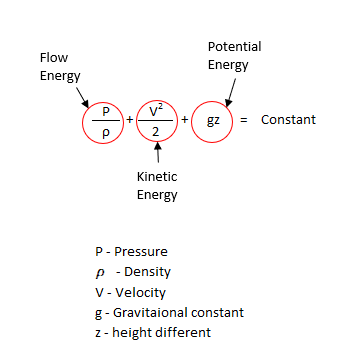
Bernoulli’s Equation

Bernoulli’s equation takes into account four main variables which are Pressure (P), Density (r), Velocity (v), and a height difference (z); along with a single constant for gravity. you can see the relationship between the velocity squared and the pressure from the equation above.  Being that this relationship is a constant along the streamline; when the velocity increases; the pressure has to come down. Now we have to look at how fluids like to behave. Fluids within a system like to be at a constant pressure when at the same height and reach a state of equilibrium. This means that fluids will always flow towards a low pressure area, which means that if you create a constant low pressure area you can amplify the air stream. This is the same principle as to why airplanes can fly.

EXAIR Super Air Nozzle entrainment

Since compressed air can be an expensive utility, it is good to minimize it and maximize the surrounding entrained air. Therefore we have designed our products to use this entrainment principle to amplify the air blast while using less compressed air and more entrained ambient air. Products like our Super Air Knife can see an amplification ratio (ambient air to compressed air) of up to 40:1; this means for every 1 SCFM of compressed air used we are entraining 40 SCFM of ambient air.

EXAIR’s Super Air Knife

We use this principle for our Air Amplifiers, Air Knifes, Air Nozzles and Jets, Safety Air Guns, and our Gen4 Static Eliminators. Our goal is to save you money and give you better results in the process.  

If you have questions about any of our engineered Intelligent Compressed Air® Products, feel free to contact EXAIR or any Application Engineer.

Cody Biehle
Application Engineer
EXAIR Corporation
Visit us on the Web
Follow me on Twitter
Like us on Facebook