


At EXAIR, we always recommend using the least amount of pressure to “do the job”. This helps to save money and save on compressed air. But some customers wish to use outdated methods, like open pipes, copper tubes, drilled pipes, etc. These methods are unsafe as well as waste money and compressed air. EXAIR has engineered nozzles to help enhance your blow-off devices. Here is a customer that I helped recently, to tell a story about the EXAIR Super Air Nozzles.

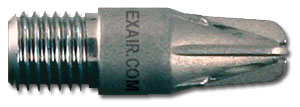
I received an email from an engineer who was looking at our Super Air Nozzles. The characters of the story were four blow-off lines that were made from 6mm ID copper tubes. (Reference picture above) The system was designed to blow out holes after machining. The engineer oversaw the task of optimizing 25 machining stations and this was the theme of the story. He purchased four Nano Super Air Nozzles, model 1110SS, for a trial. He was impressed with the performance, the low sound level and the design for safety. I would consider the Nano Super Air Nozzles as the protagonist. But, for the upper management in his company to sign off, he had to show cost savings and improvements. He asked me to help him to present this story in calculating the compressed air savings.
He gave me some additional details about their application to build the plot of the story. He was using compressed air about 50% of the time throughout an 8-hour day at a pressure of 80 PSIG. He asked me to find a happy ending to this story with the annual savings and the payback period. I did many of these calculations for other customers, and I was happy to help. It is sometimes easier to speak in terms of money for everyone to relate to a situation, especially management. (The numbers below can be adjusted to match your application and blow-off devices).
Knowns:
Cost of compressed air: $0.25/1000 cubic feet of air (this is based on $0.08/Kwh electricity cost)
Flow: 1110SS Nano Super Air Nozzle = 8.3 SCFM at 80 PSIG
A 6mm ID copper tube flow rate = 19.8 SCFM at 80 PSIG
The difference in compressed air flows from a 6mm tube to the Nano Super Air Nozzle is (19.8 SCFM – 8.3 SCFM) = 11.5 SCFM. At a 50% duty cycle, we get 11.5 SCFM * 0.5 = 5.75 SCFM (cubic feet/minute) of additional compressed air being used. Per year, the amount of compressed air wasted is:
5.75 Ft3/min * 60 min/hour * 8 hours/day * 250 days/year = 690,000 cubic feet per year.
With the cost to make compressed air at $0.25/1000 cubic feet, we are saving:
690,000 Ft3/year * $0.25/1000 Ft3 = $172.50 per year per nozzle.
From these values, we get the payback period for a model 1110SS Nano Super Air Nozzle to be just around 97 days.
The remaining life of the Super Air Nozzle will save the company a lot of money by using less compressed air. The calculations above are only for one nozzle. As discussed above with the engineer, they had 4 tubes/station and 25 stations in their plant. So, if you multiply each figure by 100, you can see the amount of money that can be saved; a total of $172.50 * 100 = $17,250 per year. The engineer presented the complete story to upper management, and it was an easy decision to replace the copper tubes with EXAIR nozzles.
The moral of the story is, don’t be fooled by the upfront low cost of a tube, pipe, drilled hole, or a substandard nozzle. The operational cost outweighs the acquisition cost every time. With the characters, plot, and the setting of this story, not going with an engineered solution will cost you a lot of money in the long run. With a mindset of taking total cost of ownership into account, another positive attribute is the improvement in safety. EXAIR engineered nozzles are designed to be OSHA compliant.
If you want help to write your own storybook, happy ending, you can contact an Application Engineer. We will be happy to assist you in finding a hero for your blow-off stories.
John Ball
Application Engineer
Email: johnball@exair.com
Twitter: @EXAIR_jb
Photo: Book by Pezibear. Pixabay license.