How to Handle High-Demand Events with Compressed Air Systems

When production ramps up, deadlines tighten, or seasonal demand spikes, your compressed air system becomes one of the most heavily relied-on utilities in your facility. High-demand events, whether planned or unexpected, can create inefficiencies, consume excessive energy, and create bottlenecks across your entire operation.

The good news? With the right forethought and the right equipment, you can maintain performance, protect uptime, and even reduce operating costs during these peak loads. EXAIR’s engineered compressed air products are specifically designed to help manufacturers meet high-demand challenges without compromising efficiency or output.

Start with System Efficiency: Reduce Air Consumption at the Point of Use

During a high-demand event, every SCFM counts. One of the fastest, most cost-effective ways to free up capacity is to replace outdated, inefficient blowoff methods. Open pipes, drilled holes, and homemade nozzles waste tremendous amounts of compressed air and can violate OSHA safety standards. EXAIR’s Super Air Nozzles, Safety Air Guns, and Super Air Knives are engineered to:

  • Reduce air consumption
  • Maintain or increase blowoff force
  • Operate safely under OSHA dead-end pressure limits
  • Lower overall system load, freeing capacity for critical processes

By upgrading just a few high-usage blowoff points, facilities often recover enough compressed air to handle peak demand without purchasing additional equipment.

Engineered solutions (like EXAIR Intelligent Compressed Air Products) are the efficient, quiet, and safe choice.

Stabilize System Pressure During Peak Use

Pressure drops become more common when demand spikes. That decline leads to reduced quality, slower cycle times, and even unplanned downtime. EXAIR products are engineered to deliver more output force with less compressed air. For example:

  • Super Air Amplifiers entrain up to 25 parts room air for every 1 part of compressed air, multiplying output while drastically reducing consumption.
  • Super Air Knives produce a laminar, high-velocity sheet of air—even at lower pressures—helping extend system stability during peak loads.

These technologies lighten the load on your compressor while maintaining performance at the point of use.

Add Extra Compressed Air Storage to Handle Peak Demand

One of the most overlooked strategies in high-demand planning is preloading your system with stored compressed air. Storage acts as a buffer, preventing pressure drops and reducing the load on your compressor during short, intense spikes.

  • Provides supplemental airflow during short bursts of high demand
  • Reduces compressor cycling, improving efficiency and equipment life
  • Helps maintain system pressure and air quality
  • Offers a cost-effective alternative to purchasing an additional compressor

How to Integrate Storage Into Your Strategy

  • Add receiver tanks downstream near high-consumption equipment
  • Use strategic storage at point-of-use
  • Pair storage with efficient EXAIR blowoff, cooling, or conveying products to reduce total system demand.

Pro tip: If your system is already stretched thin, combining extra storage with EXAIR air-saving solutions often eliminates the need for new compressors entirely.

High Demand Doesn’t Have to Mean High Stress

High-demand events are inevitable in manufacturing—but system strain, energy waste, and reduced performance don’t have to be. By optimizing efficiency, stabilizing pressure, preparing with modular tools, and using engineered products, your facility can handle peak demand confidently and cost-effectively.

EXAIR products are purpose-built for these challenges, offering efficient, OSHA-compliant, high-performance solutions that help your compressed air system keep up with whatever you throw at it.

If you’d like to help identify opportunities in your facility, explore EXAIR’s full line of compressed air-saving products. Or reach out to a Application engineer at techelp@exair.com.

Jordan Shouse, CCASS

Application Engineer

Send me an email
Find us on the Web 

How Compressed Air Storage Can Help You Handle any High Demand Event

You designed your compressed air system to handle the volume you need for your plant, but your continued growth has started to tax that system with some high intermittent demand.

Managing high intermittent demand in the compressed air system requires evaluation of several elements of your system:

  1. Air compressor controls.
  2. System master controls.  
  3. Piping and air velocity.
  4. Storage: wet, dry, and at points of use.
  5. Identifying and examining large air users.
  6. Designing with flexibility and the future in mind.

Today I’m going to cover #4, more specifically installing a secondary storage tank!

Utilizing a secondary receiver tank to mitigate the impact of larger volume-consuming events is a common and useful strategy that many compressed air professionals will pursue. In this kind of scenario, the receiver tank acts much like a capacitor in a camera flash. A camera battery charges a capacitor which then dumps its charge into the flash bulb when you take a photo for a notably bright flash, which is what one generally wants from your camera flash.

In this same way, a receiver tank acts like a capacitor to “dump” the air volume needed to make a compressed air device work at its design pressure and flow for some prescribed period of time. In situations like this, the high demand does need to be an intermittent one so that the tank can then re-charge from the compressor system and be ready for the next air use event. This means that certain calculations need to be made to ensure that the receiver tank is sized properly to provide the desired effect.

How do you size a receiver tank? Here’s the calculation to determine the proper size:

Let’s consider an example of an Air Amplifier solution. A customer wants to blow on hot metal parts coming out of an oven to cool them down as an “air quench”. We evaluate the application and determine that (2) 2″ Super Air Amplifiers will provide the right amount of flow. Those units are going to operate at 60 PSIG to provide the desired effect. (2) 2″ Super Air Amplifiers will consume 24.5 SCFM @ 60 PSIG. Each batch of parts comes out of the oven at a rate of one batch every 5 minutes. They want to provide the necessary cooling for a total of 30 seconds to have the air quench effect. So, every 5 minutes, the Air Amplifiers will be blowing for 1/2 minute. Each “on” event consumes 12.25 Standard Cubic Feet of air. We then have 4 minutes, 30 seconds left to replenish the tank.

The last piece of information we need to know is the system pressure for the compressed air header feeding the tank. The system pressure is 120 PSIG. And so, our calculation looks like this:

V =  0.5 min. x 24.5 rate of flow x (60 PSIG + 14.5 PSIA)
120 PSIG – 60PSIG
V =  913
60 PSIG
V = 15.2 ft.3

There are 7.48 gallons to a cubic foot, so our receiver tank in this example would be
15.2 ft.3 x 7.48 = 114 gallons.

Given the fact that receiver tanks are made in certain, standard sizes, a 120 gallon tank or two, 60 gallon tanks piped in upstream of the compressed air load would be appropriate for this application.

As a further note, for example, the refill rate for the tank(s) would need to be a minimum of 2.72 SCFM to get the volume replenished in time for the next event. This is less than 1 HP of industrial air compressor to maintain such a flow rate to refill the tank.

With some reasonably simple math to determine tank size, and a willingness to pursue this kind of air delivery solution, you can implement that compressed air solution at a fraction of the cost compared to a new compressor.

With some reasonably simple math to determine tank size, and a willingness to pursue this kind of air delivery solution, you can implement that compressed air solution at a fraction of the cost compared to a new compressor.

If you have any questions please reach out! We have a full team of Applications Engineers in the office M-F!

Jordan Shouse
Application Engineer

Send me an email
Find us on the Web 
Like us on Facebook
Twitter: @EXAIR_JS

Installing a Secondary Receiver Tank

Picture by Clker-Free-Vector licensed by Pixabay

We often run into situations where a customer does not have enough compressed air volume to implement a solution. This leaves three possible options. 1) Abandon the project all together and continue to feel the pain the problem creates. 2) Install a larger compressor, with associated expense. 3) Install a secondary, or “point of use” receiver tank to store the compressed air volume local to the application, to be available immediately without having to rely on the distribution system for storage capability. This 3rd option is a cost-effective solution customers often use to mitigate the impact of installing a new compressed air consuming product onto the system.

Large demand events on a compressed air system can leave the system short on air. This can result in a system pressure drop which is undesirable. Utilizing a secondary receiver tank to mitigate the impact of larger volume consuming events is a common and useful strategy that many compressed air professionals will recommend and pursue. In this kind of scenario, the receiver tank acts much like a capacitor in a camera flash. A camera battery charges a capacitor which then dumps its charge into the flash bulb when you take a photo for a notably bright flash which is what one generally wants from their camera flash.

In this same way, a receiver tank acts like the capacitor to “dump” the air volume needed to make a compressed air device work at its design pressure and flow for some prescribed period of time. In situations like this, the high demand does need to be an intermittent one so that the tank can then re-charge from the compressor system and be ready for the next air use event. This means that certain calculations need to be made to ensure that the receiver tank is sized properly to provide the desired effect.

How do you size a receiver tank? Here’s the calculation to determine the proper size:

Let’s consider an example of an Air Amplifier solution. A customer wants to blow on hot metal parts coming out of an oven to cool them down as an “air quench”. We evaluate the application and determine that (2) 2″ Super Air Amplifiers will provide the right amount of flow. Those units are going to operate at 60 PSIG to provide the desired effect. (2) 2″ Super Air Amplifiers will consume 24.5 SCFM @ 60 PSIG. Each batch of parts comes out of the oven at a rate of one batch every 5 minutes. They want to provide the necessary cooling for a total of 30 seconds to have the air quench effect. So, every 5 minutes, the Air Amplifiers will be blowing for 1/2 minute. Each “on” event consumes 12.25 Standard Cubic Feet of air. We then have 4 minutes, 30 seconds left to re-plenish the tank.

The last piece of information we need to know is the system pressure for the compressed air header feeding the tank. The system pressure is 120 PSIG. And so, our calculation looks like this:

V = 0.5 min. x 24.5 rate of flow x (60 PSIG + 14.5 PSIA)
120-60

V = 913
60

V = 15.2 ft.3

There are 7.48 gallons to a cubic foot, so our receiver tank in this example would be
15.2 ft.3 x 7.48 = 114 gallons.

Given the fact that receiver tanks are made in certain, standard sizes, a 120 gallon tank or two, 60 gallon tanks piped in upstream of the compressed air load would be appropriate for this application.

As a further note to the example, the refill rate to the tank(s) would need to be a minimum of 2.72 SCFM to get the volume replenished in time for the next event. This is less than 1 HP of industrial air compressor to maintain such a flow rate to refill the tank.

With some reasonably simple math to determine tank size, and a willingness to pursue this kind of air delivery solution, you can implement that compressed air solution at a fraction of the cost compared to a new compressor.

EXAIR LLC
Visit us on the Web

Cover Photo by dkeissling and licensed by Pixabay

Installing Secondary Receiver Tanks: Step 5 in Optimizing Your Compressed Air System

SixSteps

The 5th step in the 6 steps to optimizing your compressed air system highlights the use of intermediate storage of compressed air near the point of use. Secondary, or intermediate Receiver tanks are installed in the distribution system to provide a source of compressed air close to the point of use, rather than relying on the output of the compressor.

Compressed air receiver tanks are an integral part to many compressed air distribution systems. Compressed air is stored at a high pressure after drying and filtration, but just upstream of point of use devices. The receiver tank is charged to a pressure higher than what is needed by the system, creating a favorable pressure differential to release compressed air when needed.

Think of a compressed air receiver tank as a “battery”. It stores the compressed air energy within a system to be used in periods of peak demand, helping to maintain a stable compressed air pressure. This improves the overall performance of the compressed air system and helps to prevent pressure drop.

receiver_tank

They can be strategically placed to provide a source of compressed air to intermittent high volume compressed air applications. Rather than having to pull from the compressor, a receiver tank can be sized to provide the short-term volume of air for a particular application. In a previous post, we’ve highlighted how to calculate the necessary receiver tank based on the air consumption and duration of the application.

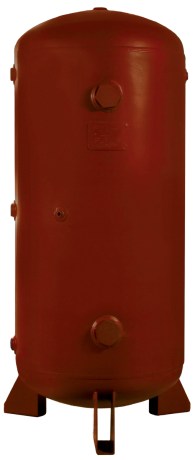
EXAIR offers from stock a 60-gallon receiver tank designed specifically for these higher-usage intermittent types of applications. Model 9500-60 can be installed near the point of high demand so that you have an additional supply of compressed air available for a short duration. The tank comes with mounting feet and is designed to stand up vertically, saving floor space. The tank meets American Society of Mechanical Engineers (ASME) pressure vessel code.

If you have an application in your facility that’s draining your compressed air system, a receiver tank could be the ideal solution. Give us a call and one of our Application Engineers will be happy to help evaluate your process and determine the most suitably sized receiver tank.

Tyler Daniel
Application Engineer
E-mail: TylerDaniel@EXAIR.com
Twitter: @EXAIR_TD