

EXAIR Cabinet Cooler Systems are a low-cost solution for protecting electrical and electronic components from heat damage. They install in minutes, and because they’re compressed air operated and have no moving parts, they’ll run darn near indefinitely, maintenance free, as long as you supply them with clean, moisture free air. And since they all come with a Filter Separator for point of use filtration & moisture removal, there’s no reason they won’t give you long-lasting, reliable cooling.
When it comes to specifying the right one for your application, we make that pretty easy as well. If your equipment is currently in operation, we can use the data from our Sizing Guide to quickly & accurately calculate the heat load. Here’s how that works:
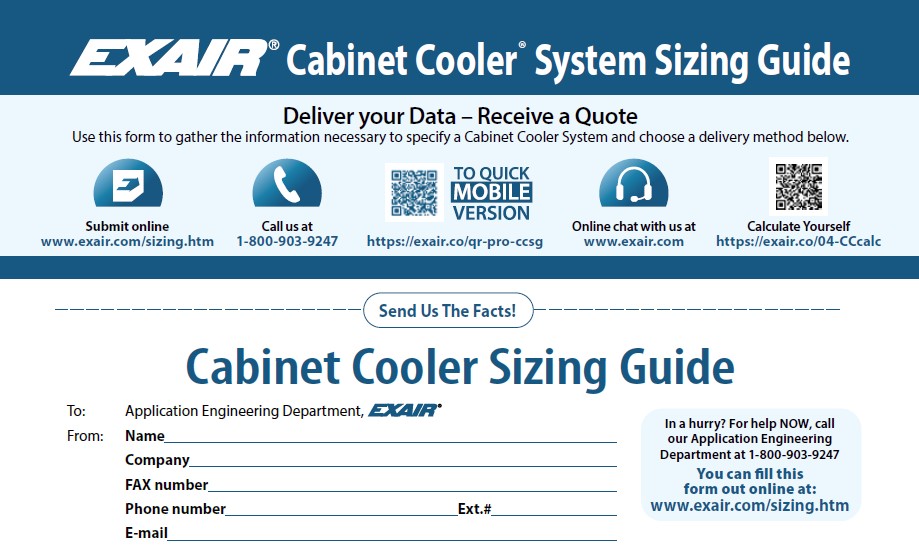
At the top, we’re just bragging about how easy it is to get the YOUR information to US, and asking how to get OUR information to YOU.

Then, we get into the data we’ll use to calculate the heat load, so we know how much cooling capacity we’ll need. Here’s how it works:
- We use the height, width, and depth of the panel to determine the heat transfer surface area.
- Current external & internal air temperatures are used to calculate the internal heat load-how much heat is being generated inside the panel. Note that we’re looking for AIR temperatures here – our calculations use basic HVAC formulas, so if you shoot a particular component’s surface temperature with a “temperature gun” or infrared thermometer, our calculation won’t be valid. A thermocouple or thermometer work best.
- Maximum external air temperature lets us calculate how much heat the panel picks up from where it’s located.
- Maximum internal air temperature desired is going to be the Thermostat setpoint. They come preset to 95 °F (35 °C), which is the “industry standard”, if you will, for panel cooling. Many manufacturers of electrical & electronic components comply with a standard 104 °F (40 °C), so it’s not unreasonable to think that if we maintain 95 °F (35 °C) air temperature inside the panel, it’ll keep those components from exceeding the 104 °F (40 °C) limit. Of course, if you’re trying to protect a device that has a lower temperature limit, the Thermostat can be reset. That may result in needing a higher cooling capacity to get to that lower temperature…which we can calculate for.

Now we’re going to consider what type of environment the panel is located in. The NEMA ratings that we make Cabinet Cooler Systems to comply with are:
- NEMA 12: Dust tight, oil tight, indoor duty. If it’s inside, with no chance of getting wet, this is your rating.
- NEMA 4: Dust tight, oil tight, splash resistant, indoor/outdoor duty. If it’s outside – or inside in an area where it can get wet, you’ll want this one.
- NEMA 4X: Same as NEMA 4, but made of Stainless Steel for corrosion resistance. If there are particularly aggressive corrosive elements in the environment, we also offer these in 316SS construction
If the cabinet is in a UL Classified Area, our HazLoc Cabinet Coolers are rated for Class I Div 1, Class II Div 1 or Class III. Or, if ATEX is the governing body for hazardous locations, our ATEX Cabinet Coolers are rated for Zones 2 & 22.

Since an EXAIR Cabinet Cooler System is made to operate on a sealed panel, any current means of cooling (like fans that circulate air throughout) will need to be removed & their openings sealed…and we also need to account for the amount of cooling they provide. We can use either the diameter of the fans, or if their nameplate(s) have air flow published (CFM), that allows us to calculate the amount of heat they’re currently removing.
That’s the data we need and why we need it to specify a Cabinet Cooler System. You can submit the Sizing Guide to us, or you can call in the data – it only takes a minute to do the calculations, and we do it over the phone all the time. Alternately, you can use the Cabinet Cooler Calculator on our website, if you’re in a do-it-yourself mood.
If you want to select a Cabinet Cooler System for an enclosure that’s not in operation (like a new build), we’ll still use some of the Sizing Guide information to calculate the external heat load, but we’ll have to estimate the internal heat load from data on the components that’ll be inside the panel. If the manufacturer publishes the heat load, that’s great – we’ll use that. If not, we can make a reasonable estimate from the power consumption.
If you’d like to find out more about how an EXAIR Cabinet Cooler System can provide the heat protection you need for your electrical panels, give me a call.
Russ Bowman, CCASS

Application Engineer
Visit us on the Web
Follow me on Twitter
Like us on Facebook