Cabinet Cooler Systems Protect Against Heat Related Failure

Electricity generates heat — there’s no way around it — and heat is bad for electrical and electronic components. Studies show that an 18°F (10°C) rise in operating temperature will cut the average reliability of typical modern electronic components in half. If you’re concerned about the reliability of your equipment, it stands to reason that you should have that same level of concern for what’s protecting it.

Fans in the panel walls that pull outside air through are a cheap & easy way to provide a cooling airflow for the components inside. They work just fine as long as the fan is properly sized, AND the environment is clean enough (remember, anything in the air is going to get inside your panel), AND the ambient temperature doesn’t get too high. Filtering the air being pulled in can help with contamination, but you have to keep an eye on the filter to make sure it doesn’t get clogged. And, in humid areas, fans will draw that humidity (and the potential for condensation) right past all those current carrying devices.

Panel air conditioners are one of the most common methods when fan cooling won’t cut it for any of the above reasons. They solve the problem of humidity, but their cooling capacity is reduced by elevated ambient temperatures. Environmental contaminants can clog the filters and foul the coils, so keeping up on their cleaning & maintenance is crucial.

Heat exchanger type (air-to-air or air-to-water) panel coolers are also subject to failure if they’re not properly maintained. Air-to-water types rely on a refrigerant powered chiller for the water, which has the same drawbacks as a panel air conditioner. It just may not be in proximity to the panel.

Vortex Tube products, like EXAIR’s Cabinet Cooler Systems, have no moving parts to wear or electric motors to burn out. They just need a source of clean compressed air, and they’ll run darn near indefinitely, maintenance free. That’s really all you have to do to prevent their failure — and the failure of the electrical and electronic components in the panel they’re installed on.

Inside, outdoors, high temperature, dirt/dust/humidity, corrosive and classified environments are no problem for EXAIR Cabinet Cooler Systems

If you have an electrical panel with critical equipment in it, you’ve got a lot of options for heat protection. If you want the most durable & reliable method, you’re looking for an EXAIR Cabinet Cooler System. We can help get you the one you need with just a few key pieces of data. You can even use that data to select the right one yourself. If you’d like to find out more, give me a call.

Russ Bowman, CCASS

Application Engineer
Visit us on the Web
Follow me on Twitter
Like us on Facebook

Resources for Finding the Right Cabinet Cooler System

From right to left: Small NEMA 12, Large NEMA 12, Large NEMA 4X

During the warmer weather, electrical panels will start to feel the “heat.”  Freon-based coolers can be less effective in higher ambient conditions; and opening the electrical panels to have a fan blowing air inside creates a dangerous hazard.  To reduce loss in production and premature equipment failures, it is important to keep electrical components cool.  The EXAIR Cabinet Cooler Systems are an easy choice for consistent, long-lasting results. 

Cabinet Coolers are powered by Vortex technology, which uses compressed air to generate cold air flow.  They do not have any moving parts to wear.  They do not require any Freon or a refrigerant compressor that can fail.  They require very little to no maintenance to keep them operating for a long time.  EXAIR offers a variety of types and cooling capacities to work inside some of the toughest of conditions.  We range from 275 to 5,600 BTU/hr (80 – 1641 Watts) of cooling power.  They are easy to install, and EXAIR has several ways that can help you start using our Cabinet Cooler Systems. 

At the start, we do have a Cabinet Cooler Sizing Guide to help determine the total heat load.  This can be sent to us for calculations and recommendations.  We also have a Cabinet Cooler System Calculator on our website if you wish to tackle this yourself. 

EXAIR does an excellent job of helping our customers purchase a Cabinet Cooler System.  We use multiple methods to make sure that you are getting the correct information and the best out of our system.  So, if it is your first time ordering a system, here are some areas to help you quickly and easily install your new unit. 

We have our Installation Guides on our website for instructions and troubleshooting.  If you are more visual, like I am, we also have informal videos to give some tips and tricks.  Here is a list: 

How to install a Cold Air Distribution Kit

How to install Side Mount Kit

The Electronic Temperature Controller upgrade

Using the Cabinet Cooler Sizing Guide

Measuring internal and external air temperatures

Installing the Dual Hardware Kit for Dual Cabinet Coolers

Installing NEMA 4/4X Cabinet Coolers

Connecting the Thermostat to the Solenoid Valve

Resetting the thermostat

If you still have any questions, you can reach us by phone at 800-903-9247 or contact us through Chat.  An Application Engineer is waiting to help you.  For our U.S. customers from now until the end of August 2026 with qualified purchases, you will receive an AC Sensor for free, a $77.50 value, as a promotional item.  As I mentioned above, EXAIR has a number of ways to assist you from start to finish.

John Ball
Application Engineer
Email: johnball@exair.com
Twitter: @EXAIR_jb

EXAIR High Temperature Cabinet Coolers for Extreme Environments

EXAIR‘s High Temperature Cabinet Cooler Systems prevent electrical panel failures in extreme environments where ambient temperatures reach up to 200°F (93°C). Traditional cooling methods like fans or standard air conditioners fail when positioned near intense heat sources. EXAIR’s specialized vortex-tube-powered coolers deliver reliable thermal protection to ensure your operations keep running smoothly without catastrophic heat downtime.

Industrial electrical cabinets often face brutal environments. Standard electronics are designed to operate optimally around 95°F (35°C). However, when control panels are installed near high-heat infrastructure, internal components quickly bake and fail. Typical problem areas include:

  • Boiler rooms
  • Furnaces and foundries
  • Industrial ovens
  • Steam lines and casting operations

Standard cabinet coolers struggle when ambient temperatures exceed 125°F (52°C). For these ultra-hot zones, a heavy-duty solution is required.

EXAIR High Temperature Cabinet Coolers use advanced vortex tube technology to turn ordinary compressed air into a clean, cold air stream. In the video below, you can see this cooling effect in action. All of this is achieved without the need for refrigerants or moving parts.

Some key benefits of Vortex Tube technology are:

  • Zero Moving Parts: No fans, motors, or bearings to wear out or clog from ambient dust.
  • No Refrigerants: Eliminates Freon leaks, compressors, and complex chemical maintenance.
  • Instant Installation: Mounts in minutes through a standard electrical knockout.
  • Continuous Integrity: Available in NEMA 12 (dust-tight), NEMA 4 (splash-resistant), and NEMA 4X (corrosion-resistant stainless steel) ratings to maintain your enclosure’s structural seal.

Precise and Efficient Temperature Control

Compressed air is a valuable resource, and EXAIR systems are optimized to ensure it isn’t wasted.

  • Thermostat-Controlled Systems: These configurations use an adjustable mechanical thermostat factory-set to 95°F (35°C). The cooler only activates when the interior temperature hits critical levels, automatically shutting off once cooled.
  • Electronic Temperature Control (ETC): For precision applications, the EXAIR Electronic Temperature Control system utilizes a digital LED readout and a quick-response thermocouple to manage internal environment settings accurately down to the degree.

Choosing the right unit depends on your specific cabinet dimensions and internal heat loads. High-temperature models start at cooling capacities of 1,000 BTU/hr and can scale up significantly to handle heavy component loads.

To avoid guesswork, you can use the online EXAIR Cabinet Cooler Calculator to input your panel’s dimensions and temperatures. The tool will automatically determine if a high-temperature system is required and identify the exact BTU capacity you need. Or if you would like an Application Engineer to assist you, feel free to give us a call at 1-800-903-9247!

Al Wooffitt
Application Engineer

Send me an Email
Find us on the Web
Like us on Facebook
Twitter: @EXAIR_AW

Keeping Control Panels Cool in Malaysia’s Palm Oil Industry

As the weather warms up, we start hearing from more customers who are dealing with hot, humid plant environments. Heat is often the first concern when it comes to protecting an electrical control panel, but in many facilities, humidity is just as much of a problem. Moisture inside an enclosure can lead to corrosion, nuisance faults, and shorter component life, especially when sensitive electronics are involved.

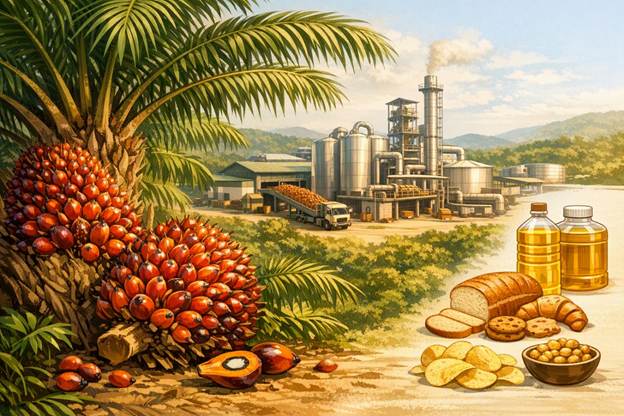
A recent application came from a customer building a control panel for an end user in Malaysia. That location immediately stood out because Malaysia’s climate is hot and humid year-round, and the end user was in the palm oil processing industry. Palm oil is big business in Malaysia. The country is one of the world’s leading producers and exporters, and the industry supports a large network of plantations, mills, refineries, food ingredient suppliers, and downstream manufacturers.

It is also an important piece of the broader food and beverage industry. Palm oil is widely used as an edible oil and as a functional ingredient in products such as baked goods, snacks, confectionery, margarine, shortenings, instant noodles, and other processed foods. For food manufacturers, it offers consistency, shelf stability, versatility, and availability at scale. So, when a palm oil processing plant has production equipment or control panels go down, the impact can reach well beyond one facility. It can affect ingredient supply, processing schedules, and the larger food production chain.

That is why uptime matters so much in this kind of application. Palm oil plants are built around continuous production, and the surrounding conditions can be tough on electrical enclosures. In this case, the customer needed a NEMA 12 Cabinet Cooler System capable of providing approximately 1000 Btu/hr. of cooling power. To provide some extra capacity and keep the system from being undersized, I recommended a 1700 Btu/hr. Cabinet Cooler System with 24 VDC thermostat control. The 24 VDC option also made sense because the customer could power the thermostat from inside the panel without having to run additional electrical circuits. The thermostat would control the temperature to within 2 degrees of its 95F setpoint. Electronics can live comfortably at a bit higher temperature than can humans. This helps save energy to cool the application without overdoing it.

Another benefit that really helped this application was the constant supply of clean, cool, dry air into the enclosure. Instead of pulling in the same hot, humid plant air that surrounded the cabinet, the Cabinet Cooler System purged the enclosure with compressed air that had already been treated at the production point and then filtered again at the panel with the included 5 micron compressed air filter/separator. That helped bring the cabinet environment down from the typical tropical humidity range of 80–90% RH to something closer to the 40–50% RH range inside the enclosure.

Before making the change, the end user had been using small DC fans to pull outside air through the panel. In a Malaysian palm oil processing environment, which meant pulling hot, humid air directly into the enclosure. The fans may have moved air, but they did not solve the heat problem, and they contributed to the moisture problem. By switching to the Cabinet Cooler System, the customer was able to address both concerns at the same time: lower internal temperature and lower humidity. Since the system has no moving parts to wear out, it also keeps maintenance simple, which is always a welcome advantage in a production environment where downtime can get expensive fast.

This was a good example of how a relatively simple enclosure cooling solution can make a big difference. In industries closely tied to food and beverage production, reliability is not just about protecting one panel. It is about keeping a process moving, protecting product flow, and helping a plant stay on schedule.

Neal Raker, Application Engineering Manager
nealraker@exair.com