
Line Vac Troubleshooting / Alumina Ball Conveying

Recently, I had a good interaction with a customer on a Line Vac Application. You can read through the e-mail below to get a better understanding of the issues at work in a typical conveying application.

INQUIRY:
Dear Sir,

We have Line Vac model 6084 operating at between 80 & 90 psig. We are trying to convey alumina balls to a height of about 12 ft. The balls are spherical with diam. between 4 & 7mm (about 1/4 inch). Packed density =50lbs/ ft3 actual density must be in region of 60lbs/ft3. We are only able to convey a very small amount of alumina. Feeding more than a nominal amount blocks the feed tube. Can you please help?

Regards,
Robert

RESPONSE:
Hello Robert,

Yes, I think we have a few ideas you can consider to make the application work a little better.

First thing you must do is to verify with zero doubt about the actual, net operating pressure at the Line Vac inlet. The way you do this is to install a pressure gauge onto a pipe tee and install the pipe tee into the inlet of the Line Vac. Then re-connect your compressed air supply to the 3rd leg of the pipe tee. Operate the Line Vac and note your working pressure on the gauge. If it is less than 80 PSIG, you could do better on the pressure by up-sizing your feed lines and all fittings that are included within. Re-test the Line vac as outlined above and note any improvement in net working pressure.

OK, let us assume you were able to fix the supply problems that contributed to the excessive pressure drop. You can then make a modification to the Line Vac itself by taking it apart and removing the internal part called a generator. This is the part with the air jet holes drilled into it. You can proceed by enlarging these holes to a larger diameter. This will give you higher vacuum performance similar to our Heavy Duty Line Vac series of Line Vac. Do note that if you do not check your plumbing supply lines as indicated in the first paragraph, making this modification could make things worse. So, you do need to be confident that your compressed air system is up to the task.

Another direction you can take will be to go to a smaller size Line Vac to improve your performance. This may seem counter-intuitive at first, but have an open mind.  Going smaller size on Line Vac reduces your air consumption requirement which makes the demand on your compressed air system less which reduces the chances of you have an extreme pressure drop at the Line Vac. The other idea at work here is that you are essentially trying to pull a vacuum over a smaller cross-section area with a smaller Line Vac which enables higher air velocity within the conveying tube with less effort. That higher conveying air velocity is what you need to pull these relatively dense alumina balls without having them stall inside the conveying hose.

If I were to suggest a size to move down to, I’d go with a 1-1/4″ unit from the 2″ model you have now. That would take your air requirement at 80 PSIG down from 45 SCFM to 26 SCFM. In other words, cutting the air required by almost half.  Hopefully, now you are beginning to have the understanding. And then, you can make the same hole enlarging modification to the 1-1/4″ unit that I described above if you wanted to in order to improve through put by about 20 – 30%.  Do note that you have to be able to maintain input pressure right at the Line Vac in all cases.

Best regards,
Neal Raker, Application Engineer
nealraker@exair.com

Ionizing Point Best Thing for Static on Trim Scrap in Cyclone Separator

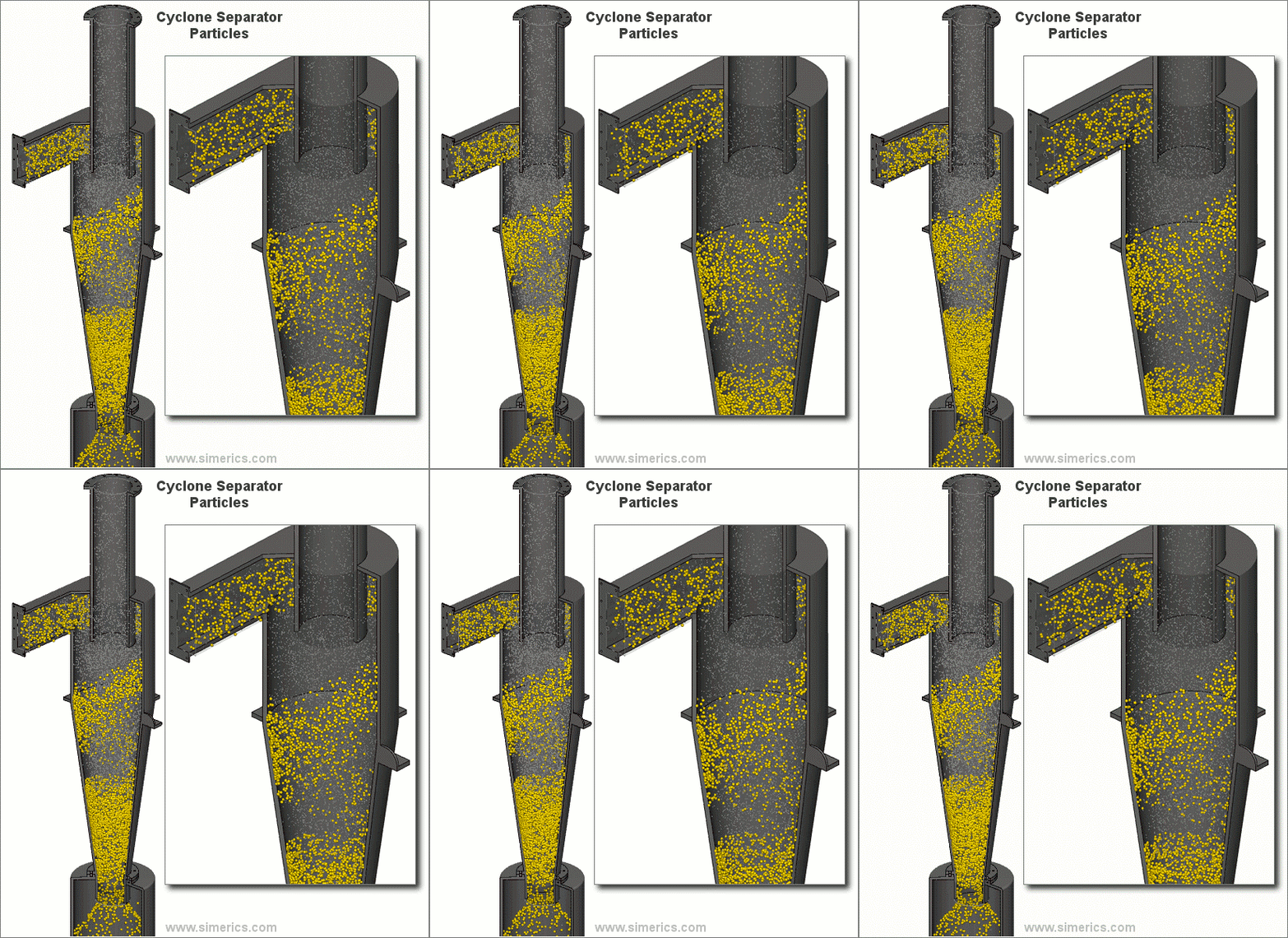
This application came in from our distributor (AYRFUL) in Argentina. They had a customer who is recycling film scraps. The scrap material is conveyed into a cyclone separator. The problem is that the scrap becomes charged with static as a result of the motions and interactions within the conveying pipe. This results in the scrap sticking to itself and to the parts of the cyclone separator inside. The problem is so bad that it becomes almost impossible to separate the material when it comes time to clear it out of the cyclone separator once clogged.

After discussing the challenges the customer faced in trying to keep their cyclone up and running, we decided to recommend that the customer utilize 4 pieces of EXAIR’s Model 7199 Ionizing Point and 1 piece of Model 7941 (4 outlet Power Supply) to neutralize the static within the cyclone.

The ionizing Points would be attached by means of inserting through the wall of the inlet pipe of the cyclone separator.

Ion Point

cyclone

The existing blower moving air into the cyclone separator will do the job of carrying the positive and negative ions into the cyclone separator and keep it and the contents at a neutral state.

If you have a similar problem, contact us to discuss the application. We would be glad to help with our full range of static eliminators to address your application issues.

Neal Raker, Application Engineer
nealraker@exair.com
Line Vac Conveys Small Parts Directly From Mold Cavity to Shipping Box

In the U.S., EXAIR Corporation works factory direct with our customers. Occasionally, we will discuss applications and come up against some questions for which we don’t have a solid answer for the customer. One of the solutions we have for this circumstance is a risk free 30 day guarantee the customer can take advantage of to return the product if things don’t work out for any reason. This applies to any stock item we have and is always there to act as a reasonable back stop so that the customer isn’t stuck with a solution that is not really working for them.

Another solution we offer is our Efficiency Lab. In those cases where the customer is trying to justify the energy savings for their application but don’t have the right tools at their disposal, we can arrange to have them ship their current “air solution” to us and we can measure, force, flow, sound level and even static decay rate if necessary. We then provide a full report of what they have submitted and make a recommendation of a suitable EXAIR product that could take the place and provide a higher efficiency in operation which will translate into operation cost savings, process improvement, increased safety, lower sound operation or all of these combined.

A customer in the plastic injection molding industry contacted me the other day and wanted to know if he could convey his parts (a small, barrel-shaped component used in coax cable connections). He wanted to use a ¾” Line Vac model 6080 to do it. I had some reservations about it because his part had an outside diameter of .435” and a length of .62”. Since it was a barrel shape and was so close to the ½” inside diameter dimension of the Line Vac,  I was concerned that they could cock in the tube leading to the Line Vac and get stuck. Another concern was that the customer wanted to mount multiple, ¾” hoses side by side on a fixture and have the fixture come up to within 7” of the parts and have the parts drop off their ejector pins and go right into the throat of the hoses. Again, I had serious doubts.

I mentioned our options above and he asked if I could run a quick test for him if he sent me some of his parts. I agreed and a couple days later I had the parts laying on my desk. We pulled together a model 6080 ¾” Line Vac and some ¾” ID hose, connected the air and began testing. I started with a healthy 80 PSIG and those parts shot out of the output hose like a bullet. Nothing got stuck, no matter how I oriented the parts to the suction hose, the capture velocity at the tip of the suction hose worked to properly orient the part and pull it in.

After I determined that it would work at 80 PSIG, I wanted to see how low I could go with the input pressure and keep good performance. I went down to 30 PSIG and did have some problems with parts getting stuck just before the Line Vac. So, I bumped the pressure up to 40 PSIG. Everything worked smoothly and nothing became stuck.

Next I wanted to actually drop the parts into the suction hose to see if they could manage to go in. It worked beautifully!  I held the parts directly above the hose at about 7 inch height and the capture velocity of the vacuum flow oriented the parts properly again and pulled them right on through.

Now, the customer will be buying one himself to run his test. If all goes well on his end, we’re looking at another 15 pieces to be used on a single molding machine and there are multiple machines to outfit.

Neal Raker, Application Engineer
nealraker@exair.com