Compressed Air Problems? Ask An Application Engineer If An EXAIR Super Air Nozzle Is Right For You.

A few years back, I had the pleasure of working with a machine shop manager who wanted to reduce the compressed air consumption in their facility. They had ten lathes, machining high-tech plastic products, and used crimped copper tubing to blow off chips and shavings as the parts were turned. They ran continuously — as did the air compressor — which occasionally caused header pressure to drop below the level required for operation of the pneumatic chucks & tool changers.

These cheap and easy blow offs were making things expensive and difficult for the company.

After some discussion and an Efficiency Lab test of one of their crimped tubes, I recommended our Model 1100 1/4 NPT Zinc Aluminum Super Air Nozzles. They’re our most popular engineered Air Nozzle for typical industrial blow-off applications. They generate a forceful, focused blast of air that’s ideal for chip removal on machine tools, and they’re ideally suited for a number of other uses as well. They bought ten (one for each machine) and installed them one afternoon, right before close of business, by cutting the crimps off the copper tubes and fitting them with simple compression fittings. The whole operation took about five minutes. When the machine shop manager arrived the next morning, he was at first alarmed because there was so little noise coming from the shop (he thought something was wrong with the machines) and then impressed when he found all the lathes were running, and the Super Air Nozzles were so much quieter than the crimped tubes.

The copper tube used to have a crimped end that was aimed at the part in the chuck. They simply cut it off and used a compression fitting to install the Super Air Nozzle.

While our Model 1100 Super Air Nozzle is our most popular one, EXAIR makes a wide range of engineered Air Nozzles to meet the needs of almost any blow-off application. If you’re replacing something else, we can test your current device(s) in our Efficiency Lab (like we did the crimped copper tubing here) and determine the Air Nozzle that most closely matches the performance required for your application.

If it’s a new application, we have tools at our disposal for proper product selection too:

  • The Catalog: Our Air Nozzles & Jets catalog section lists them all, from smallest to largest, with performance data, dimensions, and airflow patterns. I actually like to start with the airflow pattern: once we know the size & shape of the needed/desired flow, we can narrow down our selection.
  • Application Database: At last count, we had over 200 blow-off applications written up. Now, that includes Air Nozzles as well as Air Knives, Air Amplifiers, and Safety Air Guns (which have Air Nozzles on them), but keep in mind what I said about picking the size & shape of the airflow.
  • Engineering Assistance: If you’re short on time, find yourself completely stumped, or just want a 2nd opinion on the best product for your application, we’re here from 7am to 4pm Eastern Time to help you over the phone, in a Live Chat, or at an Engineering Consultation web meeting. You can also email techelp@exair.com, 24/7, with details about what you’re after.

At EXAIR, we want to help you get the most out of your compressed air use. If you want to find out more, give me a call.

Russ Bowman, CCASS

Application Engineer
Visit us on the Web
Follow me on Twitter
Like us on Facebook

Efficiency: Air Tools That Pay for Themselves

In manufacturing, compressed air is often called the “fourth utility.” Like electricity, water, and gas, it’s essential for keeping production running. But unlike the others, compressed air is frequently misapplied, or wasted, making it one of the most expensive utilities in a plant.

The good news is that the right tools can dramatically improve compressed air efficiency. In many cases, they pay for themselves quickly through energy savings, reduced downtime, and improved productivity. That’s where EXAIR engineered compressed air products come in.

Let’s look at a few examples of air-powered tools that deliver measurable ROI.

Air Amplifiers: Move More Air with Less Energy

Moving large volumes of air is a common requirement in industrial environments—whether for ventilation, drying, cooling, or removing fumes. Traditional compressed air nozzles can consume a lot of air while producing relatively small airflow.

Model 120024 4″ Super Air Amplifiers are commonly used to exhaust welding smoke and fumes.

Air Amplifiers use the Coandă effect to entrain large volumes of surrounding air, dramatically increasing airflow while minimizing compressed air consumption. In many cases, they can increase airflow up to 25 times the supplied compressed air.

This means you can:

  • Move more air with less compressed air input
  • Reduce overall compressor load
  • Lower energy costs

For applications like ventilating enclosures, exhausting smoke or fumes, and cooling parts, air amplifiers can often replace inefficient open pipe blow offs or multiple air jets.

Super Air Knives: Efficient Blowoff for Drying and Cleaning

Blow off is one of the most common—and most wasteful—uses of compressed air. Many facilities still rely on drilled pipe or open copper tubing, which wastes enormous amounts of compressed air while generating excessive noise.

Super Air Knives create a laminar sheet of high-velocity air across the entire length of the knife. This provides powerful and uniform blow off while using significantly less compressed air than traditional methods.

Benefits include:

  • Reduced compressed air consumption
  • Uniform drying and cleaning
  • Low noise operation
  • No moving parts and minimal maintenance

Applications range from removing water after washing processes to blowing debris off conveyors, sheets, or molded parts.

Efficiency in compressed air usage isn’t just about saving energy—it’s about improving productivity, reliability, and process performance. When you replace inefficient air practices with engineered solutions, you often gain benefits across the entire operation.

If you’re looking to reduce compressed air waste or improve a blow off, cooling, or static problem, the right air tool may be a small investment with a big return.

And in many cases, it’s an investment that pays for itself.

Jordan Shouse, CCASS

Application Engineer / Sales Operations Engineer

Send me an email

The EXAIR Knowledge Base

At EXAIR, we are committed to providing our customers with the necessary tools to tackle challenges and enhance their workforce training through a comprehensive array of resources known as the Knowledge Base. This collection is systematically organized by various criteria to deliver practical, experience-driven solutions.

In our Knowledge Base, you can explore case studies that demonstrate our success in assisting clients with process optimization, reducing compressed air consumption to lower expenses, and improving workplace safety. Additionally, we provide a categorized FAQ section organized by product line, a range of calculators to estimate potential savings, and various application examples that showcase our capabilities.

We encourage you to utilize these resources to gain insights into our methodologies and the tangible benefits we offer. Each element is designed to support your understanding and application of our solutions effectively.

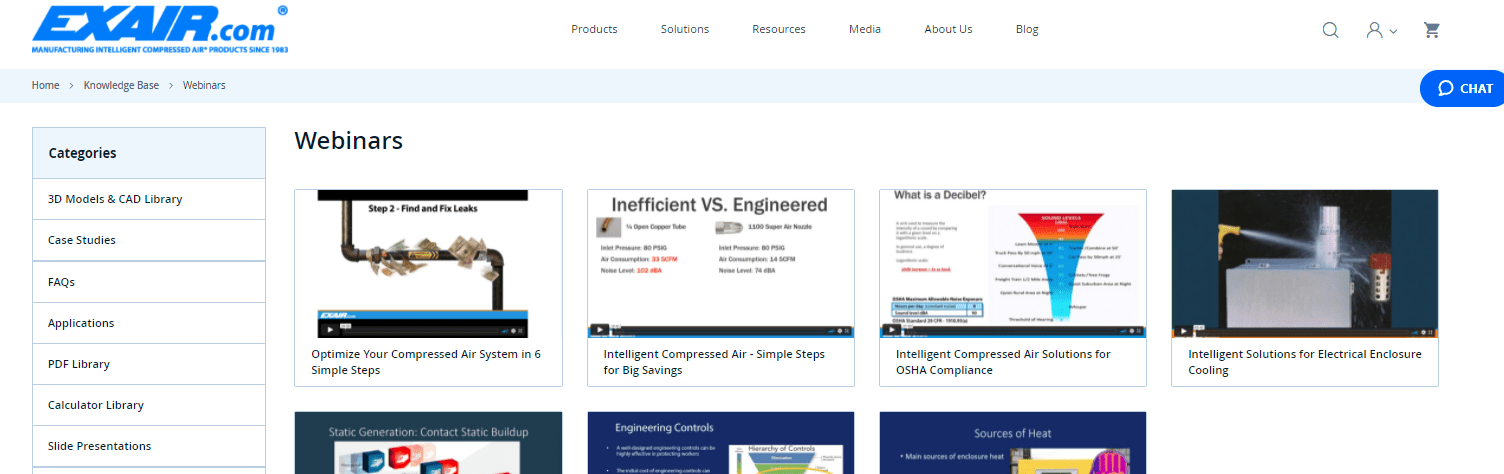
We provide a selection of on-demand webinars that you can access for free at your convenience. These sessions explore various topics, such as the distinctions between inefficient and engineered nozzles, static generation, and techniques for detecting and fixing leaks. Our video library also includes product demonstrations, casual content, and practical advice for optimizing the use of our products. Furthermore, we offer Application Assistance and an Efficiency Lab, which deliver customized recommendations and performance evaluations.

EXAIR’s Free Efficiency Lab

In addition to the comprehensive resources available in the Knowledge Base, EXAIR is supported by a team of experienced Application Engineers with expertise spanning various industries and processes. It is highly probable that one of our engineers has dealt with a similar application, and we are committed to helping you identify the most effective solution.

If you have questions about our Knowledge Base, or anything regarding EXAIR and our products, please do not hesitate to reach out.

Jason Kirby
Application Engineer
Email: jasonkirby@exair.com
Twitter: @EXAIR_jk

Safety Air Gun Case Study

On the first of this month, my co-worker Jason wrote a blog about our case study program. Check it out here. Case Study: Make Your Case. He did a great job breaking the case study program down, and how it can save you money on compressed air and even get a credit to save money on the purchase of EXAIR products. It inspired me to write about one of the most common case studies I send to customers!

You can read and download the case study at the bottom of this blog, but below are the key points!

It is pretty common to get calls about blow-off guns not complying with OSHA dead end pressure and allowable noise exposure. And 9 out of 10 times we can help with that concern along with the added benefit of being more efficient and saving compressed air supply.

Before EXAIR, this customer used open-ended guns with large cross-drilled holes, while these cross-drilled holes allowed the guns to be compliant with the OSHA dead end pressure standard 29 CFR 1910.242(b) they resulted in a staggering 104 dBA. And because of how often they were being used they were not in compliance with OSHA 29 CFR 1910.95(a) allowable noise exposure. Not to mention, these guns consumed a whopping 49 SCFM @ the 80 PSIG supply pressure.

After EXAIR, in total, after a short testing phase, they bought 355 model 1250-12 Safety Air Guns. The 1250-12 reduced the sound level to 82 dBA (a 22 dBA reduction) and reduced the air consumption to 35 SCFM @ 80 PSIG (a 14 SCFM reduction).

When you worked the math out over a working year, they saved over $28,506.50 dollars in compressed air generation costs. And brought the sound level into compliance with their environment and working patterns. (Not to mention the $1,500 USD credit they got for providing the case study information)

EXAIR Intelligent Compressed Air Products have been making things better for compressed air users for over forty years. If you’d like to find out how MUCH better we can make things for you, give me a call.

Jordan Shouse, CCASS

Application Engineer

Send me an email
Find us on the Web