Recently, I had a customer ask me about our Adjustable Spot Cooler and how to change the cold flow and cooling capacity. In this video, I will demonstrate how to change the generator to accomplish both. Watch below:
In machining environments, temperature control isn’t optional—it’s essential. Excess heat reduces tool life, warps materials, slows production, and increases scrap rates. Traditionally, shops have relied on liquid coolant systems to manage these challenges. But as processes evolve and industries push for cleaner, safer, and more efficient operations, EXAIR Cold Guns have become a compelling alternative.
So how do Cold Guns stack up against traditional coolant? Let’s break it down.
An EXAIR Cold Gun uses a vortex tube to convert compressed air into a focused stream of cold air. There are no moving parts, no chemicals, and no maintenance-heavy equipment like pumps or filters. Once installed, it simply delivers reliable cooling—often dropping air temperatures as low as 20°F—to keep tools and work pieces from overheating.
The appeal is simplicity: clean, dry cooling without the mess that comes with managing coolant.
Cooling Performance: Cold Air vs. Liquid Coolant
Liquid coolant still holds an advantage in applications that rely heavily on lubrication. Operations like deep pocket milling, tapping, or cutting difficult metals benefit from the coolant’s ability to both cool and lubricate the cut.
Cold Guns excel where pure cooling is the priority. For grinding, engraving, routing, plastics machining, and many dry-cutting processes, the Cold Gun delivers consistent, targeted cooling that improves tool life and part finish without introducing moisture or chemical residue. For many shops, that alone makes it a better fit—especially when contamination is a concern.
Cleanliness, Maintenance, and the Work Environment
Coolant brings with it a certain level of maintenance. Tanks have to be cleaned, concentration levels must be monitored, and filters, pumps, and lines require regular attention. On top of that, coolant mist can create slippery floors and lingering odors and can irritate skin or eyes.
A Cold Gun eliminates these issues entirely. The cooling air is clean, dry, and chemical-free. There’s no mist to manage, nothing to wipe down, and no system to maintain. For applications involving electronics, wood, plastics, food-grade parts, or any material sensitive to contamination, this alone often decides the debate.
Cost of Ownership and Long-Term Value
Coolant systems can become expensive over time—not necessarily because of the initial installation, but because of everything required to keep them running. Disposal costs, replacement fluid, lost production during cleaning, and equipment upkeep all add up.
Cold Guns, by comparison, have almost no ongoing costs. They simply run on compressed air. With no moving parts to wear out and virtually no maintenance, they offer a predictable and low-cost long-term solution.
Every machining process is different, and choosing between a cold gun and coolant often comes down to the details of your setup. If you’d like help evaluating your application, reach out anytime.
At EXAIR, we are committed to providing our customers with the necessary tools to tackle challenges and enhance their workforce training through a comprehensive array of resources known as the Knowledge Base. This collection is systematically organized by various criteria to deliver practical, experience-driven solutions.
In our Knowledge Base, you can explore case studies that demonstrate our success in assisting clients with process optimization, reducing compressed air consumption to lower expenses, and improving workplace safety. Additionally, we provide a categorized FAQ section organized by product line, a range of calculators to estimate potential savings, and various application examples that showcase our capabilities.
We encourage you to utilize these resources to gain insights into our methodologies and the tangible benefits we offer. Each element is designed to support your understanding and application of our solutions effectively.
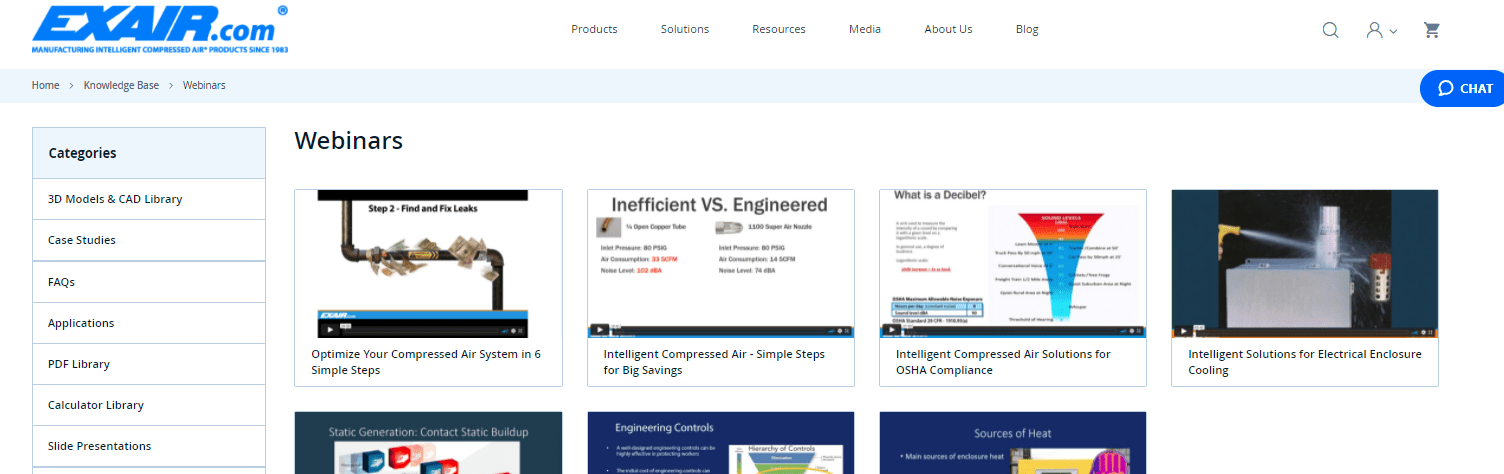
We provide a selection of on-demand webinars that you can access for free at your convenience. These sessions explore various topics, such as the distinctions between inefficient and engineered nozzles, static generation, and techniques for detecting and fixing leaks. Our video library also includes product demonstrations, casual content, and practical advice for optimizing the use of our products. Furthermore, we offer Application Assistance and an Efficiency Lab, which deliver customized recommendations and performance evaluations.
EXAIR’s Free Efficiency Lab
In addition to the comprehensive resources available in the Knowledge Base, EXAIR is supported by a team of experienced Application Engineers with expertise spanning various industries and processes. It is highly probable that one of our engineers has dealt with a similar application, and we are committed to helping you identify the most effective solution.
If you have questions about our Knowledge Base, or anything regarding EXAIR and our products, please do not hesitate to reach out.
EXAIR’s E-Vacs offer an excellent solution for a variety of applications such as pick and place, chucking, surface mounting, lifting, and vacuum forming. When it comes to choosing the right model for your needs, there are a few key factors to keep in mind. While picking the correct vacuum cup size is crucial, and understanding the size and weight of the part is essential, one of the most important aspects is assessing the type of material you’re dealing with. In particular, is the material porous or non-porous?
Porous materials, as the name implies, contain numerous (very small) holes. This enables air to pass through when attempting to create a vacuum. It can be tricky when using an E-Vac. To tackle this issue, a high vacuum flow is necessary. In contrast, non-porous materials do not permit air to flow through, allowing for a higher vacuum level to be reached with a lower vacuum flow. If you’re aware of which category your material belongs to, we can choose the right E-Vac.
If you’re dealing with porous materials like paper, cardboard, or certain fabrics, we suggest using one of our vacuum generators that creates a low vacuum level along with a high vacuum flow. With vacuum levels reaching up to 21″ Hg and flows up to 18.5 SCFM, this type of E-vac generates more vacuum flow to tackle porosity and leakage. Plus, they can also lift or hold fragile materials, helping to avoid any warping or distortion of the surface from too much vacuum.
Cardboard – Photo by OpenClipart Vectors and licensed by Pixabay
Glass – Photo by dflamini and licensed by Pixabay
On the other hand, if your material is non-porous, such as glass, steel sheet, or plastic, you’ll need a generator that can create a high vacuum level with a lower vacuum flow. EXAIR’s non-porous high vacuum units can reach vacuum levels of up to 27″ Hg and vacuum flows of up to 15.8 SCFM. These vacuum generators provide the best holding capacity for heavy materials. You can find sizes that require as little as 2.3 SCFM of compressed air at 80 PSIG, and up to 30.8 SCFM for the largest and heaviest materials.
Once you’ve determined which vacuum generator is most suitable for your material, you will then need to select between our E-Vac accessories to complete your system. We offer different sizes and styles of vacuum cups, as well as mufflers (both standard and straight-through style). We also have auto-drain filters to ensure the compressed air supply is clean and moisture free. This will make your E-Vac system virtually maintenance free.
If you would like to talk to an Application Engineer to help you determine the best option for your application, give me a call!