
How to Select the Right Cooling System with EXAIR’s Electrical Enclosure Heat Load Guide

Selecting the right cooling system for an industrial electrical enclosure requires accurate data rather than guesswork. Under-sizing a cooling unit leads to persistent overheating and component failure, while over-sizing wastes valuable compressed air energy. The EXAIR Cabinet Cooler Sizing Guide provides a structured framework to determine the exact cooling capacity required for your control panels. By accounting for the unique environmental and operational variables of your facility, this guide helps you choose a system that delivers optimal thermal protection.
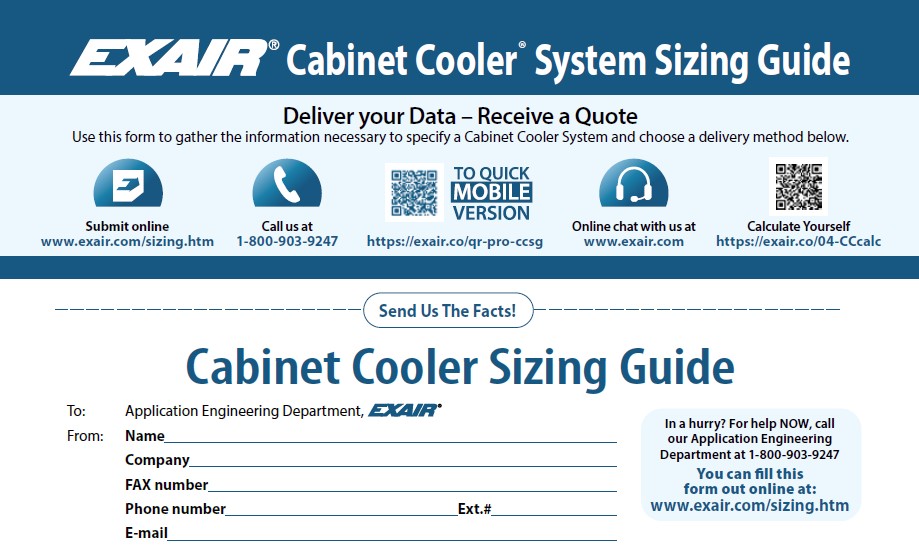
The heat load calculation begins by mapping the enclosure’s physical dimensions and temperature differentials. Users must measure the cabinet’s width, height, and depth to calculate the total exposed surface area. Next, you must record the current internal and external air temperatures, alongside the maximum expected ambient temperature during the hottest months. Comparing these figures against your desired internal temperature—typically 95°F (35°C) for standard industrial electronics—establishes the temperature differential (ΔT) required to calculate external heat transfer.

A precise calculation requires evaluating four primary sources of heat: internal, external, fan, and solar loads. Internal heat represents the energy dissipated by active electronics such as variable frequency drives (VFDs) and transformers, often expressed in BTU/hr. External heat reflects the ambient thermal energy radiating through the cabinet walls from the surrounding factory floor. For outdoor installations, the guide accounts for solar heat gain based on the panel’s color and sun exposure, and evaluates any existing cabinet fans that must be sealed during installation.

Once all variables are gathered, the data can be submitted through the interactive EXAIR Cabinet Cooler System Calculator for instant configuration. This digital tool instantly processes your specifications to recommend a precise model number from EXAIR’s extensive catalog, which features cooling capacities ranging from 275 to 5,600 BTU/hr. Utilizing this guide ensures that your selected system matches your exact NEMA requirements and voltage preferences, providing a reliable engineering solution that protects your electronics and eliminates downtime

If you have questions about the Cabinet Cooler Systems Heat Load Guide, or anything regarding EXAIR and our products, please do not hesitate to reach out.

Jason Kirby
Application Engineer
Email: jasonkirby@exair.com
Twitter: @EXAIR_jk

Which Air Wipe is Right for You?

When dealing with continuous cylindrical products like cables, pipes, hoses, or wire, achieving consistent and uniform 360-degree cleaning, drying, or cooling is notoriously tricky. EXAIR‘s Air Wipes solve this issue by using a “Coanda” effect to create a high-velocity, uniform ring of air that tightly hugs the material’s surface. To accommodate varying plant environments, we provide two main versions of our innovative blow-off systems: the Standard Air Wipe and the Super Air Wipe.

Both the Standard and Super Air Wipes feature a convenient split design. This means there is no need to thread the continuous material through the wipe; instead, the two halves easily clamp around the product, making installation quick and keeping your production line moving seamlessly.

Air Wipes deliver a steady stream of compressed air that exhausts through a tiny ring nozzle. This primary airflow adheres to an angled Coanda profile, creating an area of low pressure that induces a massive volume of surrounding ambient air. The resulting airstream creates a uniform 360-degree wiping action that impacts target material at a 30-degree wiping angle.

The airflow and force can be easily tuned in two ways:

  • Gross Adjustments: By adding or stacking shims to open the air gap.
  • Fine-Tuning: By adjusting the inlet air pressure using a pressure regulator.

Standard Air Wipe: The General-Purpose Solution

The Standard Air Wipe is an economical, reliable choice designed for general, non-corrosive industrial environments where temperatures do not exceed 150°F (65°C).

  • Materials: It features an aluminum body with polyester polymer shims and black oxide-coated alloy steel screws.
  • Hose Connection: For diameters up to 4 inches, it includes a flexible PVC coupling air hose with brass fittings to link the two halves.

Super Air Wipe: Built for Harsh Environments

If your application requires higher durability, superior corrosion resistance, or needs to withstand extreme heat, the Super Air Wipe is the way to go.

  • Materials: Constructed with stainless-steel screws, shims, and brackets.
  • Hose Connection: Models up to 4 inches are equipped with a durable, stainless-steel wire-braided hose.
  • Temperature Ratings: The Super Air Wipe can operate in temperatures up to 400°F (204°C) for aluminum models, and up to a scorching 800°F (427°C) for stainless steel models.

While performance between the two lines is physically identical, material composition dictates which product is best for your factory floor.

  • Choose the Standard Air Wipe for standard blow-off, drying, or cleaning jobs in mild, non-corrosive environments. It provides maximum efficiency at a highly cost-effective price point.
  • Choose the Super Air Wipe if your environment involves extreme heat (like right next to a furnace or heated extrusion bath) or aggressive chemicals (like harsh cleaning agents or salty seawater).
Gen4 Super Ion Air Wipe

For facilities struggling with static, we also offer the Super Ion Air Wipe, available in 2-inch and 4-inch sizes. It combines the 360-degree blow-off of a Super Air Wipe with emitter points for fast, highly efficient static dissipation.

If you would like to discuss your Air Wipe application, please give us a call!

Al Wooffitt
Application Engineer

Send me an Email
Find us on the Web
Like us on Facebook
Twitter: @EXAIR_AW

Cabinet Cooler Accessories: Adding to Efficiency and Effectiveness

Accessories can add much needed enhancements to assist in making your application as efficient and effective as possible. The same is true when it comes to our Cabinet Cooler Systems. Among the most essential accessories for our products are compressed air filters and regulators, which we highly recommend using with all our offerings, as well as with other brands. The Filter Separator effectively eliminates water, dirt, and rust from your compressed air system, while its 5-micron filter element prevents contaminants from clogging or damaging your equipment. For even more precise filtration, an Oil Removal Filter should be installed downstream of the Filter Separator; this filter utilizes a 0.03-micron element to remove oil and solid particulates. Additionally, our Pressure Regulators allow you to set the desired operating pressure, and we advise maintaining the minimum pressure necessary for optimal performance. This not only conserves air consumption but also fine-tunes the efficiency of EXAIR products in various applications.

From left to right; a few value added accessories for your Vortex Tube: Hot Muffler, Cold Muffler, Automatic Drain Filter Separator, Oil Removal Filter, and Solenoid Valve/Thermostat Kit.

A Cold Air Distribution Kit is an additional accessory available with our Cabinet Cooler Systems that enhances their efficiency. This kit features a length of flexible vinyl tubing designed to channel cold air for optimal circulation or to target specific hot spots. It also includes tubing connectors and adhesive-backed clips to secure the tubing in place.

Solenoid valves and thermostats are effective tools for conserving compressed air. Cabinet Cooler Systems equipped with thermostat control utilize a solenoid valve and thermostat to regulate the flow of compressed air, activating it only when cooling is necessary. The thermostat is preset to 95°F (35°C) and typically maintains a temperature within ±2°F (1°C) inside the cabinet. Solenoid valves are available in various voltage options, including 120V at 60Hz, 110V at 50Hz, 240V at 50/60Hz, and 24VDC. All solenoids are CSA Certified and either UL listed or recognized.

EXAIR’s Side Mount Kits facilitate the installation of cooling systems on the sides of electrical enclosures, particularly beneficial in scenarios where vertical or top mounting is impractical. It is important to note that NEMA 4 and 4X Cabinet Cooler Systems must be installed in a vertical orientation. These kits preserve the NEMA ratings for both large and small enclosures classified as Type 12, 4, and 4X, and they fit into standard electrical knockouts measuring 1-1/2 NPS. The Side Mount Kits designed for NEMA 12 Cabinet Cooler Systems are constructed from aluminum, while those intended for NEMA 4 and 4X systems are made from either Type 303 or Type 316 stainless steel.

If you have questions about the Cabinet Cooler Systems accessories, or anything regarding EXAIR and our products, please do not hesitate to reach out.

Jason Kirby
Application Engineer
Email: jasonkirby@exair.com
Twitter: @EXAIR_jk

Protecting Electrical Enclosures Safely and Reliably with Cabinet Cooler Systems

As summer temperatures increase, so does the volume of calls we get about Cabinet Cooler Systems. A typical call goes something like this:

“One of our control panels has a drive in it that’s overheating. If it goes down, so does the whole line. How soon can I get a Cabinet Cooler System?”

All of our Cabinet Cooler Systems — including the UL Classified HazLoc and ATEX models — are in stock and available for same day shipment.

“Great! How do I get one?”

With just a few key pieces of information, I can quickly and accurately calculate the heat load of your panel, and specify the right Cabinet Cooler System. You can input that information into our Sizing Guide online, or you can call me. It only takes a minute to do the calculations, and we do it over the phone all the time. Here’s what we need to know:

  • Panel dimensions: Grab your favorite tape measure & write down the height, width, and depth of the panel. We’ll calculate the heat transfer surface area from that.
  • Current internal & external air temperatures: Take a thermometer to where the panel is. Write down what it reads when you get there — that’ll be the ‘external’. Then, put it inside the panel, and write down what it reads after a few minutes — that’ll be the ‘internal.’ We use those to calculate the internal heat load — how much heat is being generated by the components inside the panel.
    • Optional: if you have accurate heat dissipation data for the housed components, we can use that instead of the temperatures. This is how we do it if the panel isn’t currently in operation.
    • Important note: if we ARE using temperatures, it’s important to measure the AIR temperatures, as opposed to using a heat gun to ‘shoot’ the surface temperature of a component. The formulas we use are based on tried-and-true HVAC formulas, and we’ve been proving their accuracy for decades.
  • Maximum external air temperature: How hot does it get on the hottest day of summer? We’ll use that to calculate the external heat load — how much heat the panel absorbs from the environment.
  • Desired internal air temperature: Many electrical/electronic component manufacturers specify a maximum operating temperature of 104°F (40°F), so the ‘industry standard’ in panel cooling is to maintain an internal air temperature of 95°F (35°C), so that’s where we pre-set our Thermostats. If you know for a fact that the components inside your panel need a cooler environment to operate in, the Thermostats can be reset. Keep in mind, we may need to provide a Cabinet Cooler System with a higher cooling capacity in those cases. Or, if you know for a fact that your equipment can handle a higher operating temperature, the Thermostats can be adjusted…and you can save on your compressed air usage.

If there are fans circulating outside air through the panel, we’ll need to know about them too. They’re providing a finite (sometimes substantial) amount of cooling, and they’ll have to be removed, and their holes covered, for proper operation of the Cabinet Cooler System. If not, that’s like running your air conditioner with a fan in the window.

The other considerations are all about where the panel is, and what it’s exposed to:

  • NEMA ratings are all about keeping the environment out of the panel:
    • NEMA 12: Oil tight, dust tight, indoor duty
    • NEMA 4: All that, and splash resistant, indoor/outdoor duty
    • NEMA 4X: All that, and stainless steel construction for corrosion resistance.
  • If it’s a UL or ATEX Classified area, we have systems for that:
    • HazLoc systems are UL Class I Div 1, Class II Div 1, and Class III rated.
    • ATEX systems are rated for use in ATEX Zones 2 & 22.

If you have an electrical or electronic panel that needs reliable, durable heat protection, you might need an EXAIR Cabinet Cooler System. To find out more, give me a call.

Russ Bowman, CCASS

Application Engineer
Visit us on the Web
Follow me on Twitter
Like us on Facebook