Gen4 Stay Set Ion Air Jet Solves Printing Problem for PVC Manufacturer

We have mentioned here on the EXAIR Blog numerous times just how bad static can get in cooler, dryer regions with low humidity. The amount of moisture in the air is expressed as relative humidity. This value is given as a percentage of water vapor in the air, compared to how much it could hold at that temperature. In conditions of lower relative humidity, static charges build up much easier. When the relative humidity is high, there’s a higher concentration of water molecules present in the air. These water molecules “coat” the surface of the material, allowing electrons to move more freely and form a layer over the material. This layer of water molecules acts like a lubricant, reducing the forces that cause static to generate. There are many applications that static may only pose an issue once the climate changes. 

This could lead one to deduce that tropical climates don’t experience static, given the high humidity present in these areas. While it may be LESS common to experience static troubles in humid conditions, it’s far from impossible.

Such was the case during my recent visit with our partners in Costa Rica. A client of theirs that handles a variety of extruded PVC pipes and shapes was having some problems with a printing process. In their line, after the pipes are extruded, they must mark a batch code and company name on the outside of the pipe. On some days the residual static charge is so high that the ink won’t properly adhere to the outside of the pipes.

A process that should be automatic was requiring them to station an operator nearby to keep an eye on the printer. When issues arise, they must stop production, clean the marking off, and run it back through again. They don’t have the man-power to allocate a person to stand there and monitor things continuously, so this has led to some batches going out marked wrong and leading to rejection and subsequent return.

Fortunately, EXAIR has a wide variety of products designed specifically for use in treating industrial static problems. After checking out the application, it was clear that one of our Ion Air Jets was going to provide a great solution for the customer. Since the specific location of the marking varies depending on the diameter of pipe, they needed something that could also be adjusted. I recommended our Stay Set Ion Air Jet to be installed just prior to the printing head and directed onto the pipe where we’re to apply the marking.

After installation, they continued to monitor closely for a few shifts and managed to make it through a complete day without any rejected material. They no longer have a need to monitor this step in the process and can free up personnel for more important tasks in the facility.

As winter draws to a close, don’t assume static will just automatically go away when the warmer temperatures of spring and summer arrive. In some cases, as was in this application, static can be present despite humid conditions.

Tyler Daniel, CCASS

Application Engineer

E-mail: TylerDaniel@EXAIR.com

Twitter: @EXAIR_TD

A Tale of Two Super Ion Air Knives

A manufacturer of plastic bottles had a problem with static charge. Right after the bottles are extruded and cooled, they have an apparatus that “unscrambles” them and places them, single file, onto a conveyor. It does so with some fabric belts and plastic rollers. If you know anything of static electricity, dear reader, you probably recognize that there aren’t too many better ways to generate a static charge than to rub plastic against plastic, or (even worse) plastic & fabric together.  Here’s a prime example of the kind of static charge you can get, just from unrolling plastic film.

The separation of the non-conductive surfaces (like when this plastic film is unrolled) is capable of generating an incredible amount of static charge.

Now, the bottle makers didn’t have a static meter, but they didn’t need one to know they had issues:  the bottles that the “unscrambler” was putting on the belt were still very much “scrambled.”  They installed a Model 112209 9″ GEN4 Super Ion Air Knife Kit, to blow ionized air up from under the bottles as they entered the belt conveyor, and they did see what they’d call an improvement, but not quite what they’d call a solution.

Unfortunately, dissipating the static from just about half of the surface area of the bottle was still leaving them with half a problem.  However, by adding a Model 112009 9″ GEN4 Super Ion Air Knife (the 112209 Kit’s Power Supply has two outlets, and its Filter Separator & Pressure Regulator are capable of handling the flow to two 9″ Air Knives,) they were able to blow ionized air down from the other side, and up from where the first one was installed.  A soft “breeze” was all it took…a stronger air flow would have worked against the “unscrambler” anyway…because even at very low supply pressures, the Super Ion Air Knives produce an extremely fast static dissipation rate.

Even with a 5psig supply…which makes for just a “whisper” of air flow, the EXAIR GEN4 Super Ion Air Knife eliminates a 5kV charge in under half a second.

If you’ve got problems with static charge, we’ve not only got improvements; we’ve got solutions. Give me a call to find out how we can help.

Static Returns with Colder Temperatures

The temperatures have been dipping a bit in Cincinnati.  One day it might top 80F (26C), the next it could only get up to 60F (15C).  So, its typical Cincinnati weather.

With the fluctuation in ambient temperatures comes a fluctuation in humidity and varying propensity for static.  Lower temperatures, and the corresponding aridity in the air which usually accompanies them, are prime conditions for generating static.  This is because the relative humidity (which is a percentage of moisture held in the air compared to the maximum it could hold (at a given temperature)) normally drops below 30%, which promotes static.

But why?

Lower relative humidity essentially means less moisture (water) in the air.  And, water conducts electricity very well.  So when relative humidity is above 30%, the surfaces and materials in a given environment will absorb the moisture in the air or they will form a very thin surface layer of moisture which dissipates accumulated static charges.  The thickness of the moisture layer increases with increased relative humidity, so when relative humidity drops, so does this layer on surfaces and materials.  Then, when this layer of moisture is no longer present, static can easily build up.

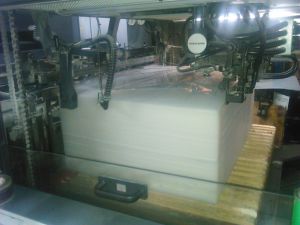
Such was the case for the end user in the application photos shown below.

IMG_0894
Stacked plastic sheets experiencing a static problem

IMG_0896
Additional view of plastic sheets

This system began experiencing a process disturbance when separating stacked plastic sheets.  The operation is supposed to remove a single sheet at a time, but static was causing the machine to pick up multiple units in each pass.  (Separating two insulators such as these sheets is enough to create a static charge in any environment, let alone when humidity drops and static is more prevalent.)

For this application, we recommended a set of Super Ion Air Knives with the ionized air stream aimed along the short edge of the sheets.  As the sheets begin to separate, the ionized air flow from the Super Ion Air Knife has a chance to penetrate in between the sheets and eliminate the static charge. This prevents the machine from picking up more than one sheet at a time.

As the temperatures and humidity drop it is common to experience static problems.  For help with a solution, contact an EXAIR Application Engineer.

Lee Evans
Application Engineer
LeeEvans@EXAIR.com
@EXAIR_LE

EXAIR Ion Bar Provides Unique Solution In Clean Room

Statically charged hopper
Statically charged plastic caps in a clean room hopper would not flow properly from the hopper into the next process. The problem was solved with EXAIR Ion Bars.

One of the well known truths in the industrial world is that lower temperatures increase the potential for static.  Another truth is that static problems wreak havoc on industrial processes.

Sometimes the process disturbance repels a label or a printing onto a material, sometimes the static causes shock hazards, and sometimes the problem is with material flow.  In the photo above, their problem was the latter of those three.

The problem for the end user was the clinging of material, preventing proper conveyance into the machine on the other side of the hopper that we can’t see.  But, looking closely at the reflection in the glass and noting the attire of this employee, we can see that this is a clean room application.

In discussing options with the end user, we determined that using an air assisted solution, such as a Super Ion Air Knife or Ion Air Cannon, posed a risk of taking any existing dust airborne without adding suitable dust collection.  Given that the problem was localized to the hopper, and that adding dust collection would increase the complexity of the solution, we sought to remove the static without air.

This left us with the tried-and-true solution of static removal without air – an Ion Bar.  The Ion Bar can eliminate a 5kV static charge in 0.30 seconds at a distance of 50mm (2″).  In this application that decay rate was more than adequate and installation of two bars across the top of the hopper “raining” ions down onto the caps was the final choice of the end user.  To allow for adequate treatment of all caps, the personnel using the machine intermittently “mix” the caps, allowing static eliminating ions to contact more of the material.

This application was a great example of how an EXAIR solution can solve a problem to increase machine throughput.  If you have an application with a similar need, contact an EXAIR Application Engineer.

Lee Evans
Application Engineer
LeeEvans@EXAIR.com
@EXAIR_LE