
Calculate Heat Loads from the Sun for Outdoor Control Panels

I am always happy to see the sun rise each morning. But, electrical panels that are exposed to the sun are not.  Solar heat adds significant BTU’s to the overall heat load in an electrical panel.

2443850489_145df6ce2f_b

A customer had a VFD to control a 300HP blower motor for a dust collection system. The VFD was getting an over-temp error and shutting down the system.  He contacted EXAIR to get a Cabinet Cooler to keep the VFD cool.  We went through our normal questions to determine the heat load, i.e. the size of the cabinet, the temperature inside, the temperature outside, the maximum external temperature and the desired temperature.  As we went through the questions, he stated that the cabinet was located outside.  This is not an issue for our Cabinet Coolers as EXAIR has NEMA 4 and 4X (IP66) Cabinet Coolers.  It did stem another question; was it under cover?  He mentioned that it was not.
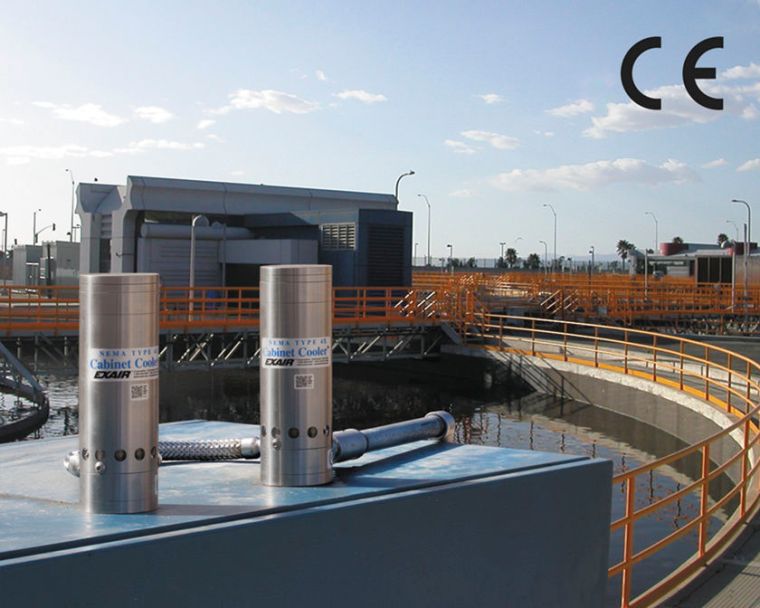
NEMA 4 Cabinet Cooler

Generally in calculating cooling capacities with our Cabinet Coolers, we size the units by adding the ambient heat load and the electrical heat load. With the panel exposed to the sun, this adds another component to the total heat load.  To get an estimation on the amount of solar heat, color becomes a big factor as the darker colors will draw more heat.  Here is a good approximation to follow:

Solar heating by color

In this application, the customer had a gray panel, a common color. With an exposed surface area of 16 ft^2 (1.47 M^2), we would have to increase the heat load by 16 ft^2 * 7 Watts/ft^2 = 112 Watts.  This equates to 112 Watts * 3.41 BTU/hr/Watt = 382 BTU/hr of added heat.  (Or 112 Watts * 0.86 Kcal/hr/Watts = 96 Kcal/hr).

If an electrical panel is outside and cannot be shaded from the sun, we can still protect the sensitive components inside.  With the proper sized Cabinet Cooler, your equipment will remain running cool.  If you need help to determine the correct Cabinet Cooler, inside or out, you can either contact an Application Engineers at 800-903-9247 or fill out our Cabinet Cooler Sizing Guide.

John Ball
Application Engineer
Email: mailto:johnball@exair.com
Twitter: @EXAIR_jb


“The sun” image courtesy of Lima Andruška, https://creativecommons.org/licenses/by-sa/2.0

Calculating and Choosing the Right Cabinet Coolers

“I need one of your Cabinet Coolers for my control panel, the dimensions are 24″ H x 30″ W x 16″ D, what do you recommend?”. This is a very common inquiry we receive when discussing our Cabinet Cooler Systems for the first time with a potential customer. While it would be nice if it was a simple as using just the dimensions, there is more that goes in to making the proper selection.

Following explains how to go about calculating and choosing a Cabinet Cooler System. If, at any time, you prefer EXAIR to calculate and assist with your choice – contact our Application Engineering department and we will be happy to get you up and running.

Our Cabinet Coolers are sized by cooling capacity in Btu/hr., which range from our lowest of 275, up to our largest Dual System providing 5,600 Btu/hr. Now if you know the Watts loss , we can convert this over to Btu/hr. (Watts X 3.41 = Btu/hr.). If you are unsure, we need to determine the current heat load of the cabinet by using the dimensions, current temperatures (internal and external) and worst case external temperature and the desired temperature you are looking to maintain inside the enclosure. To simplify this process, we offer our Cabinet Cooler Sizing Guide.

Sizing Guide
EXAIR’s Cabinet Cooler Sizing Guide

The current internal and external temperature will determine one of your ΔT’s (temperature differential), which is used to determine a multiplier from the table below. We then take your maximum external temperature and your desired internal temperature to give us another ΔT and multiplier. Use the sq. ft. of the cabinet and multiplying it by the temperature conversion multipliers. Add these sums together to determine the total heat load in Btu/Hr. This value will help you to choose the proper Cabinet Cooler system to solve your heat problem.

Temp Conversion Table

Now that we have the heat load properly calculated, we need to know the NEMA class of the enclosure. We offer NEMA 12 for general use where there aren’t any corrosives or liquids present, NEMA 4 for wet or damp environments and NEMA 4X for wet, corrosive applications.

We offer Thermostatically Controlled Systems with available voltages of 120VAC, 240 VAC or 24VDC. This is the most efficient means of operation as the unit only operates when the internal desired temperature is exceeded. In addition, we also offer Continuous Operating Systems, providing constant cooling and positive pressure into the cabinet. Each system  includes a filter separator for the supply line to keep water and dirt from entering the cabinet as well as duct tubing.

Of course, if you need any additional assistance, you can always contact one of our application engineers. If you can provide a little bit of information, we can do the calculating and get you on your way.

Justin Nicholl
Application Engineer
justinnicholl@exair.com
@EXAIR_JN

Using EXAIR Cabinet Coolers to Replace Fans

3050 with qs
Which device is causing the overheating condition?

When an electrical device mounted inside a control panel goes offline due to an overheating condition, it can be difficult to determine which component in the panel is the root cause.  There may be an intermittent heat load from a variable frequency drive that isn’t present when troubleshooting, making things appear to be OK.  Or, the overheating condition may only happen during peak operation on days with high ambient temperatures.

Fortunately, no matter the root cause, an EXAIR Cabinet Cooler can maintain temperature within the enclosure at a desired set-point, eliminating overheating conditions and lost throughput due to downtime.

IMG_3052
We investigate to determine what is housed inside of our customer’s electrical control panels.

When calculating heat load, EXAIR Application Engineers consider the components within the control panel.  We inquire with our customers regarding devices such as VFD’s, which may lead to temperature spikes, or fans, which actively remove heat (albeit that they often force dirt and debris into the enclosures they’re designed to be cooling).

IMG_3053
To accurately calculate heat load, we require the diameter of any fans installed on the enclosure.

Fans can be particularly important, because with the installation of any EXAIR Cabinet Cooler, all external fans will need to be removed, and their openings will need to be sealed (internal fans can remain in place).  So, this means we have to account for any heat the fans may already be removing from the application, even if it isn’t enough to keep the enclosure cool.

IMG_3051
Measure any fans used to bring ambient air into the enclosure.

In order to determine the amount of heat a fan is removing from an application, we consider the diameter of the fan, which corresponds to a typical air flow volume in CFM (cubic feet per minute).  We then consider that 1 BTU/hr. is the amount of heat required to raise the temperature of one pound of water by 1 degree Fahrenheit, and it is also the amount of heat needed to raise/lower the temperature of one cubic foot of air by 1 degree Fahrenheit in one minute.  This means that for every CFM the fan is moving, we are reducing the temperature of the air by 1°F .  To put it another way, we remove 1 BTU/hr. for every °F * every CFM the fan is moving.

As an example, a 3″ fan will move 22 CFM.  In an enclosure with a current temperature differential of 15 degrees Fahrenheit, this fan is removing 330 BTU/hr.

15°F * 22 CFM = 330°F*CFM

15°F

x 22 CFM X 1 Btu/hr = 330 Btu/hr

CFM °F

The fans holes should be covered up with sheet metal using rivets, caulk/sealant, duct tape or other ingenious methods you know of. But please cover and seal the cabinet as well as you can.

Using the Cabinet Cooler Sizing Guide and the experience of the EXAIR Application Engineers, we can accurately calculate heat load of an overheating electrical control panel.  When you need help with determining which Cabinet Cooler to use, contact an EXAIR Application Engineer.  We’re here to help.

Lee Evans
Application Engineer
LeeEvans@EXAIR.com
@EXAIR_LE


Cabinet Cooler Systems Simple, Quick, and Easy

In this corner EXAIR Cabinet Cooler
In this corner:  EXAIR Cabinet Cooler


When compared to air-to-air heat exchangers and refrigerant based air conditioners, Cabinet Cooler systems win hands down.

Companies generally do not have issues with their control panels until the heat of summer. As the ambient conditions get warmer, the temperatures inside electrical panels also rise.  Sensitive electronics start to malfunction and shut down.  A telecommunication company was having the same issues.  They operated an ultra-broadband access service.  When the temperature alarms triggered, the system would shut down and reset.  This on and off cycling concerned the engineers in damaging and reducing the life of the electronics inside the telecommunications control box.

They contacted EXAIR as a possible supplier to retrofit their cabinets in critical areas. They started the conversation with a list of some stringent requirements.  They indicated that they were looking at other options like a refrigerant panel and an air-to-air heat exchanger.  The challenge was on…

Conditions:

Power Consumption: 350 Watts

Maximum Ambient Temp: 150 Deg. F (65 Deg. C)

Cabinet Location: Very limited space

Requirements:

  1. Retrofitting capability and ease of installation to existing cabinets
    1. EXAIR Cabinet Cooler: Excellent. 22mm knockout hole, about 30 minutes to install and weighs 0.5Lbs (0.2Kg).
    2. Refrigerant Type: Poor. Large panel cut outs, roughly 4 hours of installation, and weighs about 30Lbs (13.6Kg)
    3. Heat Exchanger: Poor. Large panel cut outs, roughly 2 hours of installation, and weighs 16Lbs. (7.3Kg)
  2. Fit into tight spaces
    1. EXAIR Cabinet Cooler: Excellent. For this application, it is 5.2” (131mm) high and 1.17” (30mm) diameter.
    2. Refrigerant Type: Poor. 22” (560mm) X 12” (305mm) X 8.5” (216mm). But also need additional room for air flow.
    3. Heat Exchanger: Good. Roughly 11” (279mm) X 16.5” (419mm) X 3.5” (89mm). But also need additional room for air flow.
  3. Able to handle high ambient condition
    1. EXAIR Cabinet Cooler: Excellent. We have a HT version for conditions up to 200 Deg. F (93 Deg. C).
    2. Refrigerant Type: Poor. Limited to about 125 Deg. F (52 Deg. C) maximum.
    3. Heat Exchanger: Good. Limited to 160 Deg. F (71 Deg. C) maximum
  4. Keep internal temperature at or below 95 Deg. F (35 Deg. C)
    1. EXAIR Cabinet Cooler: Excellent. With the high ambient temperature, it has very little effect on the cooling capacity.
    2. Refrigerant Type: Poor. The refrigerant will not work with the high ambient unless a water-cooled condenser is used. Added cost.
    3. Heat Exchanger: Poor. This unit will not be able to keep the temperature below ambient temperatures.
  5. Low maintenance (or maintenance free)
    1. EXAIR Cabinet Cooler: Excellent. No moving parts!!! With filtered compressed air, just put it into the panel and let it run. No PM required.
    2. Refrigerant Type: Poor. Minimum quarterly cleaning of condenser, changing the condenser filter, do electrical checks on compressor and fans, and refrigerant leak checks.
    3. Heat Exchanger: Good. Electrical checks on fans.
  6. Long life span
    1. EXAIR Cabinet Cooler: Excellent. 5 year warranty with units lasting over 10 years.
    2. Refrigerant Type: Poor. With high ambient conditions, the compressors and fans can short cycle causing premature failure.
    3. Heat Exchanger: Good. The fans can quit allowing electronics to heat up.
  7. Low cost (!!!) (This had 3 exclamation marks)
    1. EXAIR Cabinet Cooler: Excellent. Base unit less than $300.00
    2. Refrigerant Type: Poor. Base unit is near $1,500.00
    3. Heat Exchanger: Good. Base unit is near $1,000.00

Overall, in this scenario, there is no comparison. The EXAIR Cabinet Cooler can be mounted in minutes and start supplying cool air to the electrical components.  With no maintenance required and no moving parts, you can get many years of service.  Simple, quick, and easy made EXAIR Cabinet Cooler the correct choice.  All Cabinet Cooler systems are available with a UL Listed NEMA 12, NEMA 4, or NEMA 4X rating. They are CE compliant and available in 316SS for highly corrosive applications. If you have electrical heating issues like the telecommunication company, you can contact one of our Application Engineers for help.

John Ball
Application Engineer
Email: johnball@exair.com
Twitter: @EXAIR_jb