
What’s So Great About EXAIR’s CAD Library?

I was first introduced to CAD drawings when I was in the Navy. Right out of Nuclear Power School, I reported to a new construction Trident submarine. My first job was taking paper P&ID’s (Piping & Instrumentation Diagrams) to the Engineering room to verify that the valves, flanges, welds, pressure gauges, thermometers, etc. of various reactor and steam plant piping systems were in the right place, correctly labeled or marked, and visually free of defects. They’ve come a LONG way, technologically, since then:

When I left the Navy, I included some vague verbiage about CAD expertise on my resume. That actually got me a pretty cool job with an industrial pump company...making to-scale drawings of pump and drive assemblies, usually mounted on steel baseplates, that showed distances from the pump’s fluid ports to the baseplate mounting holes, so the millwrights & pipe fitters could work together to prepare for installation.

The absolute number one most important resource I had at my disposal was the ability to get to-scale CAD files (.dxf or .dwg) from pump, motor, gearbox, coupling, etc., manufacturers. The first rule of CAD is “never draw anything twice” and I rarely had to draw anything, except for items that we were fabricating ourselves. I had to call some manufacturers; others I could email; some would mail out a 3.5″ floppy disk (I know I’m dating myself with that one) or a CD (before THEY went obsolete) with everything they made on it…and some had drawing files you could download straight from their website. Just like EXAIR does.

Almost all the drawings I made back in the late 20th Century were 2D (front and side views), but nowadays, almost everyone uses solid modeling software (or apps) for drawings. This has the distinct advantage of being able to see the assembly from any angle, so you can tell right away if there’s going to be physical interference between two parts in close proximity to each other. While you can download models in a number of formats from the EXAIR website, .stp files are common to most modeling apps, so they’re the ones that get downloaded most.

If you have questions about EXAIR products — how they work, what they’re made of, which one is best for your application – give me a call. And if you need a drawing, I can help with that too.

Russ Bowman, CCASS

Application Engineer
Visit us on the Web
Follow me on Twitter
Like us on Facebook
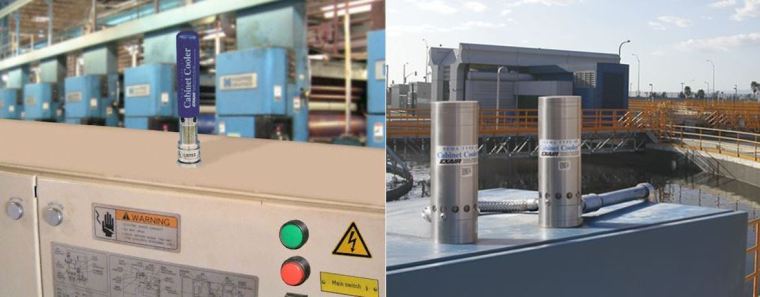
EXAIR Cabinet Cooler System Used on Cement Barge

I joined the Navy, right after high school, to get out of Ohio, see the world, and never come back. “My recruiter said” (if you are considering military service, those can be famous last words, just so you know) that I would be a good candidate for Nuclear Power School, so I took the test. As a math & science nerd scholar, I qualified for admission easily.  About halfway through Nuke School, I volunteered for submarines.  My decision was based in no small part on the sea stories of our instructors, the strong reputation of better food, and my deep appreciation for the movie “Operation Petticoat.”

Upon graduation, I was assigned to a new construction Trident submarine.  I did not see the world…I saw the Electric Boat shipyard in Groton, Connecticut, and Naval Submarine Base King’s Bay, Georgia.  Hilarity occasionally ensued, but never in the context of that movie I so adored.  I moved back to Ohio (on purpose) soon after my enlistment was up.  The food WAS good…I can unreservedly vouch for that.

In the new construction environment of the shipyard, I became quite familiar, and developed a deep respect for, the high level of attention paid to the materials and workmanship that a seagoing vessel demanded…not to mention, one with a nuclear reactor on board.  Reliability and durability are obviously key factors.

I had the pleasure recently of assisting an electrical contractor who was looking for a cooling solution for a new Variable Frequency Drive enclosure installation on a cement barge.  The ship’s engineer (a Navy veteran himself) had told the contractor that his priorities were reliability, durability, and dust exclusion.  He couldn’t have made a better case for an EXAIR Cabinet Cooling System.

Based on the specified heat load of the VFD, the size of the enclosure, and its location, a Model 4380 Thermostat Controlled NEMA 12 Cabinet Cooler System, rated at 5,600 Btu/hr, was specified.  This equipment is internal to the ship; had it been exposed to the elements, a NEMA 4X system would have been presented.

Up to 2,800 Btu/hr cooling capacity with a single Cabinet Cooler System (left) or as much as 5,600 Btu/hr with a Dual system (right.)

EXAIR Cabinet Cooler Systems have no moving parts to wear, no electric motor to burn out, and no heat transfer surfaces (like a refrigerant-based unit’s fins & tubes) to foul.  Once it’s properly installed on a sealed enclosure, the internal components never see anything but cold, clean air.

If you have a need to protect an electrical enclosure in aggressive environment, give me a call.  With a wide range of Cabinet Cooler Systems to meet a variety of needs, we’ve got the one you’re looking for, in stock and ready to ship.

Russ Bowman
Application Engineer
Find us on the Web
Follow me on Twitter
Like us on Facebook