The Venturi Effect: Discovered by Giovanni Battista Venturi

Giovanni Battista Venturi was born in 1746 to an affluent family in Reggio, Italy. An aspiring student, Giovanni was ordained as a priest and a professor by the age of 23. An avid historian of science at the University of Modena, he was the first to emphasize Leonardo da Vinci as a scientist rather than just an artist as he’s more commonly known. Despite his love for history, it wasn’t long before the University of Modena became aware of his talents in mathematics where they appointed him as professor of geometry and philosophy in 1774. During his tenure at the University of Modena, Giovanni was promoted to the Professor of Experimental Physics, served as the Duke of Modena as the State engineer and auditor, later serving diplomatic roles in both France and Switzerland.

Giovanni is most well-known for his work in developing what is now known as the venturi effect. In 1797, he published a study on the flow of water through short cylindrical tubes. It wasn’t until 1888 that Venturi’s design was applied to something practical when a man named Clemens Herschel received a patent for the first commercial venturi tube. The original purpose of the venturi tube was to measure the amount of water used in individual water mills and is still used to this day as a means of measuring fluid flows.

Venturi tube.jpg
Venturi Tube

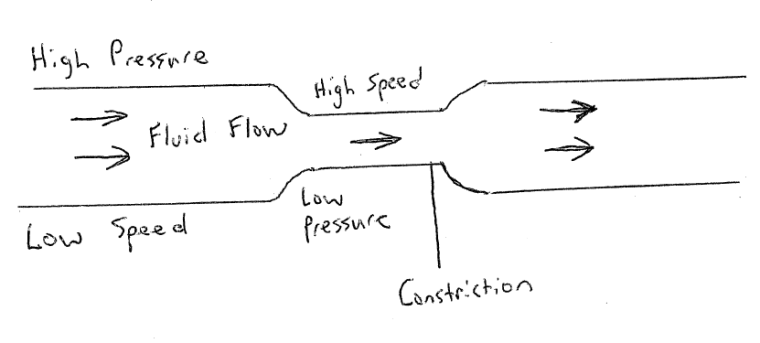
The venturi effect is a principle in fluid dynamics and states that a fluid’s velocity must increase as it passes through a constricted pipe. As this occurs, the velocity increases while the static pressure decreases. The pressure drop that accompanies the increase in velocity is fundamental to the laws of physics. This is known as Bernoulli’s principle. Below is an illustration of how the venturi effect works inside of a constricted tube.

venturi

In everyday life, the venturi principle can be found inside of many small engines such as lawn mowers, gas powered scooters, motorcycles and older style automobiles. Inside the carburetor, there is a small tube through which filtered air flows from the intake. Inside of this tube is a short narrowing. When the air is forced to constrict, its velocity increases and creates a vacuum. This vacuum draws in fuel and mixes with the air stream causing it to atomize.  As the throttle valve is opened further, more fuel is forced into the engine. This increases the RPM and creates more power.

inlineworks
In-Line E-Vac

This principle is also applied to EXAIR’s line of E-Vac products to create vacuum. The .gif below illustrates how an In-Line E-vac works. (1) Compressed air flows through the inlet (2) and is directed through a nozzle, constricting the flow of air. (3) As the air stream exhausts, it expands causing a decrease in pressure and an increase in velocity prior to passing through the venturi. (4) A vacuum inlet tangential to the primary airflow is located at the suction point between the orifice and the venturi. (5) The airflow that is drawn through the vacuum inlet mixes with the primary airstream, then exhausts on the opposite end.

The venturi effect is used in a variety of other EXAIR products used for cooling, drying and cleaning, in addition to the vacuum generators. If you have a process in your facility that may benefit from an Intelligent Compressed Air solution, give us a call. We’d be happy to discuss your application and implement a solution to both reduce your compressed air costs and improve worker safety.

Tyler Daniel
Application Engineer
E-mail: TylerDaniel@exair.com
Twitter: @EXAIR_TD

Photo: Venturi Tube with labels by ComputerGeezer and Geof.  GNU Free Documentation License

How To Choose The Right Style & Size Vacuum Cup

When you are using vacuum to pick and place different objects, how do you know which style vacuum cup and size you need?  EXAIR offer’s (3) different styles of vacuum cups in a variety of sizes to cover a wide variety of applications.

The first is the round cup, they are suited to smooth, flat surfaces.  They grip and release quickly, hold their shape with frequent use, and grip well when used with vertical loads.  Also, round cups are offered with cleats for a better gripping power when the load is heavy.  Vacuum Cups with cleats provide extra rigidity that lends itself to heavy loads.  The extra rigidity prevents the cup from peeling away or deforming when a heavy load is required.

Large Round Cleated Vacuum Cup
Round Cup With Cleats

Next we have the Oval Cup, they provide the most gripping power due to their larger surface area.  They naturally lend themselves to heavier loads.  They are ideal for flat rigid sheet materials such as wood, glass, cardboard and composites.

Oval cup
Oval Cups Provide The Most Vacuum Which Make Them Ideal For Heavy Loads Due To Their Larger Contact Area

Last but not least we have the Bellows Cup, they are best suited for curved, uneven or textured surfaces.  The bellows or more accurately called “convolutions”, provide a collapsible area that allows the cup to quickly compress when it contacts the surface of item to be moved.  Please know that the grip/release time is greater due the the larger internal volume of the cup.

bellows cup
Bellows Cup Are Excellent For Uneven Or Textured Surfaces, However They Longer Pick-Up & Release Times

Here is an example: If we want to pick up a sheet of glass that weighs 20 lbs, what size vacuum cup(s) do we need?  Fortunately we have published charts in our catalog with the math already completed, but this is how we arrived at the answer.  Using the formula below:

Cup Diameter Formula

D = Cup Diameter
W = Weight of item
N = Factor of safety ( We recommend a safety factor of 2 for horizontal lifting and 4 for vertical lifting).  For this exercise we will use a safety factor of 4.
U = # of cups (Remember it takes a minimum of 3 points to make a plane)
V = Vacuum level (psi) – Exair Porous E-Vac’s are rated to 21″ HG, Non – Porous 27″ HG and the Adjustable E-Vac 25″ HG.   (Each inch of HG equals .491154 PSI)
π = 3.14159
μ = Vertical surface friction coefficient (.5 for typical non-porous materials such as metal, glass, stone, etc..)

Cup Diameter Formula Solved

The calculated diameter is 2.26″ so we would choose the next standard size which is 2.5″ diameter.

When you are looking for Vacuum Cup application assistance or expert advice on safe, quiet and efficient point of use compressed air products give us a call.   We would enjoy hearing from you!

Russ Bowman, CCASS

Application Engineer
EXAIR Corporation
Visit us on the Web
Follow me on Twitter
Like us on Facebook

Thinking Outside of the Box

Over the years of working at EXAIR, I have spoken to thousands of customers. The applications we discuss can run the full range that is showcased in the Solutions section of our website. It is always fun to approach applications when we have to think outside of the box for a solution. Throughout the Application Engineering department, our level of experience here combined with the customer’s knowledge of their setup, sometimes results in a solution that is not straightforward. Sometimes, we have to think outside of the box.

What kind of application may we have encountered where the obvious solution wasn’t the one that worked? One of the best applications that came to mind for me is when a customer was attempting to lift/pick up a very porous piece of filter media like the pre-filter from a Heavy Duty HEPA Vac. This material is extremely lightweight and porous. When hearing from a customer, I want to pick this material up, my mind quickly goes to the E-Vac Vacuum generators which are used to generate vacuum to operate suction cups.

In-Line E Vac picking up a block of cut extrusion.

With this material however, the vacuum flow needed is quite extensive and there is another product which is going to be a more efficient use of compressed air. That product, the Super Air Amplifier. As you can see in the photo below, a 2″ Super Air Amplifier easily lifts the porous material and because the suction side is a nominal hose size a hose can easily be attached if needed. The image shows a single amplifier lifting a larger sheet from a bench, these could be organized in an array like suction cups to pick materials up.

Model 120022 – 2″ Super Air Amplifier picking up a porous pre-filter material.

The moral of the story is to keep an open mind for solutions, while one path will always work other paths may become a more efficient manner. These solutions don’t always fit inside a box nice and neat. The Super Air Amplifier fit this because the amount of air entrained is tremendous and can easily be utilized to pull low vacuum force/high flow applications. This is very similar to fume evacuation which would be a “normal” application for the Super Air Amplifier.

If you want to discuss any point of use compressed air application with us, contact an Application Engineer and let us help you determine the solution your job needs.

Brian Farno
Application Engineer
BrianFarno@EXAIR.com
@EXAIR_BF

We Lift Things Up and Put Them Down (Part 2): EXAIR’s E-Vac Vacuum Generators

A few months ago, I wrote here on the EXAIR Blog about my wife and I competing in our very first powerlifting competition. It’s a long and tiring process training for months for one single day, but to see all of your hard work payoff on the platform come competition day makes it all worth it. After competing on Saturday, we were both back in the gym the following Monday morning getting ready for the next one. Memorial Day weekend we participated in the Rivercity Barbell MAYhem meet in Northern Kentucky, another trophy for my wife, and another 2nd place medal for me. I’m beginning to see a trend here…. The entire day didn’t go the way I wanted it to, but I was pleased with a strong finish: a 500lb deadlift on my 3rd attempt to end the day. Exactly what I had in mind on the drive home in early January after our first meet.

After a full, long day of lifting stuff up and putting it back down, I was definitely ready to hit the bed right upon getting home. I could’ve saved myself quite a bit of energy and exhaustion by using one of EXAIR’s E-Vac Vacuum Generators. Although I’m fairly certain that would end in a quick disqualification…  

EXAIR’s E-Vacs are designed to take the difficult part out of lifting, placing, clamping, and mounting across a wide variety of parts and materials. EXAIR offers two primary styles of E-Vacs to serve your needs: In-Line E-Vacs & our Adjustable E-Vacs

The In-Line E-Vacs are a single stage, cylindrical units that are compact and easy to mount right at the point of use. They can be held in place by threading directly onto a compressed air line, or by the use of a mounting clip. We offer styles for use with porous materials, such as paper or cardboard, with vacuum levels up to 21” Hg and vacuum flows up to 18.5 SCFM. For non-porous materials, such as glass, we offer units with vacuum levels up to 27” Hg and with vacuum flows up to 15.8 SCFM.

Adjustable E-Vac

For applications that may have varying weights and sizes, we offer a line of Adjustable E-Vacs as well. With the simple loosening of a locknut and turning the exhaust, you can increase and decrease both the level of vacuum and the vacuum flow. This style is also an excellent choice for applications where large particulate may be present and can pass through the vacuum. We offer (4) different models with adjustable vacuum up to 25” Hg and vacuum flows up to 81 SCFM.

No matter what it is you’re trying to pick up, EXAIR has an E-Vac suited to the task. For help in sizing the appropriate vacuum generator for your application, feel free to give us a call. Hopefully by then I’ve figured out how to win one of these competitions, and I’m sure I’ll have a trophy case full of ‘em for my wife.

Tyler Daniel

Application Engineer

E-mail: TylerDaniel@EXAIR.com

Twitter: @EXAIR_TD