
Vortex Tubes Make Hot Air Too

Back in the spring, my good friend and co-worker Neal Raker wrote a great piece, titled “Can I Use A Vortex Tube For Heating?” which I will try my best not to borrow too much from or outright plagiarize in the blog to follow. I only mention it because I had the pleasure of helping a customer with one of the “usually few and far between” Vortex Tube heating applications recently.

Like Neal said, the conditions under which Vortex Tubes fit a heating application are fairly narrow, but certainly not unheard of. In this situation, a reciprocating air motor had been in place on a piece of factory machinery for years. A recent change in the part being manufactured meant that the motor had to be slowed down, which meant throttling down on the vent valve on the motor’s pneumatic exhaust. When they did this, the valve became prone to freezing up, meaning someone had to rig up a heat gun and climb up on top of the machine to the vent valve, directing hot air on the valve until it thawed. It got to be a real hindrance to the process when this happened several times a day.

The caller was familiar with our Vortex Tube products, having used Mini Coolers and Cold Guns in other parts of the plant. He knew that there was hot air coming out of the other end, and thought it could be used to thaw the vent valve, but was concerned, because it was such a low flow.

Mini Cooler (left) and Cold Gun (right).
Mini Cooler (left) and Cold Gun (right).  Cold air from one end; hot exhaust minimized on the other.

He was right: the hot air exhaust of both the Mini Cooler and Cold Gun is a small fraction of the total air supply…that’s by design. Also, it’s passed through a noise reducing muffler which further spreads it out to make it nice & quiet…also by design.

That’s when a fuller explanation of Vortex Tube operation came into play: See, the Mini Coolers and Cold Guns are all set to a high Cold Fraction (the percentage of supply air that is directed to the cold end,) so, although the hot exhaust is indeed fairly hot, there’s just not a lot of it. By contrast, our 3400 Series Maximum Cold Temperature Vortex Tubes are adjustable for lower Cold Fractions (from 20-50%,) meaning that the hot exhaust flow can range from 50-80% of the supply air flow. Additionally, the hot end of the Vortex Tube has male NPT threads, for convenient porting & direction of the hot air flow.

The EXAIR Vortex Tube.  Cold air from one end; hot air from the other.  Fully adjustable.
The EXAIR Vortex Tube. Cold air from one end; hot air from the other. Fully adjustable.

Now, back to the conditions that made this a good fit for the Vortex Tube: the machinery already had an ample and easily accessible supply of compressed air…they were able to tap a line from the air motor’s supply. The closest outlet for their heat gun was on the other side of the walkway, which meant they had to stretch an extension cord across the walkway, creating a trip hazard. The vent valve is also small enough that they could use a Model 3402 Vortex Tube, which utilizes only 2 SCFM @100psig…a tiny fraction of what the air motor uses.

With the Vortex Tube mounted permanently in place, the vent valve now operates flawlessly, without the need for manually thawing with the incredibly inconvenient heat gun.

If you think you might have a decent fit for a Vortex Tube heating application, give us a call. You may be right.

Russ Bowman
Application Engineer
(513)671-3322 local
(800)923-9247 toll free
(513)671-3363 fax
Find us on the Web
Follow me on Twitter
Like us on Facebook
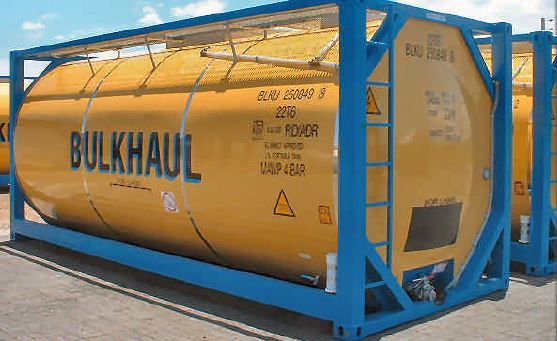
Vortex Tube Thaws Steam Connections on Bulk Liquid Sea Containers

Bulk container

Vortex Tube applications for cooling are many and a wide variety. Heating applications though, do tend to be a bit more elusive. That being said, I thought I would highlight a recent application where vortex tubes were used to thaw out steam lines that are used to heat up fluids in bulk sea containers.

We have all seen them running up and down the expressways, the large, bulk liquid containers that have the multi-modal capability to be on a ship, a train or a truck going down the road. I personally never thought about what the users of these tanks must do in order to get the liquid inside up to certain temperatures to allow the material inside to flow easily. I live in the Midwest area of the US, so we get really cold weather for only a few weeks during the year. In the Northern climates though, these bulk container users must have ways to thaw out the product before it can be used. To do this, these bulk containers are equipped with steam lines. Steam is used to heat the liquid inside to get it up to temperature. Once the steam is connected to the lines and circulating, all is well. But before they can get to that point, the steam connections on the tank are usually plugged with ice from condensate from previous use. The previous method was to simply snake a steam line up inside the heater lines to warm them up, but that presented a further problem. That same condensate ends up rolling out the pipe and dripping on the ground, re-freezing and creating a huge slip hazard.

 Steam connections

Above are the typical 1” BSP steam connections found on the bulk tanks.

In order to eliminate the slip hazard, the customer began looking for another method to supply a hot gas to these steam lines to thaw them out. In comes EXAIR with our Vortex Tube selection. The idea is to replace the mini steam line with the hot air output flow from a vortex tube to thaw out the connections. Since the customer has compressed air utility in plentiful supply on site, this makes for a very convenient way to warm up the pipes with a relatively “dry gas”. That being the dry compressed air supplied in the facility. The customer ended up using (2) model 3225 Vortex tubes with Cold Flow Mufflers, to provide the hot air for the steam connections. In fact, the diameter of the hot tube for the vortex tubes was the perfect size to simply slide up inside the steam pipes and hang there until the pipes were free of the problematic ice. There was still some small amount of liquid that re-froze from within the steam pipes, but it was certainly much more manageable than the mess the customer was dealing with previously.

Neal Raker, Application Engineer
nealraker@exair.com

Multi-tools, Adjustable Wrenches, and Vortex Tubes

I like tools and gadgets that can perform a variety of functions. From the Swiss Army Knife, to the multi-tools by Leatherman, Gerber, etc., I’m a sucker for anything that might offer me the chance to NOT dig through my toolbox for something that’s probably not there because it didn’t get put back the last time.

That’s why another of my favorite tools is the adjustable spanner…you may know it as the Crescent, or perhaps, the “all sixteenths,” wrench. Its popularity is cemented in American legend, as pioneering aviators Charles Lindbergh and Richard Byrd both famously included them in the scant provisions they took with them on their long flights across the Atlantic and to the North Pole, respectively. Remember, this was back when every single ounce of weight that someone took on a plane with them had to be carefully considered. Which, come to think of it, isn’t that much different than commercial flight luggage constraints today. But I digress.

Lindbergh took only "gasoline, sandwiches, a bottle of water, and a Crescent wrench and pliers" on his famous flight.
Lindbergh took only “gasoline, sandwiches, a bottle of water, and a Crescent wrench and pliers” on his famous flight.

One other thing this tool is sometimes called is the “Crescent hammer.” Dear reader, don’t do that to such a fine instrument. Seriously; go back to the toolbox that it came from…odds are, you’ve got a real hammer there. It will strike the handle end of the screwdriver that you intend to use as a chisel much squarer. While you’re there, get your safety glasses too. You’re welcome.

Now, it’s not always a problem to use things for applications other than what they were intended for…not always. In fact, I had the pleasure of helping someone do just that with a Vortex Tube recently. During the assembly of the electrical connectors they make, they put a small dab of sealant inside. When wire is inserted by the user, this sealant helps hold it in place, and protects the bare end from corrosion. They were, however, putting more than they needed into the connectors, and were looking for a way to quickly heat the piece, which would thin out the sealant and produce an even coating inside, allowing the rest to be recovered and reused.

They were already familiar with EXAIR products, since they’re a big user of our Safety Air Guns. The caller had found our Vortex Tubes in his copy of our catalog, and was wondering if he could use the hot air flow for this. He knew what temperature he needed to reach, but didn’t have a feel for how much (or little) air flow would be needed to do the job. This was no problem, since our Model 3930 Cooling Kit comes with a Medium Vortex Tube and ten different Generators, which allows for a range of hot flows from 2 to 32 SCFM (56 to 906 SLPM), and temperatures from 96° to 261°F (35° to 127°C).

3930

If you’ve got an application that you want to use a Vortex Tube for – be it cold or hot air that you’re after – give us a call. Oh, and I was just kidding about the screwdriver; I know you have a chisel, and, like mine, it’s somewhere. Somewhere…

Russ Bowman
Application Engineer
EXAIR Corporation
Web: www.EXAIR.com
Twitter: twitter.com/EXAIR_RB
Facebook: www.facebook.com/exair

Can I Use a Vortex Tube for Heating?

VT

I had a customer come to me the other day. He had an application that required him to heat some metal bearings up to 230°F. He wanted to know if he could use a vortex tube to heat them to the desired temperature. Technically speaking, if he had a compressed air source that started at 70°F, he could conceivably heat the bearings up to about 260°F as that is about the maximum temperature of the vortex tube hot air output.

But the question really is, should he be using a vortex tube to heat those bearings? And generally, the only time vortex heating should seriously be considered is if there isn’t any utility to heat any other way, such as with electricity or with fuel of some sort. There are times when those other utilities are simply not available, but compressed air is. Or perhaps there is some reason why the customer does not want to use those other methods such as dealing with noxious fumes produced from burning a fuel.

You might ask, why not sell a vortex tube into just about any application that requires heating. The simple answer is that it truly has to be the right application to make sense from an application goals standpoint and also from the standpoint of whether it is the most effective method of heating a target object.

EXAIR Vortex Tubes, in and of themselves, are a wonderful product. They produce a hot and a cold air flow. The cold air flow volume will be the  majority of those two flows in most cases. So you could say you get more from a vortex tube in terms of energy output when it is used as a cooling device than as one for heating.

What does this explanation mean? In short, vortex tube applications for heating are usually few and far between. At least those which make any sense. A couple of those applications include heating up 5 gallon buckets of grease, paint and other chemicals on an oil rig platform located in cold regions. Another one is to use the hot flow of a vortex tube to keep a mirror in a laser application warm enough that it does not form condensation during use of the laser in a cold environment.

Do you have an application where you think a Vortex Tube might help?  Please e-mail or call one of our Application Engineers to discuss your idea. We would love to hear about your application.

Neal Raker, Application Engineer
nealraker@exair.com