
EXAIR’s Static Eliminator Variety Provides Solutions for Any Industry

As the weather starts to change and the colder dryer months are upon us, static electricity can become a real nuisance.  Machines will start jamming, alignments will be difficult, dirt will collect to surfaces, and hazardous sparks can shock personnel.  EXAIR manufactures a line of Gen4 Static Eliminators, also called ionizers, to remove these nuisances.

Static is generated from non-conductive surfaces being “rubbed”.  This could be caused from going over rollers on a conveyor, stacking product onto each other, sheet feeding, and even peeling away a backing material.  When a non-conductive surface, or insulator, is moved or separated, electrons are “stripped” and redistribute into different areas on the surface.  Static charges are typically measured in kilovolts (KV), or 1,000 volts, and they can be either positive or negative in nature.

The higher the charge, the stronger the static force.  At a 10 KV static charge, a spark can jump one inch (25 mm) from the surface.   You probably felt that shock when working with plastic or non-conductive materials.  EXAIR has a Digital Static Meter to measure the amount of static voltage on a surface.  It is a great tool for finding problem areas in your process as well as determining the effectiveness of the treatment.

Static is dynamic.  The more you rub or move the material, the higher the static charges can form.  Static can also regenerate itself after the charges have been removed.  With higher static charges, the attraction force to other materials is much stronger.  This attraction could be to other products, dust, lint, and even you.  An undesirable effect of static can be seen with dirty surfaces, tearing, alignment, jamming and shock to personnel.  The EXAIR Gen4 Static Eliminators are engineered to remove both negative and positive static charges in an assortment of designs to best fit the application.

EXAIR manufactures nine different products, including Static Eliminators with air assistance to reach farther distances or Static Eliminators without air when surfaces could be disrupted by air flow. The newest product, the Intellistat™ Ion Air Gun is engineered for clean processes, laboratory and test environments.

The Gen4 ionizers are powered by a 5,000 Vac power supply.  The alternating current, AC, will create both negative ions and positive ions.  No matter the kind of static charge is on the surface, the Gen4 Static Eliminators will be able to remove it.  The power supplies come in either a 2 port or 4 port design; so, you can power multiple Gen4 Static Eliminators with one power supply.  The input power is selectable from either 115Vac or 230Vac in both 50/60 hz. An armored and electromagnetic shielded cable connects the power supply to the ionizer in a single wire design. This will help to protect the cable from abrasions, cuts and splits in industrial areas.

The Intellistat Ion Air Gun is powered with a 24Vdc power supply. The Gen4 Static Eliminators and the Intellistat Ion Air Gun have a shockless design, and they are UL Component Recognized and CE compliant.  I will give a brief description of each product that utilizes this rugged design for optimal static neutralization.

Gen4 Static Eliminators with Air:
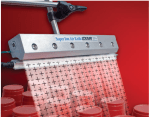
Super Ion Air Knife
  1. Gen4 Super Ion Air Knife: This product has the best compressed air efficiency in removing static by combining the Super Air Knife with an Ionizing Bar.  The Gen4 Super Ion Air Knife has a 40:1 amplification ratio and uses the laminar air flow to carry the positive and negative ions to the surface.  The laminar flow allows for a quick static discharge in fast conveyance speeds.  They can also remove static from surfaces up to 20 feet (6.1 meters) away.  EXAIR manufactures stock lengths from 3” (76mm) to 108” (2.74 meters).  Some typical applications for the Gen4 Super Ion Air Knife are found in web cleaning, sheeters, pre-paint dust removal, and shrink wrappers.
  2. Gen4 Standard Ion Air Knife: Similar to the Gen4 Super Ion Air Knife, this product has a good compressed air efficiency.  It utilizes the Coanda effect to draw in ambient air at a 30:1 amplification ratio.  They come in stocked lengths from 3” (76mm) to 48” (1.22 meters).  The Gen4 Standard Ion Air Knife are used in similar applications as well as mold releasing, package cleaning, label applications and plastic bag opening.

    Gen4 Super Ion Air Wipe
  3. Gen4 Super Ion Air Wipe: This product blows ionized air in a 360-degree pattern.  They are engineered to remove static and debris from the outside of hoses, plastic pipe, extrusions, and coated wires.  With the split design, the Gen4 Super Ion Air Wipe can easily mount around the product without having to rethread.  They come in two different sizes with a 2” (51mm) and 4” (102mm) inner diameter. The ionized air has a fast static decay for speedy transfers.

    Gen4 Ion Air Cannon
  4. Gen4 Ion Air Cannon: Just like the name, this product will shower an area with ions to remove static. It can reach distances up to 15 feet (4.6 meters).  They are used in multiple areas including pre-paint car bodies, containers, shrink packaging, lenses, etc.  As an Air Amplifier, a small amount of compressed air will draw in a large amount of ambient air.  The ions are carried to the surface from the Gen4 Ion Air Cannon in a laminar air steam.   Once the ions coat the surface area, the air flow can gently remove any debris held by static forces.

    Gen4 Ion Air Gun
  5. Gen4 Ion Air Gun: For manual static removal to target specific areas, the Gen4 Ion Air Gun will work great.  This product comes standard with 10 feet (3 meters) of shielded cable for maximum reach.  An ergonomic air gun is attached to a Gen4 Ion Air Jet to manually remove static in difficult areas and from “shock” zones.  The Ion Air Guns work great for small batch processes used for quality checks or label applications.

    Ion Air Jet
  6. Gen4 Ion Air Jet: Similar to the Ion Air Gun, this product is used for “hands-free” operations. They use a small amount of compressed air to “shoot” the ions onto a surface.  They can be operated with a solenoid valve or foot pedal to blow ions during specific times and situations.  They can easily be attached to a Stay Set Hose and Magnetic Base for best “hands-free” positioning for optimal cleaning.  They work well on small targets for automated systems or inspections areas prior to packaging.
  7.  Intellistat™ Ion Air Gun: This is EXAIR’s newest product that is a lightweight solution for static and particle removal.  The patent-pending air gun comes complete with a 24Vdc power supply and a 6mm compressed air tubing.  There is a red and green LED lights to signify the production of ionized air for visual feedback.  The engineered air nozzles are quiet and OSHA safe.  The emitter point inside that creates the ions can be easily changed for replacement.  The applications range from circuit boards, electronic manufacturing, laboratories, clean rooms, and scientific testing.

The Gen4 Static Eliminators with air can be purchased with kits which will include the power supply (required for ionization), a filter (to clean contamination from the compressed air), and a regulator (to control the blowing force).  In the spirit of compressed air efficiency, EXAIR also offers the Electronic Flow Control, EFC, that uses a photoelectric sensor to turn on the air flow only when the product is under the Static Eliminator.

Gen4 Static Eliminators without Air:

Ionizing Bar
Low cost Ionizing Bars eliminate static cling.
  1. Gen4 Ionizing Bar: This rugged design is for industrial use to remove static cling from flat surfaces. They range from a length of 3” (76mm) to 108” (2.74 meters).  Without the assistance of air, the product has to be within 2 inches (51 mm) from the surface to remove static charges.  The Gen4 Ionizing Bar is shockless and works well in applications where blowing air could be a detriment for the process.  This would include screen printing, labeling, and large printing process.

    Gen4 Ionizing Points
  2. Gen4 Ionizing Point: This single point design is manufactured to remove static on small targets in tight spots.  Utilizing the same rugged design of the Gen4 Static Eliminators, this product can remove static in spot areas and help to stop jams in slitting operations. They can also be panel mounted to neutralize duct air.

If you find that static is creating process problems, wasting time, and costing you money, EXAIR has a large line of Static Eliminators that can help you.  For our U.S. and Canadian customers, we are offering a promotion for online orders for a limited time.  You will receive an AC Sensor, a $59.00 value, for free as a Promotional item from now until the end of March 2021 with a qualified purchase.  How can you not give them a try?  If you have an application, you can contact an Application Engineer at EXAIR to help select the correct model and remove that static nuisance.

John Ball
Application Engineer

Email: johnball@exair.com
Twitter: @EXAIR_jb

Solving a Static Electricity Problem when Applying Labels

Gen4 Static Eliminators

A company was applying labels to their plastic containers.  The labels were 4” (10cm) wide by 9” (23cm) long in size with a protective backing.  The backing material had to be removed prior to applying the label to a 9” (23cm) tall container.  With their label applicator, the label would wrap around the container.  They started to see misalignment and wrinkles in the labels when they were applied.  For the nonconforming parts, they had to remove the label and clean the surface to reapply another label.  This was time-consuming and a pain in the neck.  Since winter is here in the Northern Hemisphere, the drier air makes static very easy to create and will cause issues.  They contacted EXAIR to ask about our Gen4 Static Eliminators.

 With non-conductive materials like plastic and paper, static is easily generated; especially during cooler weather.  Static can be in a negative state or a positive state depending on the type of material.  With opposite charges, things are attracted to each other and will “stick” like magnets.  For similar charges, they will repel each other.  The higher the static charge, the stronger the force.  Static is generated from rubbing, hitting, and peeling which can cause electrons to be stripped from a surface.  For the customer above, the peeling away of the backing from the label caused the negative electrons to build on one surface.  And with the containers shifting, bumping and moving along the conveyor; static was also being generated.  Since like charges repel each other, the labels were not able to stay aligned and were creating bubbles on the surface.

When it comes to removing static, EXAIR is a leader in this market.  We have a large product line of different types of Static Eliminators.  Our design generates both positive and negative ions to remove any type of static charge up to 20 feet (6m) away.  In this application, I wanted to target two areas where static is present; the labels and the containers.  Since we could get close proximity to the label and the containers, I recommended using the Gen4 Ionizing Bars.  With a quick static decay rate, we can remove the static right before applying the label.  For this application, I recommended the model 8006 6” Gen4 Ionizing Bar and two model 8009 9” Gen4 Ionizing Bars.

EXAIR’s power supplies are what gives the Gen4 Ionizing Bars energy to create ions.  EXAIR offers two models of Gen4 Power Supplies; model 7960 which can power up to two Static Eliminator products and model 7961,  which can power up to four Static Eliminator products.  Since the Gen4 Ionizing Bars were mounted in the same area, the model 7961 Gen4 Power Supply was used to run three Ion Bars at once.  This helps to save money as they did not need to buy multiple power supplies.

Together, it was very easy to mount and start using.  The model 8006 was mounted right after the backing was removed from the label.  One model 8009 was positioned in the front of the container; and the second model 8009 was positioned in the back of the container.  Now they were able to remove all the static before the label was placed on the container.

EXAIR stocks lengths from 3” (76mm) up to 108” (2743mm), and we can ship a solution the same day.  When you are losing time and working hours due to static buildup like the company above, the Gen4 Static Eliminators can resolve it quickly and easily.

If you are having problems with static in alignment, jamming, contamination, or shocking staff; you can contact an Application Engineer at EXAIR.  The Gen4 Static Eliminators can remove the static and keep your process running smoothly.

John Ball
Application Engineer

Email: johnball@exair.com
Twitter: @EXAIR_jb

Solving Static and Increasing Print Quality on Food Packaging

Gen4 Static Eliminators

A yogurt company printed bar codes on every cup that they produced. This was necessary for registering and tracing their product. After failing a bar code reader quality test, they started noticing some print issues during batch runs. They would have to stop their system, clean the inkjet printer head, and scrap product that would not register with the bar code reader.

This affects production rates, scrap rates, and overall cost. They stated that they threw away 30 to 40 cases per batch of yogurt due to this problem. They had an EXAIR catalog where they found a similar application within our Gen4 Static Eliminator product line. They contacted us to see if we could find a solution.

With non-conductive material like plastic, static is easily generated; especially during cooler weather. Static can be in a negative state or a positive state dependent on the material. For opposite charges, things are attracted to each other and will “stick” like magnets. For similar charges, they will repel each other. The higher the static charge, the stronger the force.

For the company above, the yogurt cups moved along a 7” (178mm) wide conveyor before they reached the bar code printer. This movement causes static to be generated on the surface of the cups. But, what about the inkjet printer? The function of the printer charges the ink droplets for direction and positioning. Since the ink droplets and the cup surfaces have the same charge, the droplets were being “pushed” back toward the printing head (reference photo below). Thus, the ink would dry on the surface and affect the quality of the bar code.

Bar Code Printer

When it comes to removing static, EXAIR is a leader in this market. We have a large product line of different types of Static Eliminators. Our design generates both positive and negative ions to remove any type of static charge. Since we only had to remove the static from the surface of the cup, I recommended a Gen4 Ionizing Bar. With a quick static decay rate, we can remove the static right before the bar code printer with only one Gen4 Ionizing Bar. For this application, I recommended the model 8003 3” Gen4 Ionizing Bar and a model 7960 Gen4 Power Supply. Together, it was very easy to mount and start using. EXAIR stocks lengths from 3” (76mm) up to 108” (2743mm), and we can ship a solution the same day. When you are losing 30 to 40 cases, time matters. And for this company, they received the items the next day to correct the misprints and short printing runs.

Gen4 Ionizing Bar w/ power supply

When problems occur, time can be of the essence. This is why EXAIR stocks our cataloged items for fast delivery.  For the company above, they had an EXAIR catalog which helped them to find a solution. If you would like to have an EXAIR catalog, you can click here to get one.   After they started using the Ionization Bar, the static was removed, the bar code was clean, and the operation ran smoothly. If static is causing issues for you, you can contact EXAIR and speak to one of our Application Engineers. We will be happy to assist you.

John Ball
Application Engineer

Email: johnball@exair.com
Twitter: @EXAIR_jb

EXAIR, Manufacturing Locally Equals Quick Customizations

Dryer with corn cob material

A manufacturing company contacted EXAIR about their metal tube processing. They made industrial precision tubes from start to finish. This would include turning, cutting, coating, washing and drying metal tubes to specific diameters and lengths.

For one specific problem area, they manufactured a tube with the dimensions of 1” (25.4mm) in diameter and 6” (152mm) in length. They would run a batch of 750 tubes through a wash cycle and then through a vibrating dryer with a drying material made from corn cobs. At the bottom of the vibrating dryer, the tubes would fall to an open mesh shaker table to transfer the tubes to Quality Control. The idea was to remove the excess cob material from the surface of the tubes before inspection and to recycle the drying material. But the problem was static.

When non-conductive materials slide, hit, peel, and vibrate; electrons from the surface can move from one atom to another; thus, creating static. The type of material and the amount of movement governs the positive and negative charges, and the amount of static forces.

The corn cob material is a non-conductive material, but what about the metal tubes? Since the metal tubes were coated for corrosion and abrasion protection, the surface is now a non-conductive area which will contain static. Since opposite charges attract each other, the cob material would cling to the outside surface of the metal tubes (reference photo below). Being a precision tube manufacturer, they did not want to send “dirty” tubes to their customers or allow the drying material to contaminate their measuring equipment. And, with the required quality control, the measurements had to be exact.

Tubes with cob material

The shaker table was 8 feet (2.4 meters) long and 2 feet (0.6 meter) wide with rigid walls. The top of the shaker table was covered with a canvas to allow for a vacuum system to collect the excess material and dust. About half way down, there was a 2” (51mm) drop to help jolt additional cob material off of the tubes as they landed. But the static forces were too strong to release the material. Thus, the static had to be removed from the surface, so they contacted EXAIR to see if we could find a solution.

They sent photos of their setup which always helps us to diagnose and find solutions. The target place that they suggested would be near the 2” (51mm) drop as the tubes would be suspended for just a moment. My recommendation was to use a Gen4 Super Ion Air Knife to blow ionized air around the tubes as they fell. By blowing air, we can use the non-contact force to remove the static and the cob material at the same time. But we had two issues to overcome. The width was fixed at 2 feet (0.6 meter), and the operation controls were 10 feet (3 meters) away from the mid-section of the shaker table.

Gen4 Super Ion Air Knives

EXAIR stocks many Gen4 Super Ion Air Knives ranging from 3” (76mm) to 108” (2.74meters) in incremental lengths for quick shipments. But our standard 24″ product was not able to fit inside that area nor was the five foot electrical cable long enough to reach the control panel. (As a note, it was important for the operator to be able to manually turn on and off the unit from the control panel.)

EXAIR uses an electromagnetically shielded cable to carry high voltage from our Gen4 Power Supply to our shockless, non-radioactive Gen4 Ionizing Bar. Our  stocked length for our armored cable is 5 feet (1.5 meter). After discussing the amount of movement with the table and the desired distance to the control panel, EXAIR could not use an item off the shelf. But not to worry… Since we are the manufacturer, we have the ability to make a special design for this customer.

Super Ion Air Knife Part Numbering System

I recommended a model 112220-10 special length Gen4 Super Ion Air Knife Kit. (Reference model numbering system above). Specials are non-returnable and non-cancelable, but for this customer, it was exactly what they needed. The Gen4 Super Ion Air Knives are engineered to efficiently blow ionized air to the target and remove static charge and debris.

For this special model, it was made to a specific width where the Super Air Knife was manufactured to a length of 20” (508mm), and the high voltage cable was lengthened to 10 feet (3 meters). The kit includes the Gen4 Power Supply to power the Ionizing Bar, a filter to clean the compressed air, a regulator to control the force, and a shim set to change force rates. This complete kit had everything required to begin operations to remove static and cob material from their precision tubes. The customer was able to mount the special length Gen4 Super Ion Air Knife within the shaker table and mount the power supply near the control panel.

Static can be an issue even with coated metal parts. For the customer above, EXAIR was able to make a special length Gen4 Super Ion Air Knife to work in their system. If you believe that static is causing issues, EXAIR has a great range of Gen4 Static Eliminators to remove that nuisance. You can discuss further with an Application Engineer as EXAIR for help; even if you need a custom product.

John Ball, Application Engineer
Email: johnball@exair.com
Twitter: @EXAIR_jb