
Static Elimination For Cleanrooms: The Intellistat Ion Air Nozzle

Cleanrooms (sometimes written as two words: “clean rooms”, and historically called “White Rooms” or “Dust-Free Rooms”) are engineered spaces where specialized equipment and procedures are used to maintain a very low concentration of contaminants. While certain levels of cleanliness are desirable for many processes, certain ones can be catastrophically affected by contamination. In the 1960’s, a physicist working for Sandia National Laboratories named Willis Whitfield pioneered the modern cleanroom. His designs focused on continuous filtration of the air inside. This was a real game changer for a number of industries like electronics, pharmaceuticals, semiconductors, and all kinds of scientific research facilities. They can be small – like a dedicated enclosure in a larger building or shop where one or two people perform benchtop testing, assembly, etc. They can also be enormous, like one of the earliest cleanrooms: a 70,000 square foot space at an RCA facility not far from here, in Cambridge, Ohio, where they made control equipment for some of the earliest intercontinental ballistic missiles in the U.S. military’s arsenal.

It should come as no surprise that equipment used in cleanrooms must comply to some demanding standards & specifications. To that end, ISO (The International Organization for Standardization) created ISO Standard 14644-1. It identifies nine Class Numbers, based on allowable particulate concentrations in a given volume of air. Here’s how it breaks those down:
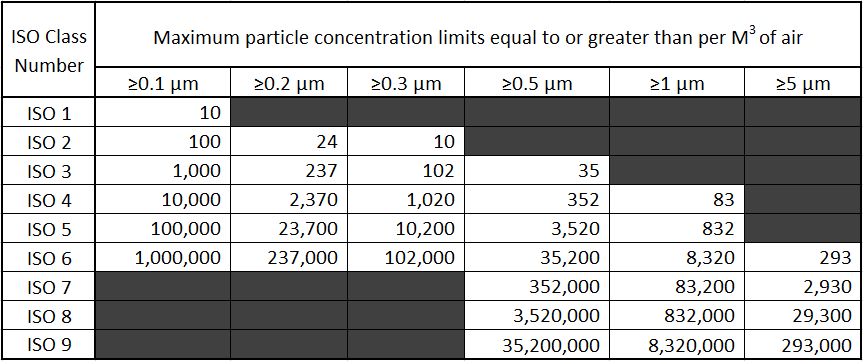
Basically, the lower the Class Number, the cleaner the air. ISO 1 is often used in semiconductor manufacturing. Medical device manufacturers and pharmaceutical facilities typically specify ISO 5 & 7.

Equipment used inside a cleanroom must be designed, and operated, so as to not increase particulate concentration limits above these limits. You wouldn’t want to use steel tools that are prone to rust, or electric tools with carbon brushes in the motors, for example.

EXAIR’s Intellistat Ion Air Nozzle was designed with these considerations in mind. They were tested by a third part independent laboratory and are classified for use in ISO Class 5 (or below) cleanrooms. This has made them especially popular in pharmaceutical laboratory use, as well as:

  • A local eyeglass & camera lens manufacturer uses them to ensure precision measurement instruments’ readings aren’t affected by any residual static charge caused by the grinding process.
  • A company that makes overlays for medical devices (IV pump controllers, patient monitoring devices…pretty much anything with pushbuttons you might find in a hospital room or a doctor’s office exam room) uses them to maintain compliance with their customers’ standards.
  • A number of food production facilities around the country use them to remove static from processed foods, and packaging containers, during filling operations.
  • A manufacturer of packaging machinery includes them on filling machines servicing the food and pharmaceutical industries.
Order before March 31, 2025 and receive a FREE AC Sensor with any qualifying Static Eliminator purchase.

Whether they’re in a cleanroom or not, the compact design, ease of installation & operation, air use efficiency, and quiet operation make them ideal for a range of static elimination applications. If you’d like to find out more the Intellistat Ion Air Nozzle (or its handheld version, the Intellistat Ion Air Gun), give me a call.

Russ Bowman, CCASS

Application Engineer
Visit us on the Web
Follow me on Twitter
Like us on Facebook

Varistat Benchtop Ionizer Solves Static Cling Problem With Tape Backing Strips

Technicians at an automotive manufacturing plant apply pieces of adhesive tape to parts. They cut the tape to length, remove the plastic backing strip, and stick the tape in place. Due to the static charge on the backing strip, it would stick to their hands when they tried to drop it in the trash can at their work station.

They purchased & installed an EXAIR Model 8600 Varistat Benchtop Ionizer above the trash can. As they peeled the backing strip off the tape, the constant stream of ionized air dissipated the static charge, allowing the strips to simply fall into the receptacle.

Lightweight and compact, the Varistat Benchtop Ionizer isn’t limited to benchtop installations.

Before installing the Varistat Benchtop Ionizer, the strips would also cling to the plastic liner in the trash can. Because the static charge has been removed, the strips don’t cling to the sides anymore, so when the liner bag is full, it’s easy to pull it out, tie it up, and not drop any strips that used to cling to the top of the bag.

The Varistat incorporates EXAIR ionization technology to supply a stream of ion-balancing airflow to remove static charge and blow away the particulate that the static charge was holding on the surface, with hands-free operation and without the need for compressed air. The Varistat is manually adjustable and provides full coverage static elimination for workbenches, parts assembly stations, web cleaning…anywhere that point of use static elimination is needed. It can reduce a 1,000V static charge to just 100V in 0.8 seconds, and is engineered to fit various industrial applications & unique processes with user-friendly features like an adjustable stand, selectable input voltage (120-240VAC), a variable speed fan, replaceable foam intake filters, and adjustable polarity for ionization balance (+/-100V, manually adjustable to <10V).

If you’d like to find out more about the Varistat Benchtop Ionizer – or any of our Static Eliminator Productsgive me a call.

Russ Bowman, CCASS

Application Engineer
Visit us on the Web
Follow me on Twitter
Like us on Facebook

RoHS, EXAIR, And You

The 20th century was an amazing time for technological advances. In just 70 years, the science & engineering communities went from believing that powered flight was impossible, to actually powering a flight that took three astronauts all the way to the Moon…and back. In the 50 years or so since then, the computers with the power required for space travel went from needing a whole room, to being able to fit on our desks, and eventually, our pockets.

All three of these: a state of the art computer from 1962 (left), the desktop computer I’m writing this blog on (middle), and a smart phone being used for its most popular function (right) all have about the same amount of computing power, believe it or not. (full disclosure: I believe it because I used my smart phone to look that up on the internet)

Along with these amazing advances in technology came exponential increases in the materials it takes to make devices like desktop (or laptop) computers and smart phones…and some of those materials don’t get along well at all with the environment, and by extension, those of us who live in said environment. This doesn’t normally matter as long as those materials are housed inside an operating computer or cell phone (or myriad other electronic devices), but it DOES become a concern when they’re disposed of. When stuff like that ends up in landfills, for instance, it has a bad habit of making its way into the water table…and that’s not good for anyone.

In 2002, the European Union (EU) started pursuing legislation to restrict the use of certain hazardous substances, to get out ahead of disposal issues by keeping them out of products from the very beginning. This led to the creation & implementation of the RoHS Directive. It’s been revised, amended, and updated over the years, because it turns out there are no viable substitutes for SOME of those substances in SOME situations. Among these exceptions:

  • Mercury is used extensively in a number of energy efficient CFL light bulbs and fluorescent tubes, so there are exemptions for that, and it works because there’s a whole industry devoted to the proper recycling of these products.
  • My personal favorite is the specific exclusion for lead in the manufacture of pipe organs. Seems that the lead based alloy that’s been used for centuries is critical to the tonal qualities of the sound that the pipes produce. Since disposal rates of these are negligible (the use of this alloy is one of the reasons they LAST for centuries), pipe organ pipes don’t have to be RoHS compliant.

Compliance with the RoHS Directive is so important to EXAIR, it’s part of our Sustainability Plan. All of our products that are subject to the Directive have certificates of compliance (available upon request) that document their compliance. Per the specifics of the Directive, these are comprised of certain products in our Optimization, Static Eliminators, and Cabinet Cooler System product lines:

  • Optimization:
    • EFC Electronic Flow Control Systems
    • Digital Flowmeters
    • Digital Sound Level Meters
    • Ultrasonic Leak Detectors
  • Static Eliminators:
    • Super Ion Air Knives
    • Standard Ion Air Knives
    • Ionizing Bars
    • Super Ion Air Wipes
    • Ion Air Cannons
    • Ion Air Guns
    • Ion Air Jets
    • Power Supplies
    • Intellistat Ion Air Guns
    • Intellistat Ion Air Nozzles
    • Static Meters
  • Cabinet Cooler System products:
    • Electronic Temperature Control Systems
    • Thermostats & Capacitors
    • Solenoid Valves

These are all of our products that are electrical or electronic in nature. Our broad line of engineered compressed air products are not subject to the Directive, as they have no electrical or electronic components. We DO make sure these comply with other regulatory directives, as applicable, such as:

  • Conflict Mineral Free: All compressed air products
  • CE: All products
  • UL: Static Eliminators and Cabinet Cooler Systems are UL Listed, HazLoc Cabinet Cooler Systems are UL Classified
  • ATEX: These are a brand new line (as of this writing) of Cabinet Cooler products

If you’d like to find out more about EXAIR’s commitment to compliance with any of these standards or directives, give me a call.

Russ Bowman, CCASS

Application Engineer
Visit us on the Web
Follow me on Twitter
Like us on Facebook

Ionizing Points for Static Elimination Without Airflow

I almost wore three socks this morning: one on each foot, and one inside the sleeve of my shirt. I don’t know if it got in there through the agitation & spin of the washing machine, or the tumbling action in the dryer, but I know how it stayed there through the removal from the dryer, folding, and placing in my shirt drawer: static charge. This was evident from the ‘snap, crackle, and pop’ it made when I pulled it out.

Static charge is all around us. It’s mildly annoying in the clothes we pull from the dryer or the packing peanuts we can’t shake from our hands when unpacking from that new whatever-I-just-ordered from that website. It’s surprisingly uncomfortable when we touch the light switch after walking across a carpeted floor. And it’s terrifying when a lightning bolt hits so close that there’s no discernible delay for the thunder.

It’s also prevalent in many industrial processes: molding, trimming, wrapping (or unwrapping), bag & bottle filling, printing…just to name a few. Some materials are more prone to it than others, but all it takes is contact, and separation, of non-conductive surfaces to generate a static charge. The faster and/or more frequent the contact & separation, the higher the charge, and oftentimes there’s no better way to build up static electricity than sliding or rubbing those surfaces together.

EXAIR has a wide variety of Static Eliminator solutions: Super Ion Air Knives for webs or sheets up to 9 feet in width, Ion Air Cannons or Jets for more focused, conical ionized air blowing, Ion Air Guns for handheld operations, Super Ion Air Wipes for tube, pipe, extruded shapes, etc., and Intellistat Ion Air Guns & Nozzles for laboratory or clean room situations. Two of our Static Eliminator ProductsIonizing Bars & Ionizing Points – require no compressed air at all for operation, and one of those is the point (‘pun intended’ or ‘spoiler alert’ – you decide) of today’s blog.

The EXAIR Gen4 Ionizing Point is compact, versatile, and easy to install. It’s perfect for applications where even a light breeze worth of air flow would be disruptive or problematic. It’s also great for ionizing an existing air flow, like in a blower duct or air conveyance line. If limited space is a problem, it’s got the smallest footprint of just about any static eliminator on the market.

The EXAIR Model 8199 Gen4 Ionizing Point packs a LOT of static elimination in a small package.

They have impressive static dissipation performance as well, as seen in the table below. The only maintenance that’s required is a periodic cleaning of the emitter point (with the Power Supply OFF, using a soft bristled, dry brush). Should the emitter point become fouled, it can also be easily replaced.

If you’ve got problems with static charge, EXAIR has a comprehensive offering of solutions…give me a call to find out more.

Russ Bowman, CCASS

Application Engineer
Visit us on the Web
Follow me on Twitter
Like us on Facebook