
Do I need a Gen4 Ion Air Jet or Intellistat Ion Air Nozzle?

EXAIR has been making a comprehensive line of Static Eliminators for decades. Like any air blowing application, the first consideration in selection is the size & shape of the airflow that’s needed to get the job done. If you’re looking for a tight, focused airflow, we have four products to choose from: a Gen4 Ion Air Gun or Ion Air Jet, or an Intellistat Ion Air Gun or Ion Air Nozzle. So, the next step in selection is whether you want something operated by hand, or mounted in place:

The Ion Air Guns are just hand held & operated versions of the Ion Air Jets/Nozzles.

From there, it’s all about where you’re going to use it, and for what. First, let’s talk about the environment:

  • First off, neither of these can be used around flammable materials or gases. If you need a static eliminator for those kinds of areas, call us and we’ll provide some leads based on your specific requirements.
  • If you’re going to use it in a laboratory or cleanroom environment, the Intellistat Ion Air Nozzle is the clear choice, hands down. It has an ISO 14644-1 Class 5 Cleanroom classification. The stainless steel mounting bracket makes installation & positioning quick & easy.
  • For more industrial environments, consider the compact and rugged construction of the Gen4 Ion Air Jet. They have 1/8 NPT threads for the compressed air connection, and a 5ft cable to attach to the Power Supply. We can also provide them with Stay Set Hoses & Magnetic Bases for ease of mounting & positioning.

Then, details about the nature of the application will be considered:

  • To prevent nuisance shocks to personnel that have to handle the material, you can likely use either. The Gen4 Ion Air Jet DOES have a faster static dissipation rate: 0.18 seconds to dissipate 5,000V, but the Intellistat Ion Air Nozzle can dissipate the charge from 5,000 to 500V in 0.6 seconds. Either way, you need at least 2,000-3,000V for a noticeable ‘zap’ so if the charge is EXTREMELY high, AND you don’t have any more than a second or two, then we can make a case for the Gen4 Ion Air Jet. Otherwise, the environment is the deciding factor.
  • If you need to get the static charge to as low of a level as possible, the balanced ionized air stream from the Intellistat’s +/- 30V offset means it can reliably reduce the static charge to 100V or less, regardless of the material and where it falls on the triboelectric series. This is going to be especially important when you’re trying to prevent damage or faulty operation of sensitive electronics, for instance.
  • Some applications require not only ionized air, but a fairly strong flow of it. We did an Efficiency Lab test for a snack food maker recently where they need to blow open a plastic bag with a gusset on the bottom and set it upright on a conveyor. They also need it to remain open so they can fill it, so they need ionized air to remove static charge. The Intellistat Ion Air Nozzle blew the bag open and dissipated the static charge just fine, but it didn’t have the flow & force necessary to expand the gusset so the bag would sit upright. The Gen4 Ion Air Jet did it every time, though.

No matter what you need to remove static from, EXAIR can help. If you’d like to discuss your application and product selection, give me a call.

Russ Bowman, CCASS

Application Engineer
Visit us on the Web
Follow me on Twitter
Like us on Facebook

Static Elimination For Cleanrooms: The Intellistat Ion Air Nozzle

Cleanrooms (sometimes written as two words: “clean rooms”, and historically called “White Rooms” or “Dust-Free Rooms”) are engineered spaces where specialized equipment and procedures are used to maintain a very low concentration of contaminants. While certain levels of cleanliness are desirable for many processes, certain ones can be catastrophically affected by contamination. In the 1960’s, a physicist working for Sandia National Laboratories named Willis Whitfield pioneered the modern cleanroom. His designs focused on continuous filtration of the air inside. This was a real game changer for a number of industries like electronics, pharmaceuticals, semiconductors, and all kinds of scientific research facilities. They can be small – like a dedicated enclosure in a larger building or shop where one or two people perform benchtop testing, assembly, etc. They can also be enormous, like one of the earliest cleanrooms: a 70,000 square foot space at an RCA facility not far from here, in Cambridge, Ohio, where they made control equipment for some of the earliest intercontinental ballistic missiles in the U.S. military’s arsenal.

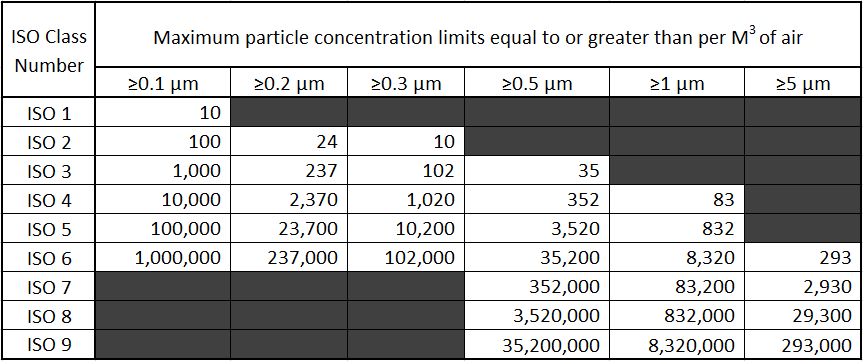
It should come as no surprise that equipment used in cleanrooms must comply to some demanding standards & specifications. To that end, ISO (The International Organization for Standardization) created ISO Standard 14644-1. It identifies nine Class Numbers, based on allowable particulate concentrations in a given volume of air. Here’s how it breaks those down:

Basically, the lower the Class Number, the cleaner the air. ISO 1 is often used in semiconductor manufacturing. Medical device manufacturers and pharmaceutical facilities typically specify ISO 5 & 7.

Equipment used inside a cleanroom must be designed, and operated, so as to not increase particulate concentration limits above these limits. You wouldn’t want to use steel tools that are prone to rust, or electric tools with carbon brushes in the motors, for example.

EXAIR’s Intellistat Ion Air Nozzle was designed with these considerations in mind. They were tested by a third part independent laboratory and are classified for use in ISO Class 5 (or below) cleanrooms. This has made them especially popular in pharmaceutical laboratory use, as well as:

  • A local eyeglass & camera lens manufacturer uses them to ensure precision measurement instruments’ readings aren’t affected by any residual static charge caused by the grinding process.
  • A company that makes overlays for medical devices (IV pump controllers, patient monitoring devices…pretty much anything with pushbuttons you might find in a hospital room or a doctor’s office exam room) uses them to maintain compliance with their customers’ standards.
  • A number of food production facilities around the country use them to remove static from processed foods, and packaging containers, during filling operations.
  • A manufacturer of packaging machinery includes them on filling machines servicing the food and pharmaceutical industries.
Order before March 31, 2025 and receive a FREE AC Sensor with any qualifying Static Eliminator purchase.

Whether they’re in a cleanroom or not, the compact design, ease of installation & operation, air use efficiency, and quiet operation make them ideal for a range of static elimination applications. If you’d like to find out more the Intellistat Ion Air Nozzle (or its handheld version, the Intellistat Ion Air Gun), give me a call.

Russ Bowman, CCASS

Application Engineer
Visit us on the Web
Follow me on Twitter
Like us on Facebook