EXAIR Products in the Semiconductor Industry

Manufacturers in semiconductor assembly and PCB production face strict cleanliness, throughput, and thermal-control requirements. EXAIRs compressed-air products, specifically our Air Knives and Vortex Tubes, and air amplifiers are proven, compact, and energy-efficient tools for precise blow-off, controlled cooling and heating for spot thermal conditioning and fume extraction. This Blog explains how EXAIR Super Air Knives and Vortex Tubes and Air Amplifiers address three common production needs: 

  1. Drying and particulate removal during lead frame processing with air knives. 
  1. Localized cooling/heating for functional PCB testing using Vortex Tubes. 
  1. Fume extraction during etching, cleaning and plating processes

I’ll cover technical fit, typical performance characteristics, and measurement/ROI considerations so engineers and plant managers can evaluate and implement these solutions. 

Intellistat Ion Air Nozzle in clean room, cleaning microchip parts before installation.

Super Air Knife and Success in the semiconductor lead frame manufacturing process.  

Typical use cases 

  • Removing rinse water or flux residues after cleaning 
  • Blowing off foreign matter, over spray, or machining debris prior to plating or die bonding. 
  • Drying prior to molding or coating operations. 
  • Static-assisted blow-off when combined with static eliminating product for electrostatically attracted particles. 

Why Super Air Knives? 

  • Uniform Laminar Sheet of air: delivers consistent, even blow-off across the width of a lead frame, reducing localized hot spots or mechanical damage. 
  • Adjustable force and flow: adjusting air pressure and shim size allow you to control force and volume so fragile wires or plated surfaces aren’t damaged. 
  • Entrainment & Efficiency: The knives are engineered so they entrain ambient air, increasing total developed flow and reducing compressed-air consumption compared to open pipes. 

Vortex Tubes for functional PCB testing / burn-in and thermal cycling

During in-line or bench functional testing, specific components or integrated circuits may overheat or require temperature conditioning to verify performance at the full range of the rated temperature specifications. Vortex Tubes give fast, localized cooling (or heating) without coolant loops, chillers, or plumbing intricacy. Subjecting devices to burn-in and thermal cycling stress helps products enter the field with confidence there will not be any preventable failures. Normally, environmental chambers are used for burn-in processes, but vortex tubes can help facilitate localized thermal ramps, corner stressing, or temporary additional cooling/heating when size, cost or availability of a full environmental chamber isn’t feasible.  

Why Vortex Tubes fit testing 

  • Instant cold/hot air from regular compressed air: no refrigeration system or refrigeration cycle; instantaneous on/off.  
  • No moving parts: high reliability and low maintenance for test fixtures. 
  • Local spot conditioning: focus cooling on integrated circuits or other small areas without cooling the entire board or fixture. 
  • Adjustable cold fraction: Vortex tubes can be tuned via the control valve to trade flow vs. temperature drop to meet testing conditions. 
Cooling or Heating with the Vortex Tube

Air Amplifiers for fume extraction and partial heat control during etching, cleaning and plating processes.

In semiconductor lead frame manufacturing, maintaining clean, particle-free environments is essential to ensure consistent product quality and process reliability. Processes such as flux cleaning, plating, molding, and soldering generate vapors, fumes, and fine particulates that can contaminate delicate components or compromise yields. EXAIR’s Super Air Amplifier provides an efficient, quiet, and maintenance-free solution for capturing and removing fumes, vapors, and airborne contaminants from sensitive production areas.

Why the Super Air Amplifier?
High-Volume Airflow Through Amplification

  • It uses a small amount of compressed air to entrain large volumes of ambient air multiplying total flow by up to 25 times.
  • Creates a strong, consistent vacuum draw ideal for capturing fumes and fine particulates at their source.

Energy Efficiency

  • Dramatically reduces compressed-air consumption compared to traditional vacuum or exhaust systems.
  • No electricity, motors, or moving parts, maintenance-free operation and long service life.

Compact and Versatile

  • Easy to integrate above process lines, in tool enclosures, or at conveyor transfer points.
  • Available in aluminum, stainless steel, and high-temperature materials for compatibility with cleanroom or chemical environments.
Model 120024 4″ Super Air Amplifiers are commonly used to exhaust smoke and fumes.

ROI and how to show value quantitatively  

  • Baseline metrics: scrap/rework rate, cycle time, compressed-air consumption, downtime for cleaning, and throughput. 
  • Pilot run: instrument a section of line with flow/force and temperature sensors for a 30 day trial. 
  • Key calculations: 
  • Reduced rework % × cost per part = direct savings. 
  • Throughput increase (parts/hr) × margin = additional revenue. 
  • Compressed-air energy reduction (compared to previous blow-offs) = kW savings (U.S. Department of Energy offers a benchmark of $0.25 per 1,000 SCF). 
  • Tangible benefits: throughput improvement, energy savings, reduced capital cost (vs. chillers/chambers), lower maintenance and smaller footprint. 

Conclusion  

EXAIR Super Air Knives, Vortex Tubes and air amplifiers are compact, reliable, and flexible products that can improve cleanliness, thermal testing, and throughput in semiconductor processes.  

  1. Select a process you think could be helped with an air knife, Vortex Tube or an air amplifier and take advantage of our 30-day money-back guarantee.  
  1. Validate throughput and quality improvements and calculate ROI. 
  1. Rollout with appropriate controls, filtration, and operator training.  

If you think any of our products can help you in your process, please reach out. We have a team of application engineers here M-F to answer your questions!

Jordan Shouse, CCASS

Application Engineer

Send me an email
Find us on the Web 

Static Elimination For Cleanrooms: The Intellistat Ion Air Nozzle

Cleanrooms (sometimes written as two words: “clean rooms”, and historically called “White Rooms” or “Dust-Free Rooms”) are engineered spaces where specialized equipment and procedures are used to maintain a very low concentration of contaminants. While certain levels of cleanliness are desirable for many processes, certain ones can be catastrophically affected by contamination. In the 1960’s, a physicist working for Sandia National Laboratories named Willis Whitfield pioneered the modern cleanroom. His designs focused on continuous filtration of the air inside. This was a real game changer for a number of industries like electronics, pharmaceuticals, semiconductors, and all kinds of scientific research facilities. They can be small – like a dedicated enclosure in a larger building or shop where one or two people perform benchtop testing, assembly, etc. They can also be enormous, like one of the earliest cleanrooms: a 70,000 square foot space at an RCA facility not far from here, in Cambridge, Ohio, where they made control equipment for some of the earliest intercontinental ballistic missiles in the U.S. military’s arsenal.

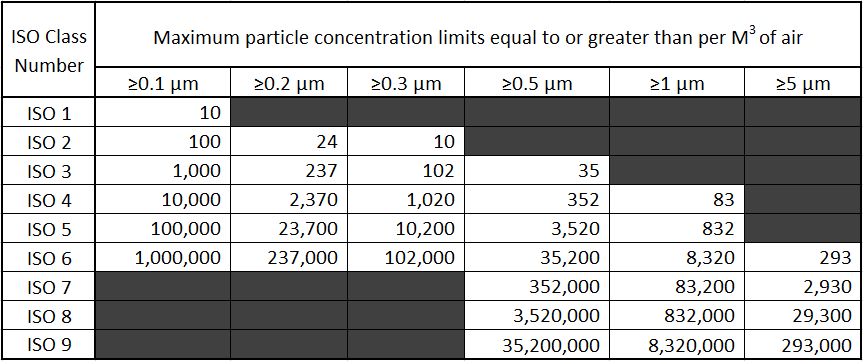
It should come as no surprise that equipment used in cleanrooms must comply to some demanding standards & specifications. To that end, ISO (The International Organization for Standardization) created ISO Standard 14644-1. It identifies nine Class Numbers, based on allowable particulate concentrations in a given volume of air. Here’s how it breaks those down:

Basically, the lower the Class Number, the cleaner the air. ISO 1 is often used in semiconductor manufacturing. Medical device manufacturers and pharmaceutical facilities typically specify ISO 5 & 7.

Equipment used inside a cleanroom must be designed, and operated, so as to not increase particulate concentration limits above these limits. You wouldn’t want to use steel tools that are prone to rust, or electric tools with carbon brushes in the motors, for example.

EXAIR’s Intellistat Ion Air Nozzle was designed with these considerations in mind. They were tested by a third part independent laboratory and are classified for use in ISO Class 5 (or below) cleanrooms. This has made them especially popular in pharmaceutical laboratory use, as well as:

  • A local eyeglass & camera lens manufacturer uses them to ensure precision measurement instruments’ readings aren’t affected by any residual static charge caused by the grinding process.
  • A company that makes overlays for medical devices (IV pump controllers, patient monitoring devices…pretty much anything with pushbuttons you might find in a hospital room or a doctor’s office exam room) uses them to maintain compliance with their customers’ standards.
  • A number of food production facilities around the country use them to remove static from processed foods, and packaging containers, during filling operations.
  • A manufacturer of packaging machinery includes them on filling machines servicing the food and pharmaceutical industries.
Order before March 31, 2025 and receive a FREE AC Sensor with any qualifying Static Eliminator purchase.

Whether they’re in a cleanroom or not, the compact design, ease of installation & operation, air use efficiency, and quiet operation make them ideal for a range of static elimination applications. If you’d like to find out more the Intellistat Ion Air Nozzle (or its handheld version, the Intellistat Ion Air Gun), give me a call.

Russ Bowman, CCASS

Application Engineer
Visit us on the Web
Follow me on Twitter
Like us on Facebook

Static Solutions for Clean Rooms and Controlled Environments

Clean rooms and controlled environments are a critical spaces for manufacturing, testing or scientific research under conditions which require less contamination from the environment. They have a low or controlled level of pollutants such as dust, other airborne particles, or chemicals. They may also limit specific materials from even entering the room. Many clean rooms work by providing a positive pressure inside the room and filtering the air entering the room. This positive pressure pushes contaminated air out of the room and the filters clean up any air moving into the room. Many controlled environments have specifications on humidity levels, maximum values for static charges, maximum values for the size of particles allowed in the air, temperature, and what materials are prohibited to enter.

With the patented and award winning Intellistat Ion Air Gun and the NEW patented Intellistat Ion Air Nozzle, we have the perfect solution for these scenarios. These are intelligent compressed air® products that create and utilize ionized air to eliminate static and remove troublesome particulates in clean rooms and controlled environments. Using a minimal amount of compressed air, and having a precise blow off pattern, each of these products can reduce static form 5000 volts, to less than 500 in under 1 second. These Intellistat products are balanced to minimize a static charge to +/- 30V, and can be used to eliminate static on some of the most sensitive electronics.

Both of these products are rated Class 5 for Clean Rooms and controlled environments per ISO 14644-1. They are also OSHA compliant for noise and dead end pressure. Other features of both products include a 6mm air connection, and a red and green LED light to signify the ionized air is being produced.

As you can see in the opposing pictures, the differences lay in the delivery system of the Ionized Air. The Intellistat Ion Air Gun offers a short throw, fast acting, and effortless trigger so that the end user can point and shoot the static away. The Intellistat Ion Air Nozzle comes with a compact Stainless Steel adjustable mounting bracket to provide hands free operation. An easy on and off switch on the top is activated and away goes the static.

Please let me know if you have questions, or would like to put these amazing tools to work in your Clean room or other application.

Thank you for stopping by,

Brian Wages

Application Engineer

EXAIR Corporation
Visit us on the Web
Follow me on Twitter

EXAIR Leads the Way with Product Standards

Standards seem to continually get introduced and updated. There is an ever increasing number of local, regional, federal, and even global standards to comply with.  We pay close attention to these standards and have the largest number of standards upon our products.

meets or exceeds oshaThe standards the every EXAIR product meets or exceeds are the OSHA standards for dead-end pressure as well as allowable noise level exposure.  The dead-end pressure directive is OSHA standard 29 CFR 1910.242 (b).  The standard refers to the fact that compressed air can be dangerous when the outlet pressure of a hole, hose or copper tube is higher than 30 psig (2 BAR).  In the event the opening is blocked by a hand or other body part, air may enter the bloodstream through the skin, resulting in a serious injury.  All of the compressed air products manufactured by EXAIR have been designed for safety.  All are safe to be supplied with higher pressure than 30 psig and still meet or exceed the OSHA standard.

The OSHA standard 29 CFR – 191.95 (a) refers to the maximum allowable noise exposure that an operator is permitted to be exposed to for a given period of time.   The chart of allowable exposure times is shown below.   All EXAIR products are engineered to create the minimum amount of noise while efficiently utilizing compressed air.   Many times blow offs are cross drilled to permit air to escape in order to meet the OSHA standard for dead end pressure, this process increases the noise level generated by that blow off considerably.

OSHA Noise Level

One of the most stringent compliance that EXAIR has upon its products is the UL/CUL listings and recognition.  All EXAIR Cabinet Cooler Systems are UL listed, we were the first to insure your electrical cabinet’s NEMA integrity remained by putting our Cabinet Cooler systems to the UL test. This means that the Underwriters Laboratories have deemed these products safe for operation throughout the US and Canada per their standards that are applicable for each of the product groups.   The products undergo numerous tests and scenarios to ensure that an operator will be safe during the normal operation of the units.   The tests for the Cabinet Cooler Systems includes environmental exposure for the given NEMA type of the enclosure along with many other tests.  The Static Eliminator Power Supplies are also UL listed.

cULlistedcULrecognized

CE is another standard which EXAIR pays great attention to to meet or exceed. CE is a standard that is normally preferred when dealing with countries outside of the US but is gaining popularity within the states as well.  CE being a European standard actually stands for a french phrase, “Confrmité Eurpéene” which is translated to “European Conformity”.  Any EXAIR product displaying the CE mark conforms where there are applicable directives.CE

The RoHS directive is targeted on heavy metals that are generally found within electronics.  Substances like Mercury, Lead, Polybrominated biphenyls, Cadmium, or Hexavalent chromium.  In order to meet the RoHs directive a product must have 100 parts per million or less of mercury and for other substances there must be less than 0.01% of the substance by weight in a raw homogeneous materials level. All EXAIR products which are electronic or contain electronic devices are compliant to the 2002/95/EC RoHS directive, also including the amendment outlined in the European Commission decision L 214/65.  This includes all EXAIR Static Eliminators, Electronic Flow Control, and Electronic Temperature Control products.ROHS_Vector

EXAIR maintains records to be sure our supply chain is providing product which meets the conflict mineral free guidelines of the Dodd-Frank Act.  EXAIR supports Section 1502 of the Dodd-Frank Wall Street Reform and Consumer Protection Act and we are committed to compliance with the conflict minerals rule in order to curb the illicit trade of tin, tantalum, tungsten and gold in the DRC region. EXAIR is using the CMRT 3.02 template to document our supply chain and commitment to conflict free products. When requested we will even provide the needed forms to support our customer’s efforts in complying with the Dodd-Frank Act.

conflictfree

REACH, is another European Community Regulation this time on chemicals and their safe use.  REACH is targeted to ensure personnel and environmental health by identifying the intrinsic properties of chemical substances easily.  REACH stands for Registration, Evaluation, Authorization and Restriction of Chemical substances and was written into law in 2007. EXAIR products are not required to be registered per Title II, Article 7, paragraph 1  of the legislation since they do not contain substances that are intentionally released.   This is to ensure compliance with Regulation (EC) No 1907/2006 Title I, Article 3, paragraph 3, the European Union requires registration of chemicals and substances imported into the EU to ensure a high level of protection of human health and environment.

Reach


To conclude, when there is a safety audit, safe sourcing directive or some other form of standard/conformance that you need to meet, consider EXAIR compressed air products. Please contact us to find out if we can help you meet or exceed those standards.

Brian Farno
Application Engineer Manager
BrianFarno@EXAIR.com
@EXAIR_BF