EXAIR Ion Air Gun in Photo Printing Industry

In the high-precision world of photo printing, even tiny specks of dust or static can ruin a perfect print. From professional labs to industrial photography printers, quality and consistency are everything. That’s where the EXAIR Ion Air Gun steps in, a tool that’s quietly revolutionizing how photo printers manage static charges, clean surfaces, and ensure flawless prints.

While it might be a “perfect” application for a Super Ion Air Knife, the Ion Air Gun works better if the product is stationary.

The Challenge: Static and Contamination in Photo Printing

Photo printing — whether inkjet, laser, or large-format — is highly sensitive to the environment. Two of the biggest issues that professionals face are:

Static electricity: As paper moves rapidly through printers, it can accumulate static. This attracts dust, causes paper jams, and leads to print defects.


Particulate contamination: Even microscopic dust or fiber can show up as marks, dots, or streaks on glossy prints.

Traditional air blowers or manual wiping often redistribute dust rather than removing it — and they do nothing to neutralize static charge.

The EXAIR Ion Air Gun is engineered to solve both static and contamination problems in one tool. Here’s how it stands out:

Active Static Neutralization

The gun emits a stream of positive and negative ions that neutralizes static charges on surfaces instantly. This helps:

  • Reduce paper jams
  • Prevent dust attraction
  • Improve media handling through print engines

By eliminating static, prints come out cleaner and production runs flow more smoothly.

Ionized Clean Air Blast

Instead of just pushing air around, the ion air gun combines ionization with a strong, focused airflow. This:

  • Removes dust and debris from paper or film
  • Prepares surfaces before printing
  • Cleans out nooks and crannies where particles hide

The result? Cleaner prints with fewer re-runs and less waste.

In the competitive world of photo printing, attention to detail defines success. The EXAIR Ion Air Gun offers a practical, effective solution to two persistent problems — static and contamination. Whether you’re running small-batch professional prints or large industrial photo runs, it can help ensure every print meets the highest standard.

Jordan Shouse, CCASS

Application Engineer / Sales Operations Engineer

Send me an email
Find us on the Web 

Press Release – New 230-Volt Varistat Benchtop Ionizer Removes Static at a Distance

EXAIR has decided to open up our product line for areas that do not have or wish not to use compressed air.  This award-winning EXAIR Varistat® Benchtop Ionizer is a powerful fan-driven static eliminator engineered to neutralize static charges on surfaces in demanding industrial environments. This Ionizer delivers a consistent stream of ionized airflow, effectively eliminating static and particulate without the need for compressed air. The Varistat is now available in 230 volts to meet the needs of industrial locations. Easily mounted on bench tops or machines, this static eliminator is manually adjustable and perfect for processes needing comprehensive coverage.

            The new 230-volt Varistat sets itself apart from other fan-driven static eliminators by offering highly adjustable features and allowing for versatility. Features like selectable voltage 115VAC/230VAC, variable fan speed, and adjustable polarity make the Varistat a complete solution for eliminating static in a variety of processes and facilities. Once plugged in, the Varistat provides rapid static decay capable of reducing 1000V to 100V in 0.8 seconds. This product features two replaceable ion emitter points and two 30 PPI foam filters to ensure optimal performance over extended periods, as well as LED lights to signify proper function.

            The Varistat is part of an extensive line of static eliminating products from EXAIR that are UL listed and CE compliant. Products like the Intellistat Ion Air Gun, the Gen4 Super Ion Air Knife, and the Gen4 Ionizing Bar, exhibit the wide range of static solutions offered and the ability to combat static in a variety of manufacturing processes.

For U.S. and Canadian customers, EXAIR offers a 30-day unconditional guarantee on our cataloged items to try.  You can see how effective the Varistat Benchtop Ionizer or any of our Static Eliminators can be.  If you need help in selecting the best product for your application, an Application Engineer will be happy to help you.  And for qualified orders until March 31st, 2025, you will receive a complimentary AC Sensor, a $76.00 value, for free. 

John Ball
Application Engineer
Email: johnball@exair.com
Twitter: @EXAIR_jb

Static Elimination For Cleanrooms: The Intellistat Ion Air Nozzle

Cleanrooms (sometimes written as two words: “clean rooms”, and historically called “White Rooms” or “Dust-Free Rooms”) are engineered spaces where specialized equipment and procedures are used to maintain a very low concentration of contaminants. While certain levels of cleanliness are desirable for many processes, certain ones can be catastrophically affected by contamination. In the 1960’s, a physicist working for Sandia National Laboratories named Willis Whitfield pioneered the modern cleanroom. His designs focused on continuous filtration of the air inside. This was a real game changer for a number of industries like electronics, pharmaceuticals, semiconductors, and all kinds of scientific research facilities. They can be small – like a dedicated enclosure in a larger building or shop where one or two people perform benchtop testing, assembly, etc. They can also be enormous, like one of the earliest cleanrooms: a 70,000 square foot space at an RCA facility not far from here, in Cambridge, Ohio, where they made control equipment for some of the earliest intercontinental ballistic missiles in the U.S. military’s arsenal.

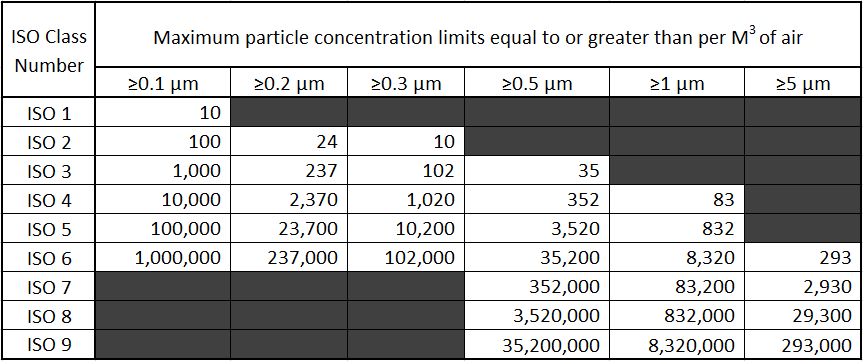
It should come as no surprise that equipment used in cleanrooms must comply to some demanding standards & specifications. To that end, ISO (The International Organization for Standardization) created ISO Standard 14644-1. It identifies nine Class Numbers, based on allowable particulate concentrations in a given volume of air. Here’s how it breaks those down:

Basically, the lower the Class Number, the cleaner the air. ISO 1 is often used in semiconductor manufacturing. Medical device manufacturers and pharmaceutical facilities typically specify ISO 5 & 7.

Equipment used inside a cleanroom must be designed, and operated, so as to not increase particulate concentration limits above these limits. You wouldn’t want to use steel tools that are prone to rust, or electric tools with carbon brushes in the motors, for example.

EXAIR’s Intellistat Ion Air Nozzle was designed with these considerations in mind. They were tested by a third part independent laboratory and are classified for use in ISO Class 5 (or below) cleanrooms. This has made them especially popular in pharmaceutical laboratory use, as well as:

  • A local eyeglass & camera lens manufacturer uses them to ensure precision measurement instruments’ readings aren’t affected by any residual static charge caused by the grinding process.
  • A company that makes overlays for medical devices (IV pump controllers, patient monitoring devices…pretty much anything with pushbuttons you might find in a hospital room or a doctor’s office exam room) uses them to maintain compliance with their customers’ standards.
  • A number of food production facilities around the country use them to remove static from processed foods, and packaging containers, during filling operations.
  • A manufacturer of packaging machinery includes them on filling machines servicing the food and pharmaceutical industries.
Order before March 31, 2025 and receive a FREE AC Sensor with any qualifying Static Eliminator purchase.

Whether they’re in a cleanroom or not, the compact design, ease of installation & operation, air use efficiency, and quiet operation make them ideal for a range of static elimination applications. If you’d like to find out more the Intellistat Ion Air Nozzle (or its handheld version, the Intellistat Ion Air Gun), give me a call.

Russ Bowman, CCASS

Application Engineer
Visit us on the Web
Follow me on Twitter
Like us on Facebook

ISO 14644-1 Cleanroom Designations

The number of clean room certificates is vast.  So, ISO narrowed this range to make a common standard, called ISO 14644.  This standard shows the maximum allowable particles per unit volume by micron size that can be permitted for certain industries.  This would include pharmaceuticals, semiconductors, quality control, laboratories, cosmetics, etc.  The chart for maximum particle concentrations is located in the sub-category, ISO 14644-1.  The classification is by number for easy reference.

A clean room recirculates the air inside the room and uses filters to remove the particles.  The filters can be made from either High Efficiency Particulate Air filter media, HEPA, or Ultra Low Penetration Air filter media, ULPA, depending on the quality required.  The lower the ISO number, the more cost involved in achieving such a status.  This will include entrance and exit requirements, clean room garments, and materials of construction.  Each class is divided into ISO numbers, ranging from 1 to 9. The class identifies the maximum limit for particulate size and quantity per cubic meter of air. The chart below showcases the size and the quantity breakdown.

The EXAIR IntelliStat® Air Guns and IntelliStat® Nozzles can be used in rooms that are ISO 5 and larger.  The IntelliStat product is designed for manual or hands-free operations to remove static and to clean surfaces.  It is a great product for quality checks, PCB manufacturing, cleaning glass lenses and medical devices without sacrificing the clean room requirements. 

EXAIR does have the capability to design and create specialized products as well to suit specific clean rooms. If you would like to discuss your production environment or blow-off application within a clean room, please contact an Application Engineer.    

John Ball
Application Engineer
Email: johnball@exair.com
Twitter: @EXAIR_jb