Filtration Efficiency and the Meaning of HEPA Filtration

To become more aware of our Heavy Duty HEPA Vac Systems, I am going to dive into the media and filtration efficiency.  The model 901357 HEPA filter has an efficiency level of 99.97% at 0.3 micron.  What does this mean?

In the simplest of terms, filtration is a method of separation.  With air filters, we are separating particles from air.  Particles, due to their mass and size, behave in certain ways as they pass through a fibrous media.  The three main methods for capturing particles are done by:

  1.  Inertial Impaction – Generally with particles over 2 microns in size.  Large particles that are captured because they cannot pass through the openings of the media.  An example, a fly being captured by a spider web. 
  2. Direct Interception – Generally with particles between 0.2 micron and 2 microns in size.  These medium-sized particles follow the air stream around filter fibers and openings.  Because of the tortuous path, the winding turns and the inertial mass of the particle causes it to contact a fiber and get captured.  An example, a sports car going too fast on a curvy road.  The momentum can push you off the edge of the road and into the trees.    
  3. Diffusion – Generally particles less than 0.2 micron in size.  Small particles with very little mass that are bounced around by the air molecules.  The smaller size and weight, the more movement the particle has.  This will increase the chance of hitting a fiber and getting captured.  An example, walking home drunk and being attacked by bees.  You will randomly run everywhere and end up in the neighbor’s bushes.
Diagram 1: Total filtration curve with individual mechanism by particle size

In Diagram 1 above, you notice how each filtration mechanism is used to capture the particles by size.  When you combine the efficiencies of each mechanism, you will get the total efficiency of a filter.  The particle sizes in Diagram 1 are limited above the vapor range.  This inverted “Bell” curve is a typical characteristic for fibrous filters.   If you look closely, you will notice that the MPPS, (Most Penetrating Particle Size) is between 0.2 and 0.3 micron.  That means that if you go larger than 0.3 micron or smaller than 0.2 micron, the filter is more efficient.  That is correct.  With the examples above, a particle in the range of 0.2 to 0.3 micron has enough mass to resist the “bounce” force from other molecules and is light enough to minimize inertia forces, allowing it to pass by and around the fibers of the filter.

Now let’s apply these variables to our HEPA filter.  With the 901357 HEPA media, the efficiency is 99.97% at 0.3 micron.  Knowing the characteristics of a filter, we can apply the inverted curve analysis like in Diagram 1.  As you can see in Diagram 2, the 901357 HEPA efficiency curve will show the efficiency of capturing particles at different sizes.   

Of course, there are different grades of filtration, and they are classified by ISO and European standards.  The chart above shows the different types and grades.  The EXAIR HEPA filter would fall into the H13 class.  HEPA stands for High Efficiency Particulate Air filter, and ULPA stands for Ultra Low Penetrating Air filter.  You can tell by the number of 9s after the decimal to determine the downstream cleanliness.  These standards use the MPPS to test the efficiency and qualify the filtration rating.  For any application that has very fine particles and/or requires very clean exhaust air, the Heavy Duty HEPA Vac System should be recommended. If you have any questions, you can contact an Application Engineer at EXAIR.

John Ball
Application Engineer
Email: johnball@exair.com
Twitter: @EXAIR_jb

Photo: Reference standard EN 1822 or ISO 29463

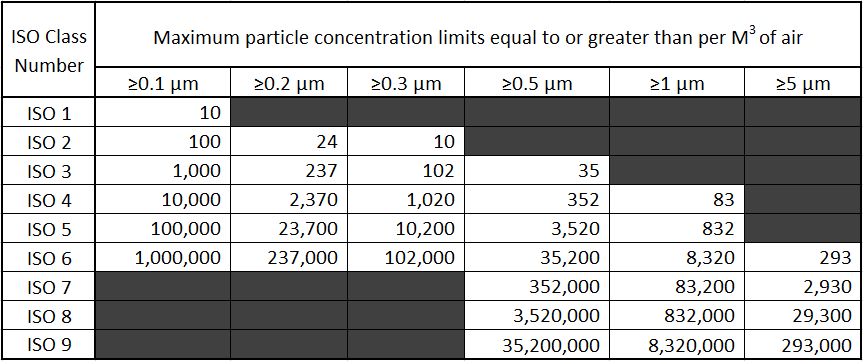
ISO 14644-1 Cleanroom Designations

The number of clean room certificates is vast.  So, ISO narrowed this range to make a common standard, called ISO 14644.  This standard shows the maximum allowable particles per unit volume by micron size that can be permitted for certain industries.  This would include pharmaceuticals, semiconductors, quality control, laboratories, cosmetics, etc.  The chart for maximum particle concentrations is located in the sub-category, ISO 14644-1.  The classification is by number for easy reference.

A clean room recirculates the air inside the room and uses filters to remove the particles.  The filters can be made from either High Efficiency Particulate Air filter media, HEPA, or Ultra Low Penetration Air filter media, ULPA, depending on the quality required.  The lower the ISO number, the more cost involved in achieving such a status.  This will include entrance and exit requirements, clean room garments, and materials of construction.  Each class is divided into ISO numbers, ranging from 1 to 9. The class identifies the maximum limit for particulate size and quantity per cubic meter of air. The chart below showcases the size and the quantity breakdown.

The EXAIR IntelliStat® Air Guns and IntelliStat® Nozzles can be used in rooms that are ISO 5 and larger.  The IntelliStat product is designed for manual or hands-free operations to remove static and to clean surfaces.  It is a great product for quality checks, PCB manufacturing, cleaning glass lenses and medical devices without sacrificing the clean room requirements. 

EXAIR does have the capability to design and create specialized products as well to suit specific clean rooms. If you would like to discuss your production environment or blow-off application within a clean room, please contact an Application Engineer.    

John Ball
Application Engineer
Email: johnball@exair.com
Twitter: @EXAIR_jb

Compressed Air Use in the Agriculture Industry

The history of agriculture is really the history of civilization. Once our ancestors moved from hunting & gathering to herding & planting, the concepts of villages and trade took off, and here we are, living in the suburbs, exchanging currency for goods at the local supermarket. The methods in which these goods (the food we eat) are processed have evolved from everything being done by hand, to the use of an impressive degree of modern technology. Some of that technology involves compressed air – hence the subject of this blog. Consider:

  • Gasoline or diesel driven air compressors can power tools and pumps in areas where electricity isn’t available.
  • Fertilizers and pesticides are oftentimes sprayed onto crops using products like EXAIR Air Atomizing Spray Nozzles, which generate an even, controllable spray pattern & flow rate, while making extremely small droplet sizes for maximum coverage.
  • Air Operated Conveyors like EXAIR Line Vacs are widely used to move grain, soil, fertilizer, etc., quickly & easily from storage bins or hoppers.
As a coffee lover, there’s not much I enjoy more than specifying a Line Vac for use with coffee, like the one above being used to convey green coffee beans. They’re used for roasted and ground beans too!
  • Blowoff products like EXAIR Super Air Knives are ideal for cleaning and drying produce carried on conveyor belts.
Super Air Knife drying fruits and vegetables

I had the pleasure of assisting a caller with the selection of a wet-dry vacuum for cleanup operations on a dairy farm. Since it was going to be used in an area subject to liquid spills, they wanted a non-electric solution to eliminate shock hazards from dragging an extension cord across a wet floor. They needed a HEPA filter for silica dust, and wanted the ability to quickly change operation from vacuuming up that dust, to cleaning up liquid (like fresh milk) spills.

EXAIR Model 6303 Premium HEPA EasySwitch Wet-Dry Vac System fit the bill perfectly for them. It’s compressed air operated (so no shock hazard), with more than enough vacuum power for wet or dry cleanup, and the ability to easily switch (as advertised) from wet to dry operation. Also, with no moving parts to wear out, it’ll run darn near indefinitely, maintenance free, when supplied with clean compressed air.

For critical dust containment, the HEPA EasySwitch Wet-Dry Vac System is your durable, reliable, compressed air operated solution!

If you would like to read more about the kinds of applications in which our products help customers solve interesting application problems, please visit our Application Database under “Resources” on the website – (registration required, but it’s free & fast). This resource has details of the successful use of EXAIR products across dozens of industries – Agriculture included. In fact, it’s near the top of the list (to be fair, it’s alphabetical). If you’d like to find out more about how EXAIR Intelligent Compressed Air Products can be used to your benefit, give me a call.

Russ Bowman, CCASS

Application Engineer
Visit us on the Web
Follow me on Twitter
Like us on Facebook

EXAIR Heavy Duty HEPA Vac Overview

There’s still time left to take advantage of EXAIR’s Industrial Housekeeping Promotion, now through the end of May order any of EXAIR’s Industrial Housekeeping Systems and receive a free Vac-u-Gun! At EXAIR, we have a variety of different systems designed to provide you with a maintenance-free solution for cleaning up messes throughout your plant. We offer systems for liquids, solids, and even one that can handle both. All of which will provide many years of useful life; something you cannot claim for the typical electrical vacs you may be all too familiar with replacing. For any of these applications involving fairly dusty materials, look no further than EXAIR’s Heavy Duty HEPA Vac.

Electrically powered vacuums or shop vacs are not designed to be operated in a rugged industrial environment. Filters clog, motors wear out, and you find yourself frequently replacing them. The GIF below demonstrates how many of these failures occur, leaving you without a solution until it’s been replaced.

EXAIR’s Heavy Duty HEPA Vac has NO moving parts to wear out, doesn’t require maintenance, and needs nothing but a source of compressed air to operate. A static resistant hose also prevents painful shocks that can be common when working with dry, dusty materials.

The vacuum generator is constructed of a hardened steel alloy designed to be resistant to abrasion. The lever lock drum lid fits any open-top 30, 55, or 110 gallon drum. Moving the system from one drum to another can be done quickly, allowing customers to keep different materials separate for recycling. Recycling companies will pay a premium for pre-sorted materials so this can be touted as another selling point of this system. It can be used with any open head steel, fiber, or plastic drum in good condition (ANSI Standard #MH2-2004). Complete premium systems with the drum and dolly are also included for customers who do not have a usable drum already. All of EXAIR’s filters are 100% tested in strict accordance to IEST-RP-CC-007 for a minimum 99.97% filtration down to .3 microns to meet HEPA standards.

An optional add-on, the Model 901373 filter protector, can help to reduce the time between cleaning out the HEPA filter itself as well as provide protection against wear. When looking to get the absolute most out of any of your HEPA rated filters, this filter protector is a must. It slides right over-top of the HEPA filter and pre-filter and is secured with a simple drawstring that holds it in place. The filter protector is an inexpensive tool that should be kept in the tool crib for periodical replacements.

EXAIR also offers a HEPA rated filter with our newest EasySwitch Wet/Dry Vac. It doesn’t matter what type of spills and messes you’re trying to clean up throughout your facility. At EXAIR, we have a Vac that’s Built to Last and ready for the task! Most importantly, make sure to get those orders in ASAP to take advantage of the free Vac-u-Gun with purchase!!

Tyler Daniel, CCASS

Application Engineer

E-mail: TylerDaniel@EXAIR.com

Twitter: @EXAIR_TD