

Safety should always be a serious concern within industrial environments. Walk through any production facility and you should see all kinds of steps taken to give a safe workplace to the operators, contractors, and other team members. Whether this is through a sign showing PPE required to enter an area, an emergency exit sign, a safe walkway, or machine guards. Safety has become a standard that should never be lowered and there is good reason for that.
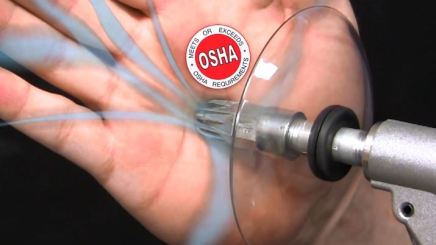
EXAIR designs all of our products to be safe and they meet or exceed OSHA standards that are directed toward compressed air safety. The first is to ensure that an operator or maintenance worker will not be injured through air impinging their skin should they come into contact with an EXAIR product. This OSHA standard is 29 CFR1910.242(b) claiming that all point of use compressed air products must be regulated to have less than 30 psig of dead end pressure. This directive is critical for worker safety and the way many blowoffs skirt by is to cross drill holes in the end of the blowoff.
Cross drilled holes may satisfy the dead end pressure standard but it does not address OSHA’s next important compressed air standard about noise exposure, OSHA standard 29CFR1910.95(a). The allowable noise level standard combined with 30 psig dead end pressure will render many home made or retail nozzles near useless because few, if any, meet both standards. Again, EXAIR has engineered and designed our Super Air Nozzles to permit 80 psig inlet pressure and still meet or exceed both of these OSHA standards so that the work can still be done by the operators while remaining safe and retaining their hearing.
For a better explanation and demonstration of how our nozzles meet these standards please see the video below.
While I use nozzles and cross drilled pipes as examples within this blog these safety features are designed into every product that EXAIR offers. This is due to the fact that OSHA, NIOSH, and the CDC do not delineate between a blow gun, blow off within a machine, or even a Cabinet Cooler System. If the device is powered by compressed air then the two key OSHA standard are in effect due to the inherit dangers of compressed air.
I encourage you now to walk through your facility and try to listen or spot compressed air points of use within your facility. Then, I ask you to call, chat, e-mail, or tweet an Application Engineer here at EXAIR and let us help you determine the most efficient and safest product to get the work done.
Brian Farno
Application Engineer
BrianFarno@EXAIR.com
@EXAIR_BF




 Section 1502 of the Dodd-Frank Wall Street Reform and Consumer protection Act, EXAIR complies with the conflict minerals rule to curb illicit trade of tin, tantalum, tungsten and gold in the DRC region. Using the CMRT 4.20 template, we’re able to document our supply chain to ensure our materials are not being sourced from places that could finance conflict in the DRC and surrounding countries.
 Finally, per Regulation (EC) No 1907/2006 Title I, Article 3, paragraph 3, the European Union enacted legislation requiring substances and chemicals imported into the EU to be registered to ensure a high level of protection for human health and the environment. Per Title II, Article 7, paragraph 1, articles must be registered when a substance is intended to be released during normal conditions of use that would exceed 1 metric ton per producer per year. Since EXAIR products do not contain substances that are intentionally released, registration is not required.


