
What Do Air Amplifiers Amplify, and Why Is It Important?

The word “amplifier” can mean some very different things, depending on the context in which it’s used. A musician may plug an instrument into an amplifier to increase the sound power being put out by said instrument. Folks who work with electronic or electrical systems use devices to amplify voltage (at the cost of current) or current (at the cost of voltage.)

In pneumatics and fluid power, there are even two very different devices called an ‘air amplifier.’ One is made to amplify the downstream pressure by using air flow and are commonly known as pressure boosters (we don’t have those), and the other amplifies the flow, proportionally to the supply pressure (THOSE are ours).

EXAIR Air Amplifiers use a small amount of compressed air to create a tremendous amount of air flow.

So that, dear reader, handles the question of what they amplify – now let’s cover why it’s important:

  • Lower cost of operation: Like the picture above says, Air Amplifiers use a small amount of compressed air, but make a tremendous amount of total developed air flow. This is a feature of our entire line of air blowing products – they’re ALL designed to consume as little compressed air as possible, and develop as much flow as possible. The less you use, the less it costs to operate…use the calculator on our website if you want to find out how much you can save.
  • Sound reduction: The discharge of compressed air into the open creates a LOT of noise, but the air entrained by our Air Amplifiers (and Air Knives & Air Nozzles) creates a low velocity boundary layer around the primary high velocity, laminar air flow. This boundary layer serves as an insulating shield, of sorts, and it results in dramatically quieter operation.
  • High ventilation rate: Because they entrain so much air from the surrounding environment, they can be used for rapid removal of fumes, smoke, airborne dust, etc. from spaces. And they’re going to do it quicker than standard Venturi or ejector devices.
Model 120024 4″ Super Air Amplifiers are commonly used to exhaust welding smoke and fumes.

That’s it for the “what they do” and “why it’s important” – if you’d like to find out how valuable an Air Amplifier can be, give me a call.

Russ Bowman, CCASS

Application Engineer
Visit us on the Web
Follow me on Twitter
Like us on Facebook

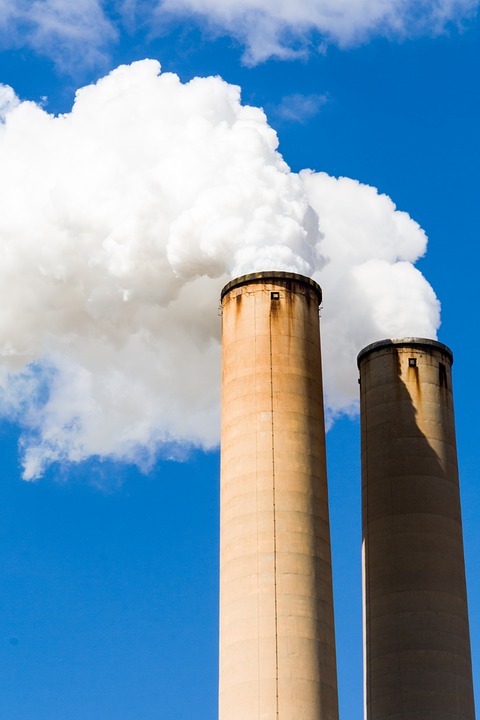
Interesting Compressed Air Application:  Cooling a Smokestack with Air Amplifiers

In some cities when you look along the skyline, you see flue stacks bellowing out plumes of white smoke.  I never paid much attention to the structure except that they were tall and in some cases very wide.  A power company contacted EXAIR about their flue stacks.  They did a temperature reading, and they found a hotspot within the wall of the stack.  To cool the hotspot, they contacted EXAIR for a solution. 

Smokestacks are large chimneys that can be from 825 feet (250m) to 1,188 feet (360m) tall and are designed to release the smoke high in the air.  As a tall structure, it is important to keep the walls stable and sound.  For this customer, they were getting a hotspot reaching a temperature of 750oF (400oC).  This was too hot, and it could cause premature issues to the construction of the stack.  They wanted to reduce the temperature to 400oF (204oC) to keep the stack from warping and degrading.  We were able to find a solution using our stainless steel Adjustable Air Amplifiers

Adjustable Air Amplifier

The area of the hotspot in their smokestack was a section around 2 feet (0.6m).  The customer fabricated a stainless-steel manifold to mount three pieces of model 6033 3” 303SS Adjustable Air Amplifiers.  The model 6033 will only use 35.2 SCFM (997 SLPM) of compressed air at 80 PSIG (5.5 bar).  With the high amplification ratio, the model 6033 can move 2,323 SCFM (65,780 SLPM) of air along the surface.  The large volume of air created good cooling capacities to reduce the hotspot temperature.  In keeping the temperature of the stack under control, they could continue operations and lessen the concern for untimely shut-downs and costly maintenance. 

By using air to cool, you can do it safely and cleanly.  Unlike fans which create turbulent flows, voids, and high noise levels, the EXAIR Air Amplifiers generates a large volume of laminar air to cool and clean.  If you would like to speak about any cooling application, you can contact an Application Engineer; even something as large as a smokestack. 

John Ball
Application Engineer
Email: johnball@exair.com
Twitter: @EXAIR_jb

Photo:  Smokestack by cwiznerPixabay Licence