EXAIR Provides Blow Off And Static Solution Within Tea Machine

I mentioned in one of my last blogs about how having a camera phone can come in handy when discussing applications.  If there is anything unclear about a description, a quick photo and email can clear things up.

Thankfully, a potential end-user of EXAIR products was proactive and took the liberty to send the video above and the photos below along with a description of their problem.

Capture
Tea bagging machine
Capture3
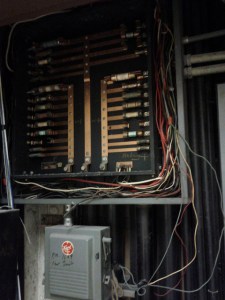
Internal components of the machine
Capture4
Internal components. Note the existing vacuum hose.
Capture5
Another image of the machine internals.

This is a tea bag making and filling machine.  Inside of the machine, as the tea bags are made and filled with tea, a small amount of dust is created with each bag.  Over time, this dust becomes substantial and collects, and must be removed to prevent disruptions in quality and processing.

The difficulty for this end user, in addition to needing to vacuum the material with something that could withstand this high dust concentration, was that the dust adhered to the machine components due to a static charge.

Capture2
Tea dust statically adhered to the machine
Capture1
Statically charged tea dust

With the strong static attraction in place, only vacuuming the material could not remove the fine dust sticking to the machine parts.  What they needed was a way to neutralize the static charge so that the dust could be released from the machine components.

We recommended a two-tiered approach.  During one portion of the solution, an Ion Air Jet would provide ionized (static eliminating) air onto a deliberate area while an operator used a Heavy Duty HEPA Vac to vacuum the dust from the same location.  We were, in effect, freeing the dust from the static cling and immediately vacuuming it away.

This was great, except the solution needed to function during machine operation, which meant having an operator standing by was not an option.  So, we had to go back to the drawing board.

In re-examining the application, we noted the existing vacuum lines in place, and considered a way to add addition vacuum.  What we determined was that a pair of Line Vacs could remove the tea dust, but we had to ionize the air in the the chamber in order to remove the static.

The problem with a more permanent installation to remove the static is that the dust present within the machine could pose a problem for the longevity of an ionizer.  Our only option would be to generate the ionized air externally and feed it into the machine, though such an arrangement is not highly desirable because when ducting an ionized airflow, the static eliminating ability of the air is reduced.

This meant that we needed a one-way entrance for the ionized air which did not induce turbulence and deteriorate the static eliminating abilities of the solution.  We came to a proposal to use a 12” Super Ion Air Knife mounted at the top of the machine used in conjunction with an actuated door approximately 12” x 2”.

With everything controlled via the same ladder rung in a PLC, the door actuator and compressed air supply to the Super Ion Air Knife and Line Vacs will engage simultaneously.  The door will open, the knife will blow ionized air, and the Line Vacs will provide additional vacuum for the airborne tea dust.  The vacuumed tea dust will be fed into the existing dust collection system.

The solution is currently being presented to the key stakeholders involved with this application.  If any questions arise, we will be here to help provide any answers we can.  If you have a similarly unique application and need a solution, or just need to brainstorm, contact an EXAIR Application Engineer.

Lee Evans
Application Engineer
LeeEvans@EXAIR.com
@EXAIR_LE

One Assembly Line, Two Problems, Two Solutions

One of the great benefits of technology is the ease with which we can take and share photos or videos.  A domestic engineering firm contacted me earlier this month in search of a suitable cooling method with their application.  They provided excellent details about the application, but there were still a few discrepancies between what was described, and what I thought was being described.

So, I asked for a photo, and thanks to the ubiquity of camera phones, I received the image below.

CAM00272
Soldered connection of harness which needed to be cooled

In this application a soldering process is performed at pin connections of an electrical harness.  The harness is then inserted into a plastic housing, and the heat remaining within the soldered joint was posing problems for the next step in production of an electronic module.  So, the end user, and the engineering firm, ultimately needed a suitable way to remove the heat from the soldering process.

And, in addition to this problem, the soldered assemblies were experiencing defects due to static as they were fed down the conveyor line shown below.

CAM00268
Module exit point onto conveyor
CAM00270
End of the conveyor. When the modules would reach the end of the conveyor, they would be statically charged.

While we knew the heat from the soldering process needed to be removed, we were not 100% certain as to how much cooling (exactly) was needed.  So, we opted to use the model 3930 EXAIR Cooling Kit which includes a medium sized Vortex Tube and all related generators to configure up to 10 different Vortex Tube models.  With this kit we were certain that a suitable cooling capacity could be reached with the minimum amount of compressed air.

To remedy the static problem, an 18” Super Ion Air Knife was installed over the width of the conveyor.  The Super Ion Air Knife was mounted with the exhausting airflow at a low, 30° angle of attack, opposite the direction of module travel.  By blowing ionized air over the full width of the conveyor, the static was removed, thereby removing the process disturbance and solving the static problem.

What started as a simple email compounded into multiple applications with problems that were all solved using EXAIR products.  If you have a similar application, whether for cooling, cleaning, static removal, conveying, or material coating, contact an EXAIR Application Engineer.

Lee Evans
Application Engineer
LeeEvans@EXAIR.com
@EXAIR_LE

When the Frost is on the Pumpkin

11199821025_0b1f23a2c5_z
Frost on the pumpkin

There is an interesting poem by American writer and poet, James Whitcomb Riley that paints a great picture of what fall feels and looks like on the farm. Following is just the first paragraph of his poem but it conveys his message with such elegance:

When the frost is on the punkin and the fodder’s in the shock,
And you hear the kyouck and gobble of the struttin’ turkey-cock.
And the clackin’ of the guineys, and the cluckin’ of the hens,
And the rooster’s hallylooyer as he tiptoes on the fence;

O, It’s then’s the times a feller is a-feelin’ at his best,
With the risin’ sun to greet him from a night of peaceful rest,
As he leaves the house, bareheaded, and goes out to feed the stock,
When the frost is on the punkin and the fodder’s in the shock.

In Cincinnati, they are predicting frost on the pumpkin this week. That’s a sure sign that colder temps are coming and with the colder climate returning, so does our old friend static electricity. And with static comes all the production problems that are associated with it. Static electricity will discharge to operators which makes them quite un-comfortable and can be dangerous. Discharges to sensors and computers cause malfunction. Jamming of feed mechanisms is never fun and neither is a label machine that refuses to cooperate.

So, if you are in the Northern Hemisphere like we are, get ready for the cold weather and the low humidity by placing EXAIR Static Eliminators into your processes.

The Ion Air Gun is a great all around performer for applications that require a hand manipulation to get the job done.

The Super Ion Air Knife is better for applications that need a wide area to be static free from a mountable solution.

The Ion Air Cannon is a wonderful, utility static eliminator that has great flexibility to be mounted in any position.

The Super Ion Air Wipe is a great way to eliminate static on the outside surfaces of any hose, wire or cable before ink jet printing such as date codes.

The Ionizing Point is a great way to eliminate static build up within airflows moving through duct work, conveyors and similar closed systems with air movement.

If you want your fall and winter to be as pleasant as the description in Mr. Riley’s poem, consider EXAIR Static Eliminators. You won’t be disappointed.

Neal Raker, International Sales Manager
nealraker@exair.com
EXAIR_NR


Frost on Pumpkin photo courtesy of Samantha Forsberg
Creative Commons license

Super Ion Air Knife Removes Static Charge On Epoxy Coated Electrical Busbar

This past week I had a local customer visit our facility looking to test the effectiveness of our Super Ion Air Knife on their 6″ wide x 10′ long epoxy coated, copper bus bar. A bus bar is a metal strip or bar (typically copper) that is used to conduct electricity for high voltage equipment in lieu of traditional wiring. With this particular customer they were applying a protective epoxy coating to the strip then used a high voltage tester with a metal brush to check the epoxy for any exposed copper.

They would put an electrical charge on to the brush and rub it across the epoxy. If any charge from the brush is able to reach the grounded copper, the test brush shuts down immediately due to the detection of an electrical path through a defect in the epoxy.  The problem they came to EXAIR to solve was related to the static charge built up on the epoxy from rubbing the test brush on it. This static charge was shocking the personnel responsible for grabbing and removing the bus bars from the test area, so they called and visited EXAIR for assistance.

busbar
Example of smaller scale bus bar used in an electrical panel.

The customer brought (2) 5′ lengths samples of the strip and a portable test machine to run the test at our facility. After they rubbed the brush across the the strip and created a static charge, our Digital Static Meter  detected anywhere from 6500V to 15,000V at different points on the epoxy coating. We tested our 6″ Super Ion Air Knife, operating at 60 PSIG at a distance of about 40″ away and were able to lower the reading to around 1400 V in a matter of seconds. While this was acceptable to the customer, they mentioned they had additional time available in the process for removing static. Keeping this in mind we decided to keep the same operating parameters but would treat the sample for 1 minute. The additional treatment time was able to lower the voltage on the epoxy to around 200V.  Pleased with this result, the customer placed an order for (2) 60″ Super Ion Air Knives to cover the length of the 10′ strip.

Super Ion Air Knife
Super Ion Air Knife provides a laminar sheet of ionized airflow across the entire length of the knife. Available in lengths from 3″ up to 108″.

To discuss how we might be able to assist with your static electricity issue(s), give us a call, we’d be glad to help.

Justin Nicholl
Application Engineer
justinnicholl@exair.com
@EXAIR_JN


Busbars image courtesy of Schezar via Creative Commons License.