Gen4 Ion Air Cannon Explained

When larger areas need to be covered with an ionized air stream and the surfaces needing to be covered are not flat, then an array of Gen4 Ion Air Cannons can often be the solution. This is something that the automotive industry as well as many others have been using since before I have been a part of the EXAIR team. So just how does the Gen4 Ion Air Cannon achieve this?

At its core, the Gen4 IAC is designed around a 2″ Super Air Amplifier, and then we add ionization and a stand. The largest benefit to this is the ability of the Super Air Amplifier to entrain large volumes of free ambient air while using small amounts of compressed air. By entraining large volumes of free ambient air and then directing it down through the throat of the IAC and ionizing it upon exit of the barrel, we maximize the potential to eliminate static on the target surfaces and provide a good blowoff at the same time. To give a visualization of the performance, check out the video below.

When adding ionization to this airstream, complex shapes can easily have static elimination as they are being conveyed. Take an automotive body for example, as it travels down the assembly line, before paint or primer, they get blown off to ensure any debris from the facility is removed before they are coated. An array of Ion Air Cannons can be installed at a distance from the surface to fit multiple vehicle models and still target the entire surface needed.

Three Gen4 Ion Air Cannons are used to blow off the debris and remove unwanted static charge from a primer vehicle body before painting.

By arranging the blow-offs to utilize the large volume of ambient air entrained and direct the airflow at an angle in which once it hits the surface, it expands in the direction needed to remove the debris it is easy to cover irregular shapes. The setup shown above will utilize 15.5 SCFM per IAC when operated at 80 psig and give a forceful blast to remove any debris on the surface; the total consumption would be 45.5 SCFM at 80 psig to remove all debris from the top surfaces of this vehicle body before it goes into the final paint area. A centrally located 4 port Gen4 Power Supply, model 7961, can simplify cabling and installation while powering all three Ion Air Cannons. To optimize compressed air usage, an Electronic Flow Control can easily be installed to shut the air off whenever a car is not present; adding something like this ionized blowoff station to existing equipment is easier.

If you would like to discuss what the Gen4 Ion Air Cannon kit or any of our point-of-use engineered compressed air products can do for you in your facility, please contact an Application Engineer today.

Brian Farno
Application Engineer
BrianFarno@EXAIR.com
@EXAIR_BF

Top Ten Reasons Why EXAIR’s Super Air Knife Is So Super

1. Efficiency – With an air entrainment ratio of 40:1 (literally means it pulls in 40 SCFM of “free” air from the surrounding environment for every 1 SCFM of consumption), compressed air consumption is dramatically lower than any other blow off device.

EXAIR Intelligent Compressed Air Products such as (left to right) the Air Wipe, Super Air Knife, Super Air Nozzle, and Air Amplifier are engineered to entrain enormous amounts of air from the surrounding environment.

2. Laminar air flow – My colleague John Ball did a bang-up job in a video blog explaining the fluid mechanics theory behind this. Operationally, laminar flow is is beneficial because it’s particularly conducive to generating a stripping or sweeping action, as opposed to the turbulent flow from an open blow off, a blower, or a fan.

3. Quiet operation – The high entrainment ratio that makes the Super Air Knife so efficient also makes for amazingly low sound levels. The outermost entrained air creates a boundary layer that attenuates the sound level of the higher velocity, hard hitting center flow.

4. Lengths available – Super Air Knives are stocked in lengths from 3″ to 9ft. Custom lengths can be made if you’re space-limited for installation, and custom shims can be installed if you want to shorten the curtain width of a stock Super Air Knife. Super Air Knives can also be coupled together for even longer lengths.

Air Knife Coupling Bracket Kits are available from stock for Aluminum, 303SS, and 316SS Super Air Knives.

5. Material of construction – No matter how aggressive the environment is, odds are, EXAIR has a Super Air Knife that’ll hold up to it. Durable aluminum models are good to 180°F (82°C). There are also two Types of Stainless Steel to choose from: 303SS for high strength, and 316SS for protection from chloride pitting corrosion & higher strength. Both 303SS & 316SS are good to 800°F (427°C). For exceptionally harsh environments, PVDF (Polyvinylidene Fluoride) constructed Super Air Knives have Hastelloy C-276 hardware & PTFE shims, which are resistant to UV light, inorganic chemicals, solvents, ozone, weather, fungi, chlorinated hydrocarbons, highly corrosive acids, weak bases, and salts. They’re good to 275°F (135°C).

6. Easy installation – Like all of our products, the Super Air Knives – from the 3″ to the 9ft models – are “user friendly” as far as mounting & installation goes. The Model 9060 Universal Air Knife Mounting System makes for quick installation and easy positioning. 24″ to 42″ Super Air Knives need to be plumbed to both ends…if you hard pipe the air supply, the Super Air Knife itself will essentially be as well supported as the piping. The same holds true for longer Super Air Knives with Plumbing Kits installed. 3″ Super Air Knives can even be fitted with Stay Set Hoses, and Magnetic Bases. And the 1/4″-20 tapped holes on the bottom of the body allow for a wide range of mounting solutions…anything you can put a bolt through, really.

The 9060 Universal Air Knife Mounting Systems are perfect for simple, fast installation and positioning.
Yes, that’s a door hinge. No, it wasn’t my idea ( but I kind of wish it was.)

7. Low maintenance – With no moving parts, they’ll run darn near indefinitely, maintenance free, as long as you supply them with clean, moisture free compressed air. Oh, and keep them clean, externally, if they’re in an area where environmental contaminants can build up on the precision finished surfaces that are essential to their air entrainment.

8. Reliability – Hand in hand with #7, no moving parts also means there’s not much that can stop them from working. They can operate continuously, if needed, or you can cycle them on & off as frequently as necessary to keep from using valuable compressed air, except when needed.

EXAIR’s award winning EFC Electronic Flow Control can be set to operate a Super Air Knife (or any of our Intelligent Compressed Air Products) in cycles as low as 0.1 seconds.

9. Static Eliminator option -The laminar, high velocity air flow is ideal for many blow off applications, but if static charge is a problem, an Ionizing Bar can be installed, turning the Super Air Knife into a Super Ion Air Knife:

10. Free stuff – OK; this last one is “super” for a limited time. Order a Super Air Knife between 11/1/22 and 12/31/2022, and get a FREE Safety Air Gun. Click here for details.

If you’d like to find out how the Super Air Knife – or any of our Intelligent Compressed Air Products can help you get the most out of your compressed air system, give me a call.

Russ Bowman, CCASS

Application Engineer
EXAIR Corporation
Visit us on the Web
Follow me on Twitter
Like us on Facebook

Clean Room Certification – ISO 14644

The number of clean room certifications are vast and vary tremendously. ISO 14644 is the most used standard when looking at electronics and pharma manufacturing controlled environments. With this popularity, it has also undergone revisions within the past five years.

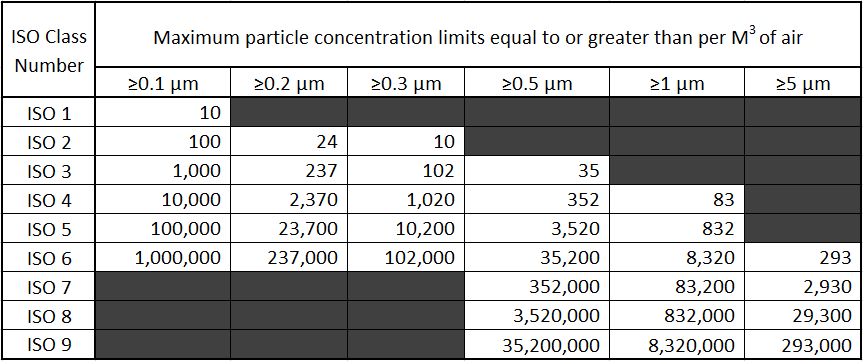
No matter the standard, each is divided into classes. The classes are rated from 1 to 9. The class identifies the maximum limit for particulate size and quantity per cubic meter of air. The chart below showcases the size and the quantity breakdown.

Cleanroom Classification Allowable Maximums.

ISO 9 as you can see is the loosest standard. This standard is equivalent to air quality within a city environment. These environments can fit a multitude of manufacturing and are some of the easiest to achieve and abide by. The opposite end of the spectrum, ISO 1 is the strictest and hardest to maintain. There are three main factors when designing for a clean room. These are surfaces, airflow, and employee access.

When selecting surfaces that will be within the environment it is best to choose a surface that will hold up to the level of use as well as not be damaged by the cleaners or solvents being used to ensure the surface is clean. This should carry over into part fixturing and even machine materials of construction as well. This is not always easy and should be a design element to the process and environment.

Airflow within the room is what helps maintain the concentration levels of particulates. Generally, a clean room is positively pressurized to where the pressure within the room is higher than that outside of the room. This results in a positive air exchange, generally this is provided by the HVAC system. Having a system that does not recirculate the air from inside of the room and a substantial filtration system is key. Another type of airflow that can be found within these environments is a blowoff operation for the part or process. When installing a blowoff within a clean room environment it should be confirmed that the materials of construction are compatible with the environment and cleaning processes and that the airflow will not be introducing particulate into the environment which can result in contamination.

Lastly, employee access should be limited to those employees who are trained and necessary to be within the environment. Sometimes if an employee wears the wrong type of deodorant it can effect an entire environment. Even the wrong type of clothing or soap can alter the state of an environment, let alone using a blowoff incorrectly or bringing the incorrect cleaner inside the cleanroom. Access to these areas should be limited and individuals should be well trained to meet the demands of the clean room.

If you would like to discuss your production environment or blowoff application within a clean room, please contact us.

Brian Farno
Application Engineer
BrianFarno@EXAIR.com
@EXAIR_BF

What’s So Super About EXAIR’s Super Air Wipe?

When you’re blowing something off with compressed air, one of the first things you want to consider is the size, and shape, of the air flow that’s going to be needed to get the job done. If you’re blowing off individual small parts, we’ve got a variety of Super Air Nozzles that will do the job quietly and efficiently. If it’s a flat plate, sheet, or film, the laminar flow from a Super Air Knife is particularly conducive to creating a stripping/sweeping flow of air, ideal from blowing moisture or debris from flat surfaces.

Let’s say you need to blow off an object from all sides…like a length of hose, tube or pipe, or even an extruded shape. You could position an array of Air Nozzles, Air Knives, or Air Amplifiers around it (there ARE times when that makes sense, but that’s a subject for another day)…or, you could pass it through an Air Wipe.

EXAIR Air Wipe products come in a range of sizes – 3/8″ to 11″ – all of which have a split design, which unlatches easily to eliminate the hassle of having to thread the product through them. Air Wipes up to the 4″ size come with a hose assembly that connects the two halves, so you just need to run one air line to them. If you want to make gross adjustments to the flow & force generated, we offer additional shims, which are easily installed to put the Air Wipe into a whole new range of performance.

These also come in two types: Super, and Standard, Air Wipes. Size for size, performance & dimensions are identical. The difference is all about the materials of construction and temperature ratings. Which one we specify will largely come down to the nature of the environment in which they’ll be installed. In the absence of high heat, or corrosive elements in the environment, the Standard Air Wipe is my recommendation all day, every day. If you need something that’ll stand up to a bit more aggressive conditions, the Super Air Wipes are certainly worth a look.

Additionally, the Super Air Wipes can be fitted with emitter points for static elimination…we call those Super Ion Air Wipes, and they come in 2″ and 4″ sizes.

360° blow off AND fast, efficient static dissipation: EXAIR Super Ion Air Wipe.

EXAIR Intelligent Compressed Air Products are the best choice for quiet, safe, and efficient use of your compressed air. If you’ve got a blow off application you’d like to discuss, give me a call.

Russ Bowman, CCASS

Application Engineer
EXAIR Corporation
Visit us on the Web
Follow me on Twitter
Like us on Facebook