
Application Assistance & Application Database

EXAIR Products are used in countless applications across all facets of industry, we have been working to compile some in an easy to read Application Database on EXAIR.com!

Why do we have this database? Well that is simple, we are talking to people every day about applications and how our products can be the solution! Why not log those successful applications in an easy-to-access location for all to see! Also, to make it even more convenient we catalog them by industry and application goal!

Here is how you can find this library.  First, you will have to sign in to EXAIR.  Click here: Log In.  Once you fill in the proper information, you can then retrieve a great amount of resources about EXAIR products that we manufacture.   The Application database is under the Resources tab also known as the Knowledge base.  (Reference photo below).
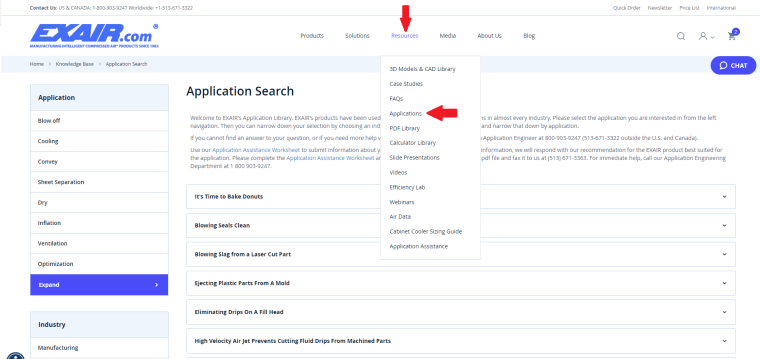
At the Application Search Library, we have over one thousand applications that we reference.  In the left selection pane, we organized then in alphabetical order under two categories, Application and Industry.

Scroll down in the selection pane until you come to the sub-category: Industry.  Under this Sub-category, you will find three selections that are related to this blog: Automation, Automobile Recycling, and Automotive.  We have other applications as well that may relate to your specific processes if you scroll up and down the list like; Part Ejection and Machining.  You will find many product applications that have already improved processes and solved problems.

If you can’t find an application in this library that matches yours reach out via our Application assistance form! This will be sent directly to the Application Engineering team, we strive to then reach out ASAP to get more information or recommend product! (Reference photos below).

How to find the Application Assistance Form
Application Assistance Form

In today’s market, companies are always looking for ways to cut cost, increase productivity, and improve safety.  EXAIR can offer engineered products to do exactly that.  With the “been there and done that” solutions already described in the Application Database; you can have confidence in finding a way in solving pneumatic issues.  If you do not sign up at www.EXAIR.com and take advantage of these offerings, you will be missing out on a great tool to optimize your compressed air system.

Jordan Shouse
Application Engineer
Send me an email
Find us on the Web 
Like us on Facebook
Twitter: @EXAIR_JS

Gen4 Ion Air Cannon Explained

When larger areas need to be covered with an ionized air stream and the surfaces needing to be covered are not flat, then an array of Gen4 Ion Air Cannons can often be the solution. This is something that the automotive industry as well as many others have been using since before I have been a part of the EXAIR team. So just how does the Gen4 Ion Air Cannon achieve this?

At its core, the Gen4 IAC is designed around a 2″ Super Air Amplifier, and then we add ionization and a stand. The largest benefit to this is the ability of the Super Air Amplifier to entrain large volumes of free ambient air while using small amounts of compressed air. By entraining large volumes of free ambient air and then directing it down through the throat of the IAC and ionizing it upon exit of the barrel, we maximize the potential to eliminate static on the target surfaces and provide a good blowoff at the same time. To give a visualization of the performance, check out the video below.

When adding ionization to this airstream, complex shapes can easily have static elimination as they are being conveyed. Take an automotive body for example, as it travels down the assembly line, before paint or primer, they get blown off to ensure any debris from the facility is removed before they are coated. An array of Ion Air Cannons can be installed at a distance from the surface to fit multiple vehicle models and still target the entire surface needed.

Three Gen4 Ion Air Cannons are used to blow off the debris and remove unwanted static charge from a primer vehicle body before painting.

By arranging the blow-offs to utilize the large volume of ambient air entrained and direct the airflow at an angle in which once it hits the surface, it expands in the direction needed to remove the debris it is easy to cover irregular shapes. The setup shown above will utilize 15.5 SCFM per IAC when operated at 80 psig and give a forceful blast to remove any debris on the surface; the total consumption would be 45.5 SCFM at 80 psig to remove all debris from the top surfaces of this vehicle body before it goes into the final paint area. A centrally located 4 port Gen4 Power Supply, model 7961, can simplify cabling and installation while powering all three Ion Air Cannons. To optimize compressed air usage, an Electronic Flow Control can easily be installed to shut the air off whenever a car is not present; adding something like this ionized blowoff station to existing equipment is easier.

If you would like to discuss what the Gen4 Ion Air Cannon kit or any of our point-of-use engineered compressed air products can do for you in your facility, please contact an Application Engineer today.

Brian Farno
Application Engineer
BrianFarno@EXAIR.com
@EXAIR_BF

Stories From The Field: Automotive Plant Tour

Throughout my years I have been in many manufacturing facilities. Oddly enough, I have seen nearly every part of a passenger car manufactured and then fully assembled. The amount of compressed air applications in automotive supplier and manufacturing facilities are tremendous. Here are some stories from just a few we have encountered over the years, and all of them can be found in our Application Database.

Air Wipe – How it works
  1. A component manufacturer, specifically a steering and transmission component manufacturer was having issues with machined parts coming out of a CNC machine with too much oil based cutting fluid on them and not passing inspection process because the oil would throw off the automated measuring system. The part was a splined shaft that the high surface tension oil stayed in the splines. The part was removed from the machine via robotic loader and set onto a fixture. The path to the fixture was outfitted with a Super Air Wipe so the robotic loader could move the part into and out of the air wipes’s airflow and remove the oil. The converging airflow of the Super Air Wipe was ideal to keep the peaks and valleys of the shaft clean of oil and they were able to direct oil back into the cutting machine so no separate collection system was needed.
Robotic Welder fitted with EXAIR Super Air Wipe

2. A seat bracket manufacturer had issues protecting the lenses on their vision systems from welding spatter. They were again able to reduce the replacement / repair downtime by installing a 9″ Super Air Wipe in front of the robotic mounted lens and keep the spatter / fumes from ever making it to the lens, resulting in expanded run times between repair / downtime.

Cooling with Air Amplifiers

3. A forging company manufacturing the pistons was having issues reducing the temperature of the pistons as they were assembled to the connecting rods. The solution for them was to install a series of Super Air Amplifiers over the fixtured, indexing line and at each dwell station a Super Air Amplifier would activate and cool down the assembly by moving large volumes of ambient air mixed with small amounts of compressed air onto the surfaces.

4. An automotive manufacturer had issues with stamping shavings and welding debris staying on the surface of parts and fixtures resulting in rework and defective parts. Implementing a series of Super Air Nozzles, and Super Air Knives resulted in debris removal that saved tooling rework as well as production reject parts.

5. Another automotive / recreational vehicle manufacturer needed help with their torture test machine for suspension components. They were utilizing fans to try and keep shock sensors cool and replicate air movement. electric fans were not able to provide a focused airflow and so enter the Super Air Amplifiers. These have also been utilized on engine torture test machines.

1 – Chevrolet Corvette C7 2014 – LT1 Engine Testing on Dyno

These are just a select few of the actual applications that I have actually help with over the course of the years. As a whole, we have helped endless number of automotive industry applications. It doesn’t matter if you are in the automotive industry or just a garage tinkerer, contact and Application Engineer and let us help you with your point of use compressed air application today.

Brian Farno
Application Engineer
BrianFarno@EXAIR.com
@EXAIR_BF

1 – Autoblog_gr; Chevrolet Corvette C7 2014 – LT1 Engine Testing on Dyno – retrieved from https://www.youtube.com/watch?v=N3h8imnOPwU on 8/31/2022

Application Database : Success Stories in Foundries

EXAIR products are used in countless applications across all facets of industry, we have been working to compile some in a easy to read Application Database on EXAIR.COM!

Today I wanted to cover a few application successes from within Foundries.

The first example is from a company who manufactures flux for aluminum processing. They were experiencing conveyor belt jam ups because not all the material would fall off at the tail end of the belt. What adhered to the belt would be carried over on the return, fell off due to gravity and vibration, and was causing build up underneath and jamming the belt. The Model 110036 36″ (914mm) Super Air Knife was installed on the end of the conveyor blowing off any tramp material as the belt came around the head pulley. This consolidated the debris to one area where they could easily reach it for removal. This all but eliminated maintenance and downtime.

Super Air Knife installed

A manufacturer of aluminum rods was having problems with removing drawing die lubricant from aluminum bar being cut to length. The lubricant was causing the bar to slip in the grippers, causing the bars to be cut short. Passing the bar through a Model 2402 2″ (51mm) Super Air Wipe effectively removed the lubricant, and eliminated grip slippage.

Super Air Wipe

The last customer operates an aluminum foundry. A small actuating cylinder’s seals were failing frequently, due to the heat from a nearby furnace. Using a Model 3230 Medium Vortex Tube, they are able to direct a flow of cold air onto the cylinder, keeping the elastomer seals cool, which greatly extends their life.

Cooling or Heating with the Vortex Tube

If you have questions about any of the quiet EXAIR Intelligent Compressed Air® Products, feel free to contact EXAIR and myself or one of our Application Engineers can help you determine the best solution.

Jordan Shouse
Application Engineer
Send me an email
Find us on the Web 
Like us on Facebook
Twitter: @EXAIR_JS