Necessity Is The Mother of Invention

Necessity is the mother of invention, or something like that. My garage is riddled with “tools” that have come from necessity at any specific point in time.

Things like a socket that has been ground down around the outer wall to fit into a space that was too tight for anything else. Maybe it is a combination line wrench that has been torch-heated and bent to go around another hard line. Eventually, it will need to be reheated and bent back to near straight. I even have some special ground screwdrivers and punches that have been used on various projects. At the moment, I can’t remember whether one was for installing a retaining ring in a master cylinder on a brake system or for removing a key from a shaft. The unique purpose eventually fades from memory after you do it so many times.

The one that I have used most recently is a mason jar that has some fittings attached to the lid and has some tubing coiled up inside. If you have ever worked on car or motorcycle brakes with me, then there is a very good chance we have used this tool at some point.

This tool started as it was purchased, with a hand pump and a small fluid container. After starting at EXAIR and bleeding several motorcycle brake systems, I recognized the need for something easier and less back-and-forth than the hand pump. So I placed a small E-Vac onto the system instead of the hand pump. I blogged about this back in April 2010. That was one of my first blogs here at EXAIR as an Application and ever for that matter. After the addition of the E-Vac, and working on some larger systems, I realized the small container was not sufficient and needed to be emptied too frequently. I needed a chamber that would handle vacuum and not degrade with brake fluid exposure. I just happened to have been canning some tomatoes and saw an extra mason jar sitting there. A couple of fittings later and I now have a 1-qt capacity pneumatic brake bleeder system.

Fast-forward to last week, and I was using the same mason jar vacuum system to draw all the power steering fluid out of two vehicles and perform a fluid change on them. This system has been loaned out to many of my friends over the past decade and always comes back to sit on the shelf until it is needed again. I may even be using it this weekend to help with a new clutch install with a friend.

At EXAIR we have a fairly extensive listing of products available in stock configurations. However, we also love to talk about how we can modify them to suit special circumstances. Please let us know if you want to discuss how we can help you create a purpose-built system or tool to suit your needs.


Brian Farno, MBA – CCASS Application Engineer

BrianFarno@EXAIR.com
@EXAIR_BF

Sometimes Plans Go Sideways – And That’s Okay

I often write and share personal experiences here. It’s kind of funny—if you had asked me 15 years ago whether I’d be writing regularly, I would have said, “Absolutely not.” That sentiment actually ties in well with today’s message.

Last night, I decided to tackle a maintenance issue on a 2014 Honda Pilot that’d been graciously loaned to us while we saved up for a newer vehicle for my wife. Her van’s transmission failed, and the cost to repair it just didn’t make sense. The Pilot has had a persistent clunking noise whenever it hits a bump. Upon inspection, I found both sway bar links were completely shot—the grease boots were torn, and the sway bar bushings were totally rotted. I had ordered the parts last winter with a few others, and I finally had time in my schedule to take care of them.

If you’ve ever worked on sway bar links, you know they usually don’t come off easily. Still, I kept a positive mindset and tried to remove the nuts holding the links in place—with zero success. So, out came the saw. I was able to cut the driver-side link out, and that’s when I should’ve realized things wouldn’t go smoothly.

My cut on the lower bolt was off and left too much of the stud. So, I grabbed another tool: the angle grinder. I’m not afraid to use the right tool—or to get rough when needed. With the sway bar supported and my hearing protection on, I went to work. It wasn’t a perfect job, but eventually I used a punch and hammer to knock out the remnants and moved on to the top mount. That one backed off halfway, then got cut at the threads and came right out. Thank goodness for sharp saw blades.

With the old link gone, I removed the deteriorated bushing and installed the new one without any trouble. Then came time to install the new sway bar link. These replacements were serviceable with grease fittings—a nice little upgrade for this older vehicle—so I had a good feeling they’d be the last ones it would ever need.

Oddly, the two new links (bought at the same time) came with different styles of lock nuts. One was slightly smashed into an oblong shape. The top nut went on snugly, but just as I was torquing it down, the Allen key recess began to round out. Not a huge deal, since I didn’t anticipate needing to take them apart again.

But the bottom stud and oblong retaining nut didn’t go so well. Halfway on, the nut tightened up severely, and the hex recess rounded out. All I could think was, “It shouldn’t be this hard.” I used the small wrench that came with the new links, and it popped loose—finally. Then I resorted to using vise grips on the flats.

Here’s where I made my mistake: I didn’t slide the grease boot out of the way and kept going. Just as I reached the last thread, the pliers slipped and pinched the brand-new grease boot. I still finished the installation—knowing I’d have to remove it again anyway—and wanted to make sure nothing else was out of alignment. At the time, I felt defeated by a simple task. This really shouldn’t have been so difficult.

In the end, I ordered another new sway bar link. It’s on the way, and I’ll attempt round two in 3–5 business days.

So, what’s the point of this story? Things don’t always go as planned. Sometimes it’s because you miss something or don’t trust your gut when something feels off. Other times, it’s stubborn determination to force something that just isn’t working. You can either dwell on it or take a breath, make a new plan, and keep pushing forward with the same energy.

I’ve seen this play out not just in car repairs, but in travel, my career, and life in general. When something doesn’t go right, it’s okay. Just adjust and move forward. It’s a mindset we bring to our work with customers at EXAIR.

That’s why our 30-day guarantee matters so much. If a recommendation didn’t work out, or testing pointed in one direction, but the results just weren’t there, we’ll help you rework the plan. We’ll back what’s already been done by covering any stock product with our 30-day guarantee and help chart a new path forward.

We’re not perfect, and we never claim to be. My plans don’t always work out either. But a failure doesn’t mean the end—it just means it’s time for a new plan of attack.

Brian Farno, MBA – CCASS Application Engineer

BrianFarno@EXAIR.com
@EXAIR_BF

Big shout-out to my youngest daughter for snapping the photo of the passenger side and spraying down the rusted studs with Aero Kroil while I was at work, and she was enjoying summer break. It definitely pays to have your kids pitch in on these projects.

Just Needs A Little More To The Left

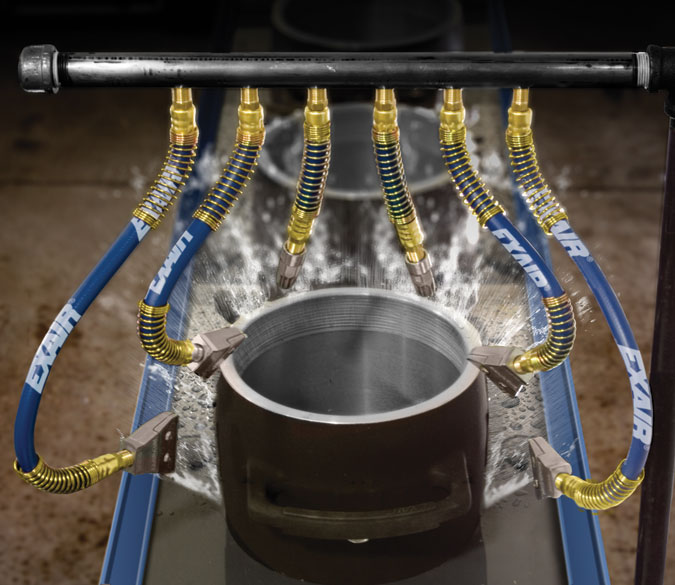
I’ve come across many applications where customers run multiple different parts or products along the same line, and each requires some form of blowoff before moving to the next stage. Too often, a system designed for just one specific part can’t keep up with the variations. Sometimes the “solution” ends up being to crank up the compressed air, which is wasteful and inefficient.

Instead of increasing air pressure or fabricating new mounts every time there’s a changeover, consider installing EXAIR’s Stay Set Hoses or Swivel Fittings.

            Stay Set Hoses are flexible and hold their shape once positioned, making them ideal for quickly adapting to different parts on the line. Available in 1/8″ and 1/4″ MNPT fittings (or a mix of both) and various lengths, these hoses can support anything from a Nano Super Air Nozzle to a Super Air Amplifier—or even a Super Air Knife. Repositioning them is easy: just bend the hose by hand to aim the airflow exactly where it’s needed for the new part.

                Swivel Fittings may be a better fit if your application doesn’t require much flexibility but still needs occasional fine-tuning. These allow up to 25 degrees of movement off axis, are made of durable 303 stainless steel, and help you easily refocus nozzles without a full tear down.

If your blowoff system isn’t keeping up with your line changes, it might be time to explore how Stay Set Hoses and Swivel Fittings can bring efficiency and adaptability to your process.       

Brian Farno, MBA – CCASS Application Engineer

BrianFarno@EXAIR.com
@EXAIR_BF

Static and Variance

Okay, folks, it is time we seriously discuss how dry it is here in the MidWest right now and how much static there is anywhere we go. The dry air is the lack of moisture due to heat being used inside facilities, and thus, the static ramps up. If you didn’t understand much of those statements then it is okay, we have a whitepaper that covers the basics. The seriousness of the static in my home has reached critical mass. We are past the funny shocks and hair standing on the end humor side of static. We have reached a critical mass where it is no longer funny, my coffee is being affected by the ambient level of static charge.

That’s right, the coffee grinder I received for Christmas is riddled with static. Now, it is still functioning, thank goodness for that. The container that houses the fresh ground, the nectar of the gods making crushed beans, is made of polycarbonate material and is prime to hold a static charge. As the dry coffee beans are ground into obliteration there is a tremendous amount of friction which causes a very high charge on the ground bean discharge that goes into a very dry non-conductive container. This means the grinds all pile up and then also cling to every single surface on the interior of the small container. That’s fine, it still does not affect the performance of the grinder. Then, when I open the lid there is a detachment that happens and a small amount of that highly charged ground bean will start to dance all over the surfaces of the container, including outside of it and onto the counter. The end result is I have to constantly wipe up coffee grinds and I am wasting the grinds that give me the caffeine I intend to consume.

The dilemma here is that I don’t want to run compressed air into my kitchen, already have one project going on in the house. Secondly, my wife would not think it would be as entertaining as I would. So, I need a non-compressed air-assisted static eliminator that can plug straight into a voltage available here in the US, and let’s face it, coffee is a global consumption so 120 VAC and 230 VAC would be preferred. Enter, the VariStat Benchtop Ionizer.

The Varistat would easily mount to the wall over my coffee generation station and could be adjusted from a gentle breeze to where it doesn’t disturb the coffee grinds all the way up to a forceful blast in case the need would arise. I could also vary the balance of the unit to meet the atmospheric and surface conditions of the container.

Okay, so I’m probably not going to buy a Varistat Benchtop Ionizer and mount it to my kitchen wall. I would easily recommend it to any kind of hopper loader or regrind operation where the static is causing the materials to cling to the containers or causing nuisance shocks. This unit is easily sat on a bench top or mounted to a wall or ceiling over a hopper or workstation. Thanks to the operation of standard 120 VAC or 230 VAC it can function nearly anywhere in the world that has electricity.

If you would like to discuss coffee, what my favorite roasts are, or more importantly how can we make this work in our building, just let me know if you have some questions and we will get back to you quickly.

Brian Farno, MBA – CCASS Application Engineer

BrianFarno@EXAIR.com
@EXAIR_BF