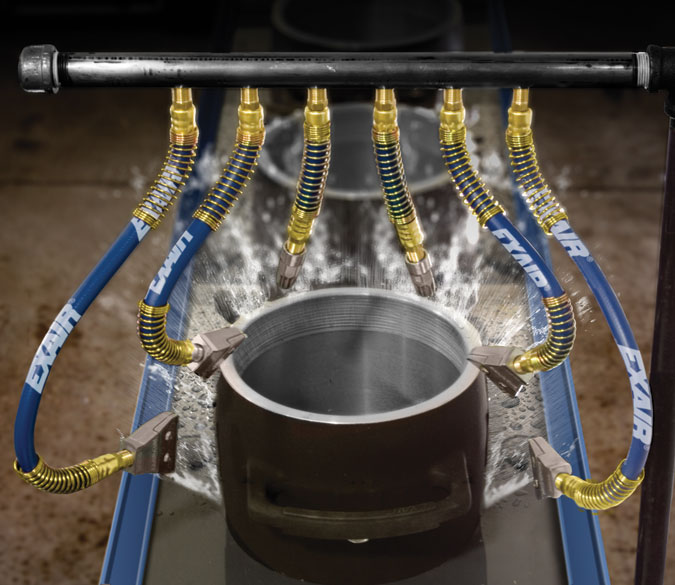
I’ve come across many applications where customers run multiple different parts or products along the same line, and each requires some form of blowoff before moving to the next stage. Too often, a system designed for just one specific part can’t keep up with the variations. Sometimes the “solution” ends up being to crank up the compressed air, which is wasteful and inefficient.
Instead of increasing air pressure or fabricating new mounts every time there’s a changeover, consider installing EXAIR’s Stay Set Hoses or Swivel Fittings.
Stay Set Hoses are flexible and hold their shape once positioned, making them ideal for quickly adapting to different parts on the line. Available in 1/8″ and 1/4″ MNPT fittings (or a mix of both) and various lengths, these hoses can support anything from a Nano Super Air Nozzle to a Super Air Amplifier—or even a Super Air Knife. Repositioning them is easy: just bend the hose by hand to aim the airflow exactly where it’s needed for the new part.
Swivel Fittings may be a better fit if your application doesn’t require much flexibility but still needs occasional fine-tuning. These allow up to 25 degrees of movement off axis, are made of durable 303 stainless steel, and help you easily refocus nozzles without a full tear down.
If your blowoff system isn’t keeping up with your line changes, it might be time to explore how Stay Set Hoses and Swivel Fittings can bring efficiency and adaptability to your process.
A metal fabricator made stainless steel tubes with a ½” (13mm) inner diameter. Their process started by cutting the tubes into 8” (203mm) lengths. The tubes would go through a wash system, then to a honing machine. Once the inner diameter was honed to the specific diameter and concentricity, the tubes would be washed again for packaging. The honing machine used oil to accurately grind the inner diameter. Since oil and water does not mix, they had to dry the I.D. before honing. They contacted EXAIR to see if we could find a solution.
Back Blow Air Nozzle Family
For cleaning the I.D. of parts, EXAIR manufactures three different sizes of Back Blow Air Nozzles that are designed to clean inside tubing, pipes, hoses, and channels. They can range from internal diameters from ¼” (6.3mm) up to 16” (406mm). The 360o rear airflow pattern can “wipe” the entire internal surface without contacting the surface to remove water, coolant, chips, and debris. In reviewing the inner diameter above, I was able to recommend a model 1004SS Back Blow Air Nozzle. This 316SS robust designed nozzle can fit inside and clean tubes with internal dimensions ranging from ¼” (6.3mm) to 1” (25mm); perfect for the ½” (13mm) diameter tube.
Model: 1604SS-12-CS
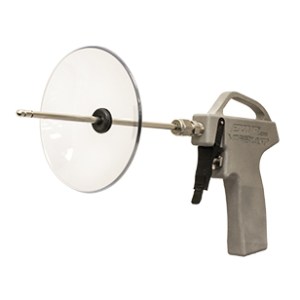
The customer indicated to me that there was a rush to start this project. EXAIR stocks thousands of cataloged items for same day shipping. He asked if EXAIR had any other components to help them to expedite their drying process. Well, of course we do! Since the tube was 8” (203mm) long, EXAIR has extension tubes that are used with our VariBlast Compact Back Blow Safety Air Gun. We have them ranging from 6” (152mm) to 72” (1829mm) in incremental lengths. For this customer, I recommended the 12” (305mm) extension to reach through the tube. And, since it was a manual operation, I also recommended the model 9040 Foot Valve.
Model 9040 Foot Valve
Their operator could place the tube over the model 1004SS Back Blow Nozzle and with the Foot Valve, turn on the compressed air to dry the tubes. With the powerful air stream, the entire internal surface was dry for the honing process to follow.
If you need to clean the inside of tubes, hoses, pipes, etc., EXAIR has the perfect nozzles for you, the Back Blow Air Nozzles. EXAIR can attach these nozzles to our VariBlast Compact, Soft Grip and Heavy Duty Safety Air Guns for easy-to-use operations. For this customer above, they were able to use components to get the operation running the next day. If you need more information, you can share your application with an Application Engineer at EXAIR. We will be happy to help.
EXAIR has been manufacturing Intelligent Compressed Air Products since 1983. They are engineered with the highest of quality, efficiency, safety, and effectiveness in mind. Since compressed air is the source for operation, the limitations can be defined by its supply. With EXAIR products and pneumatic equipment, you will need a way to transfer the compressed air from the air compressor. There are three main ways; pipes, hoses and tubes. In this blog, I will compare the difference between compressed air hoses and compressed air tubes.
The basic difference between a compressed air hose and a compressed air tube is the way the diameter is defined. A hose is measured by the inner diameter while a tube is measured by the outer diameter. As an example, a 3/8” compressed air hose has an inner diameter of 3/8”. While a 3/8” compressed air tube has an outer diameter that measures 3/8”. Thus, for the same dimensional reference, the inner diameter for the tube will be smaller than the hose.
Why do I bring this up? Pressure drop… Pressure Drop is a waste of energy, and it reduces the ability of your compressed air system to do work. To reduce waste, we need to reduce pressure drop. If we look at the equation for pressure drop, DP, we can find the factors that play an important role. Equation 1 shows a reference equation for pressure drop.
Equation 1:
DP = Sx * f * Q1.85 * L / (ID5 * P)
DP – Pressure Drop
Sx – Scalar value
f – friction factor
Q – Flow at standard conditions
L – Length of pipe
ID – Inside Diameter
P – Absolute Pressure
From Equation 1, differential pressure is controlled by the friction of the wall surface, the flow of compressed air, the length of the pipe, the diameter of the pipe, and the inlet pressure. As you can see, the pressure drop, DP, is inversely affected by the inner diameter to the fifth power. So, if the inner diameter of the pipe is twice as small, the pressure drop will increase by 25, or 32 times.
Let’s revisit the 3/8” hose and 3/8” tube. The 3/8” hose has an inner diameter of 0.375”, and the 3/8” tube has an inner diameter of 0.25”. In keeping the same variables except for the diameter, we can make a pressure drop comparison. In Equation 2, I will use DPt and DPh for the pressure drop within the tube and hose respectively.
Equation 2:
DPt / DPh = (Dh)5 / (Dt)5
DPt – Pressure drop of tube
DPh – Pressure Drop of hose
Dh – Inner Diameter of hose
Dt – Inner Diameter of tube
Thus, DPt / DPh = (0.375”)5 / (0.25”)5 = 7.6
As you can see, by using a 3/8” tube in the process instead of the 3/8” hose, the pressure drop will be 7.6 times higher.
Diameters: 3/8″ Pipe vs. 3/8″ tube
At EXAIR, we want to make sure that our customers are able to get the most from our products. To do this, we need to properly size the compressed air lines. Within our installation sheets for our Super Air Knives, we recommend the infeed pipe sizes for each air knife at different lengths.
There is also an excerpt about replacing schedule 40 pipe with a compressed air hose. We state; “If compressed air hose is used, always go one size larger than the recommended pipe size due to the smaller I.D. of hose”. Here is the reason. The 1/4” NPT Schedule 40 pipe has an inner diameter of 0.364” (9.2mm). Since the 3/8” compressed air hose has an inner diameter of 0.375” (9.5mm), the diameter will not create any additional pressure drop. Some industrial facilities like to use compressed air tubing instead of hoses. This is fine as long as the inner diameters match appropriately with the recommended pipe in the installation sheets. Then you can reduce any waste from pressure drop and get the most from the EXAIR products.
With the diameter being such a significant role in creating pressure drop, it is very important to understand the type of connections to your pneumatic devices; i.e. hoses, pipes, or tubes. In most cases, this is the reason for pneumatic products to underperform, as well as wasting energy within your compressed air system. If you would like to discuss further the ways to save energy and reduce pressure drop, an Application Engineer at EXAIR will be happy to assist you.
John Ball
Application Engineer
Email: johnball@exair.com
Twitter: @EXAIR_jb
EXAIR’sGen4 Super Ion Air Wipe provides a uniform 360 degree ionized air stream that clamps around a continuously moving part to eliminate static electricity and contaminants. It is ideal for removing dust, particulates and personnel shocks on pipe, cable, extruded shapes, hose, wire and more. This engineered product has undergone independent laboratory tests to certify it meets the rigorous safety, health and environmental standards of the USA, European Union and Canada that are required to attain the CE and UL marks. It is also RoHS compliant. New design features include a metal armored high voltage cable to protect against abrasion and cuts, a replaceable emitter point, integrated ground connection and electromagnetic shielding.
The Gen4 Super Ion Air Wipe uses a small amount of compressed air to entrain high volumes of ambient air. Two shockless ionizing points powered by our Gen4 UL Component Recognized 5kV Power Supply fills the air stream with static eliminating ions. That airflow impacts the surface of the material running through the air wipe and neutralizes the charge.
The Gen4 Super Ion Air Wipe, which compliments EXAIR’s complete line of Gen4 Static Eliminators, has an aluminum construction that is lightweight and easy to mount using the tapped holes provided. Two sizes include a 2 inch (51mm) diameter and a 4 inch (102mm). There are no moving parts to wear out. Visit EXAIR.com to see the entire Gen4 Static Eliminator product line and 1/2 inch through 11 inch Super Air Wipes for applications without static.
To discuss your application and how an EXAIR Intelligent Compressed Air Product can help your process, feel free to contact EXAIR and myself or one of our Application Engineers can help you determine the best solution.