
The Basics of a Compressed Air Leak Detection Program

It is no surprise that compressed air can be a costly utility for industrial facilities. It can easily chip away at the bottom line finances if used carelessly and without planning. This is one of the leading reasons we have educated continuously on how to ensure this vital utility is used with safety and conservation in mind. If we have installed all engineered solutions at the point of use throughout a facility, there is still more to be saved. One of the easiest things to do with a utility system inside of a facility is to leave it unchecked and undocumented until something goes wrong. This does not have to be the scenario and in fact, starting a leak detection program in a facility can help to save up to 30% of the compressed air generated.

Leaks cost money!

That’s right, up to 30% of the compressed air being generated in an industrial facility can be exhausting out to ambient through leaks that run rampant throughout the facility. When the point of use production is still working fine, then these sorts of leaks go unnoticed. Another common occurrence goes something like this example: Maybe there is a leak bad enough to drop the packaging line pressure slightly, this may get fixed by bumping up a pressure regulator, production is back up and it is never thought of again. In all actuality this is affecting the production more and more with each leak.

The leaks add additional load onto the supply side. The compressor has to generate more air, the dryer needs to process more air, the auto drains dump more moisture, it all ads up to additional wear and tear also known as false load. All of this additional load on the system can add more maintenance which if left undone can result in system shut downs. One way to begin to eliminate this false load is to deploy a leak detection program. The steps are fairly easy.

Similar to our 6 Steps to Compressed Air Optimization, you start with a baseline of how much air the system is seeing and operating pressures. This begins the documentation process which is critical to the success of the program. Next, acquire an ultrasonic leak detector (ULD) and a layout of your compressed air system piping. Utilizing the ULD, test all compressed air piping along with equipment, and tag each leak that is detected. Next, begin to repair all of the tagged leaks and document the amount of compressed air savings with each repair. This again, is more documentation which leads to giving a quantitative value to the return on investment of the program. Lastly, schedule a follow up scan that recurs on a pre-determined basis to prevent the system from returning to it’s original leaky state.

EXAIR Ultrasonic Leak Detector

If you would like to discuss starting a leak detection program in your facility or have questions about the ULD or any point of use compressed air product, please reach out to an Application Engineer today.

Brian Farno
Application Engineer
BrianFarno@EXAIR.com
@EXAIR_BF

Continuous Improvement

I’m sure I have blogged about similar topics before but I’m going ahead with this anyway.   Have you ever bought something and after using it a few times say to yourself, I really wish they would have done this or I wish this had this feature.  I do that quite often, more often that my wife really cares for.  Normally it ends up with me being in the garage or the basement working on whatever it is for several hours and possibly even breaking whatever it was I was working on.  Well, I don’t just do that at home.

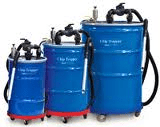
Two of our newest Industrial Housekeeping products were created from our own employees using them and seeing something that could make it better.   The easiest to see this with is our Chip Trapper System.

RDVFamily_300pxCT

Our Reversible Drum Vac Systems were around for a couple decades when someone decided to figure out a (patented) way to filter all the chips and solids out of the coolant we were processing.  So now, instead of just sucking the coolant out, we are able to filter the coolant and reuse it up to four times longer in our machines.

It is continuous improvements and being willing to listen to recommendations that make things like the Chip Trapper possible.  If you have one of our products and see a better idea, feel free to let us know, it may even be something that we could do on a custom basis for you.

Brian Farno
Application Engineer
BrianFarno@EXAIR.com
@EXAIR_BF
Super Ion Air Knife Cleans Product Exiting Cutting Application

Yesterday, I had a customer call in to discuss his application regarding chip and debris removal from his product. The customer described his process of cutting lenses for light fixtures that their company manufactures. While he was explaining the application and the problem, I was building a picture of it in my mind.  To help in the understanding the customer e-mailed me a photo of the application so I could really see the mess he was trying to deal with.

Once I saw the photo, I could see that my understanding was off just a little concerning the automatic nature of the cutting machine. Instead of having an operator pulling the cut lenses off the machine and blow them down, he wanted the lenses to come out already cut and blown free of static, debris and dust.

Once I saw the photo above, I could see that the flat nature of the target product was a perfect fit for the Super Ion Air Knife Kit model 111218. That unit fit the customer’s machine guard just right in order to accommodate the various widths of material that he processed through the cutting function. He set the Super Ion Air Knife up to blow down at a 45° angle opposite the travel of the material. In effect, he was blowing back toward the saw blade which had a vacuum system attached. Not only was the material able to exit cleaned, but it kept the processing area cleaner as well as the chips and other debris were deflected back to where the vacuum system could pull them in.

The customer’s improvement in productivity actually doubled as an aid in their housekeeping within the processing area.

Neal Raker
Application Engineer
nealraker@exair.com