Entrainment: How it Works and Why EXAIR Products are Engineered to Use it.

EXAIR Super Air Nozzle entrainment

Because of the large amount of energy required to run an air compressor, the pneumatic system is considered the fourth utility in a manufacturing plant.  And saving this commodity and using it as efficiently as you can, should be a priority.  EXAIR has many products that can save energy by using less compressed air.  And the story behind this is entrainment explained by Bernoulli’s equation. 

Bernoulli’s principle explains how a high velocity fluid can generate a low pressure.  (You can read more about Bernoulli’s principle HERE.)  Let’s start by looking at Equation 1.

Equation 1:

P + d * V2/2 = C 

P – pressure

d – density of the fluid

V – velocity

C – a constant

As you can see from Equation 1, when the velocity goes up, the pressure must go down.  When we have a lower pressure, then the surrounding fluid will fill that void.  Since air is a fluid, we can use high velocity to entrain the surrounding ambient air.  The free air will add to the compressed air to give the airstream mass for a hard-hitting force.  This ratio of ambient air to compressed air is called entrainment.  The higher the entrainment, the more efficient the product.  Bernoulli’s Principle can be applied in two ways; as a Coanda and as a Venturi.  EXAIR uses both methods in our products for creating low-pressure effects. 

Compressed air flows through the inlet (1) to the Full Flow (left) or Standard (right) Air Knife, into the internal plenum. It then discharges through a thin gap (2), adhering to the Coanda profile (3) which directs it down the face of the Air Knife. The precision engineered & finished surfaces optimize entrainment of air (4) from the surrounding environment.

The first way is from a Coanda profile.  Coanda, named after Henri Coanda, noticed that a fluid would “hug” a curved surface.  (You can read more about Henri Coanda HERE.)  The high velocity air going around the curved surface will generate a low pressure above it.  You can imagine an airplane wing generating that low pressure to fly.  We use this with our FullFlow and Standard Air Knives, our Air Wipes, and our Air Amplifiers.  With a Coanda profile, we can get an amplification ratio up to 30:1, which means that for every 1 part of compressed air, 30 parts of ambient air is entrained.  We are able to create an efficient blow-off device by using the Coada profile. 

To generate even lower pressure, this can be done by a Venturi.  This phenomenon is named after Giovanni Venturi, who discovered that by increasing the velocity through an orifice, the surrounding fluid will move with it, generating a lower pressure.  (You can read more about Giovanni Venturi HERE.)  Remember the higher the velocity, the lower the pressure from Equation 1 above.  We use the Venturi effect on our Super Air Knives, E-Vacs, Line Vacs, and Super Air Nozzles.  As compared to our FullFlow and Standard Air Knives, the Super Air Knives can generate an amplification ratio of 40:1.  As an engineered product, we were able to increase efficiency even further. 

EXAIR has been manufacturing Intelligent Compressed Air® products since 1983.  We can provide solutions that are efficient, effective, and safe for blow-off systems.  In comparison, the other blow-off devices are like incandescent light bulbs, while EXAIR products are like LED light bulbs.  Entrainment of free ambient air can save you a lot of money when using your compressed air system.  If you would like to discuss solutions to use less compressed air and improve your bottom dollar, an Application Engineer at EXAIR is available to help.   

John Ball
Application Engineer
Email: johnball@exair.com
Twitter: @EXAIR_jb

Entrainment: How It Works, and Why EXAIR Products Use It.

EXAIR Super Air Nozzle entrainment

Because of the large amount of energy required to run an air compressor, the pneumatic system is considered the fourth utility in a manufacturing plant.  And saving this commodity and using it as efficiently as you can, should be a priority.  EXAIR has many products that can save this energy safely and effectively.  And the story behind the efficiency of EXAIR products is Bernoulli’s equation. 

Bernoulli’s principle explains how a high velocity fluid can generate a low pressure.  (You can read more about Bernoulli’s principle HERE.)  Let’s start by looking at Equation 1.

Equation 1:

P + p * V2/2 = C 

P – pressure

p – density of the fluid

V – velocity

C – a constant

As you can see from Equation 1, when the velocity goes up, the pressure must go down.  When we have a lower pressure, then the surrounding fluid will have to fill that void.  Since air is a fluid, this is how we can entrain the free ambient air while only using a small amount of compressed air.  Bernoulli’s Principle can be applied in two ways; as a Coanda and as a Venturi.  EXAIR uses both methods in our products for creating low-pressure effects. 

Compressed air flows through the inlet (1) to the Full Flow (left) or Standard (right) Air Knife, into the internal plenum. It then discharges through a thin gap (2), adhering to the Coanda profile (3) which directs it down the face of the Air Knife. The precision engineered & finished surfaces optimize entrainment of air (4) from the surrounding environment.

The first way is from a Coanda profile.  Coanda, named after Henri Coanda, noticed that a fluid would “hug” a curved surface.  (You can read more about Henri Coanda HERE.)  The high velocity air going around the curved surface will generate a low pressure above it.  We use this with our Full Flow and Standard Air Knives, our Air Wipes, and our Air Amplifiers.  With a Coanda profile, the low pressure will entrain the surrounding air to add mass to the air stream.  We can get an amplification ratio up to 30:1, which means that for every 1 part of compressed, 30 parts of ambient air are entrained.  We are able to create an efficient air moving (blow-off) device by using the Coanda profile. 

Generating even lower pressures can be accomplished with a Venturi.  This phenomenon is named after Giovanni Venturi, who discovered that by increasing the velocity through an orifice, the surrounding fluid will move with it, generating a lower pressure.  (You can read more about Giovanni Venturi HERE.)  Remember the higher the velocity, the lower the pressure.  We use the Venturi effect on our Super Air Knives, E-Vacs, Line Vacs, and Super Air Nozzles.  When compared to our Full Flow and Standard Air Knives, the Super Air Knives can generate an amplification ratio of 40:1.  We were able to engineer the product to increase the air entrainment efficiency even further. 

EXAIR has been manufacturing Intelligent Compressed Air® products since 1983.  We provide solutions that are efficient, effective, and safe for air moving and blow-off systems.  Consider the following analogy; homemade air movers and blow-off devices are the equivalent to incandescent light bulbs. EXAIR products are the equivalent to LED light bulbs.  More efficient design leads to lower operating cost, higher efficiency and a higher level of effectiveness. Entrainment of free ambient air can save you a lot of money and increase your mass flow with your compressed air use to generate higher forces on your targets.  If you would like to discuss solutions to use less compressed air, an Application Engineer is available to help.    

John Ball
Application Engineer
Email: johnball@exair.com
Twitter: @EXAIR_jb

Daniel Bernoulli, Entraining EXAIR Products

Daniel Bernoulli was born February 8, 1700 in Groningen in the Netherlands and was the son of Johann Bernoulli an early developer of calculus. It is believed that Daniel did not have a good relationship with his father. This mainly stemmed from the both of them entering the same scientific contest at the University of Paris. The two tied and his father Johann took exception to being compared to his son as “equal” and could not accept the shame and banned Daniel from his home. Daniel tried to reconcile their difference but his father carried this grudge to his death.

Earlier in Daniels life his father convinced Daniel to study business as there was no income incentive to study mathematics but against his will Daniel did choose the study of business. His father then convinced Daniel to study medicine but Daniel still wanted to study mathematics and agreed to study medicine under the condition that his dad teach him mathematics privately. Daniel completed his bachelors degree at the age of 15 and his masters degree when he was 17. Daniel then went on to study medicine and received his PhD in anatomy and botany from the Universities of Basel, Heidelberg and Strasbourg.

Daniel Bernoulli was very accomplished but mostly known for Bernoulli’s principle. Bernoulli’s principle is the relationship between fluid speed and pressure. An increase in the speed of a fluid will occur simultaneously with a decrease in the fluid’s pressure or potential energy. The Venturi effect, published in 1797 by Giovanni Venturi, applies Bernoulli’s principle to a fluid that flows through a tube with a constriction in it. The Venturi tube provides a handy method for mixing fluids or gases, and is popular in carburetors and atomizers, which use the low pressure region generated at the constriction to pull the liquid into the gas flow. It also offers a particularly clear example of the Bernoulli principle.

For example, above is how a Super Air Wipe works. Compressed air flows through an inlet (1) of the Air Wipe into an annular chamber (2). It is then throttled through a small ring nozzle (3) at high velocity. This primary airstream adheres to the Coanda profile (4), which directs it down the angled surface of the Air Wipe. A low pressure area is created at the center (5) inducing a high volume flow of surrounding air into the primary airstream. As the airflow leaves the Air Wipe, it creates a conical 360° ring of air that attaches itself to the surface of the material running through it (6), uniformly wiping the entire surface with the high velocity airflow.

EXAIR incorporates the Bernoulli Principle with our engineered products which entrain air such as our Super Air Knives, Super Air Wipes, Air Amplifiers and Static Eliminating products to name a few. We have several Applications Engineers that will appreciate your call to discuss our products. If you have an application or question please call 800.903.9247 or visit us on our website www,EXAIR,com and let us help you.

Eric Kuhnash
Application Engineer
E-mail: EricKuhnash@exair.com
Twitter: @EXAIR_EK

People of Interest: Daniel Bernoulli

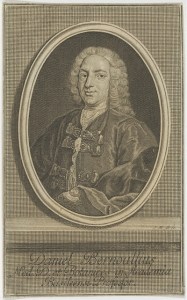
Daniel Bernoulli

Whenever there is a discussion about fluid dynamics, Bernoulli’s equation generally comes up. This equation is unique as it relates flow energy with kinetic energy and potential energy. The formula was mainly linked to non-compressible fluids, but under certain conditions, it can be significant for gas flows as well. My colleague, Tyler Daniel, wrote a blog about the life of Daniel Bernoulli (you can read it HERE). I would like to discuss how he developed the Bernoulli’s equation and how EXAIR uses it to maximize efficiency within your compressed air system.

In 1723, at the age of 23, Daniel moved to Venice, Italy to learn medicine. But, in his heart, he was devoted to mathematics. He started to do some experiments with fluid mechanics where he would measure water flow out of a tank. In his trials, he noticed that when the height of the water in the tank was higher, the water would flow out faster. This relationship between pressure as compared to flow and velocity came to be known as Bernoulli’s principle. “In fluid dynamics, Bernoulli’s principle states that an increase in the speed of fluid occurs simultaneously with a decrease in static pressure or a decrease in the fluids potential energy”1. Thus, the beginning of Bernoulli’s equation.

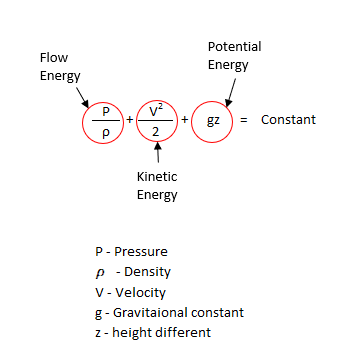
Bernoulli realized that the sum of kinetic energy, potential energy, and flow energy is a constant during steady flow. He wrote the equation like this:

Equation 1:

Bernoulli’s Equation

Not to get too technical, but you can see the relationship between the velocity squared and the pressure from the equation above. Being that this relationship is a constant along the streamline; when the velocity increases; the pressure has to come down. An example of this is an airplane wing. When the air velocity increases over the top of the wing, the pressure becomes less. Thus, lift is created and the airplane flies.

With equations, there may be limitations. For Bernoulli’s equation, we have to keep in mind that it was initially developed for liquids. And in fluid dynamics, gas like air is also considered to be a fluid. So, if compressed air is within these guidelines, we can relate to the Bernoulli’s principle.

  1. Steady Flow: Since the values are measured along a streamline, we have to make sure that the flow is steady. Reynold’s number is a value to decide laminar and turbulent flow. Laminar flows give smooth velocity lines to make measurements.
  2. Negligible viscous effects: As fluid moves through tubes and pipes, the walls will have friction or a resistance to flow. The surface finish has to be smooth enough; so that, the viscous effects is very small.
  3. No Shafts or blades: Things like fan blades, pumps, and turbines will add energy to the fluid. This will cause turbulent flows and disruptions along the velocity streamline. In order to measure energy points for Bernoulli’s equation, it has to be distant from the machine.
  4. Compressible Flows: With non-compressible fluids, the density is constant. With compressed air, the density changes with pressure and temperature. But, as long as the velocity is below Mach 0.3, the density difference is relatively low and can be used.
  5. Heat Transfer: The ideal gas law shows that temperature will affect the gas density. Since the temperature is measured in absolute conditions, a significant temperature change in heat or cold will be needed to affect the density.
  6. Flow along a streamline: Things like rotational flows or vortices as seen inside Vortex Tubes create an issue in finding an area of measurement within a particle stream of fluid.

Super Air Knife has 40:1 Amplification Ratio

Since we know the criteria to apply Bernoulli’s equation with compressed air, let’s look at an EXAIR Super Air Knife. Blowing compressed air to cool, clean, and dry, EXAIR can do it very efficiently as we use the Bernoulli’s principle to entrain the surrounding air. Following the guidelines above, the Super Air Knife has laminar flow, no viscous effects, no blades or shafts, velocities below Mach 0.3, and linear flow streams. Remember from the equation above, as the velocity increases, the pressure has to decrease. Since high-velocity air exits the opening of a Super Air Knife, a low-pressure area will be created at the exit. We engineer the Super Air Knife to maximize this phenomenon to give an amplification ratio of 40:1. So, for every 1 part of compressed air, the Super Air Knife will bring into the air streamline 40 parts of ambient “free” air. This makes the Super Air Knife one of the most efficient blowing devices on the market. What does that mean for you? It will save you much money by using less compressed air in your pneumatic application.

We use this same principle for other products like the Air Amplifiers, Air Nozzles, and Gen4 Static Eliminators. Daniel Bernoulli was able to find a relationship between velocities and pressures, and EXAIR was able to utilize this to create efficient, safe, and effective compressed air products. To find out how you can use this advantage to save compressed air in your processes, you can contact an Application Engineer at EXAIR. We will be happy to help you.

John Ball
Application Engineer
Email: johnball@exair.com
Twitter: @EXAIR_jb

  1. Wikipedia https://en.wikipedia.org/wiki/Bernoulli%27s_principle