
The Cost Of Cooling Electrical Panels

Heat, dirt, and moisture are natural enemies of electrical and electronic gear. Dirt and moisture are relatively easy to eliminate as dangers: just seal up the enclosure so they can’t get in. Heat, though, is a real “apex predator.” Whether the enclosure is sealed or not, the components inside will generate heat if they’re energized. And no matter what, the enclosure will get as hot as its surroundings in time, as long as the Second Law of Thermodynamics is in effect (spoiler alert: it’s immutable.)

So how do you keep the components in those panels cool? If the environment is clean enough and the temperature and humidity aren’t too high, fans can circulate cooling air from the environment through the panel. These are readily commercially available starting under $100.00, and generally won’t cost any more than about $50.00 a year in operating costs (electricity). If the environment is climate controlled and relatively free of contaminants, you can’t beat them. If you’re on a desktop computer, and it hasn’t burned out, there’s your proof.

Many, if not most, industrial panels, though, are in areas where fan cooling just won’t cut it. Not only will those aforementioned natural enemies like dirt & moisture be allowed in, they’ll be DRAGGED in. Luckily, modern technology presents us with a number of options, depending on the particulars of the environment. The following are some details on “the usual suspects”, and a table with total cost of ownership:

Panel air conditioners work on the refrigerant cycle and are capable of the highest cooling capacities of the methods detailed here. They’re also the most expensive, with a typical annual cost of over $1,100.00.

Aside from the high cost, they can be maintenance intensive and prone to failure, especially in dirty or oily environments. Their cooling capacity is also adversely affected by higher ambient temperatures.

Air-to-air heat exchangers transfer heat continuously through a sealed, hollow tube by vaporizing and condensing a refrigerant-type fluid. Instead of using compressors with electric motors and other mechanical components with lots of moving parts, they rely on capillary action to effect the phase changes. They can’t cool below ambient temperature, but they are the least expensive of these, coming in at around $370.00 in annual cost.

*Hot air (inside the panel) causes refrigerant in heat pipe to flash to a gas.
*Cold air (from the environment) causes the refrigerant to condense to a liquid.

Liquid-to-air heat exchangers work an awful lot like a car radiator: they circulate liquid (usually a water/glycol mix, like anti-freeze) through a heat exchanger/heat sink inside the panel and then through a heat exchanger outside the panel. Like the fan and refrigerant-based coolers, their cooling performance drops as the ambient temperature rises, except for the ones that use chilled water. In facilities that already have chilled water, that might not be a big deal, but if you need one that comes with the chiller, they can get pretty expensive. And, you still have the maintenance & durability issues that come with any refrigerant-operated cooler. Liquid-to-air systems can run as low as ~$425.00 a year in total cost, for the ones that don’t need chilled water.

Thermoelectric coolers use the Peltier effect: when voltage is applied to two electrodes connected to a semiconductor, heat is transferred from one side to the other. Their compact design with no moving parts makes them popular for high-performance gaming computers (like the one my son spends WAY too much time on), small coolers (wine experts like them because they don’t cause any vibration which can affect the wine’s quality), and certain lab, medical, and laser cooling equipment. They have a limited cooling capacity, and because electric current generates heat, that gets added to the overall heat dissipation. The annual cost for these is around $950.00.

EXAIR Cabinet Cooler Systems can be installed in minutes, have no moving parts to wear, no electric motors to burn out, aren’t affected by environmental contaminants or humidity. In fact, of all the methods available for panel cooling, they have the widest range of where they can be used:

They do require an adequate supply of compressed air, which makes up the bulk of their total cost of ownership, which is around $410.00 a year.

I’ve mentioned cost of ownership several times, so I had better get to what that means: it’s the cost of the equipment itself and installation (spread across the effective life of the equipment), plus the annual maintenance & operating costs. Here’s a table with a comparison of the panel cooling options above:

If you have electrical or electronic panels that need heat protection RIGHT NOW, we can help. ALL of our systems are in stock and available for same-day shipment. We can even help out with determining which one is right for your needs with the information from our Sizing Guide, or you can do it yourself with our online calculator. If you want some help with it, give me a call.

Russ Bowman, CCASS

Application Engineer
Visit us on the Web
Follow me on Twitter
Like us on Facebook

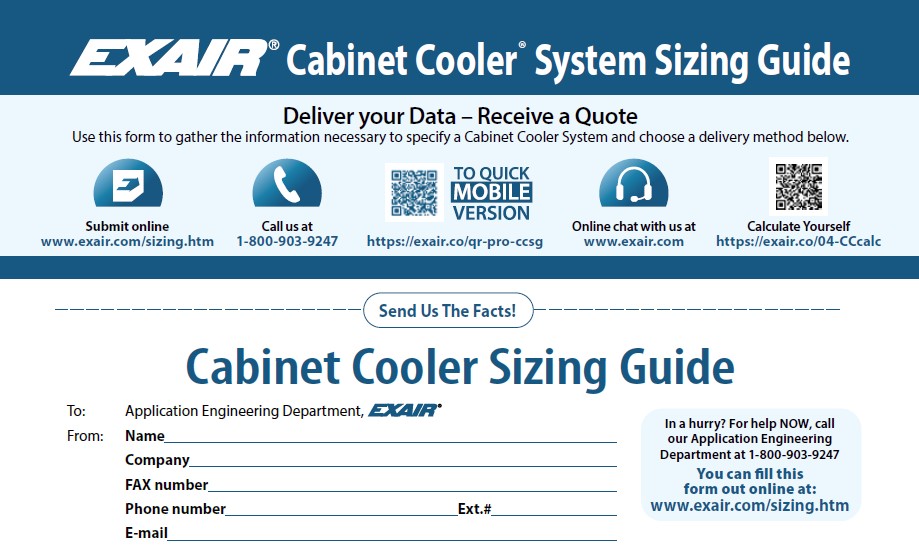
How to Select the Right Cooling System with EXAIR’s Electrical Enclosure Heat Load Guide

Selecting the right cooling system for an industrial electrical enclosure requires accurate data rather than guesswork. Under-sizing a cooling unit leads to persistent overheating and component failure, while over-sizing wastes valuable compressed air energy. The EXAIR Cabinet Cooler Sizing Guide provides a structured framework to determine the exact cooling capacity required for your control panels. By accounting for the unique environmental and operational variables of your facility, this guide helps you choose a system that delivers optimal thermal protection.

The heat load calculation begins by mapping the enclosure’s physical dimensions and temperature differentials. Users must measure the cabinet’s width, height, and depth to calculate the total exposed surface area. Next, you must record the current internal and external air temperatures, alongside the maximum expected ambient temperature during the hottest months. Comparing these figures against your desired internal temperature—typically 95°F (35°C) for standard industrial electronics—establishes the temperature differential (ΔT) required to calculate external heat transfer.

A precise calculation requires evaluating four primary sources of heat: internal, external, fan, and solar loads. Internal heat represents the energy dissipated by active electronics such as variable frequency drives (VFDs) and transformers, often expressed in BTU/hr. External heat reflects the ambient thermal energy radiating through the cabinet walls from the surrounding factory floor. For outdoor installations, the guide accounts for solar heat gain based on the panel’s color and sun exposure, and evaluates any existing cabinet fans that must be sealed during installation.

Once all variables are gathered, the data can be submitted through the interactive EXAIR Cabinet Cooler System Calculator for instant configuration. This digital tool instantly processes your specifications to recommend a precise model number from EXAIR’s extensive catalog, which features cooling capacities ranging from 275 to 5,600 BTU/hr. Utilizing this guide ensures that your selected system matches your exact NEMA requirements and voltage preferences, providing a reliable engineering solution that protects your electronics and eliminates downtime

If you have questions about the Cabinet Cooler Systems Heat Load Guide, or anything regarding EXAIR and our products, please do not hesitate to reach out.

Jason Kirby
Application Engineer
Email: jasonkirby@exair.com
Twitter: @EXAIR_jk

Cabinet Cooler Accessories: Adding to Efficiency and Effectiveness

Accessories can add much needed enhancements to assist in making your application as efficient and effective as possible. The same is true when it comes to our Cabinet Cooler Systems. Among the most essential accessories for our products are compressed air filters and regulators, which we highly recommend using with all our offerings, as well as with other brands. The Filter Separator effectively eliminates water, dirt, and rust from your compressed air system, while its 5-micron filter element prevents contaminants from clogging or damaging your equipment. For even more precise filtration, an Oil Removal Filter should be installed downstream of the Filter Separator; this filter utilizes a 0.03-micron element to remove oil and solid particulates. Additionally, our Pressure Regulators allow you to set the desired operating pressure, and we advise maintaining the minimum pressure necessary for optimal performance. This not only conserves air consumption but also fine-tunes the efficiency of EXAIR products in various applications.

From left to right; a few value added accessories for your Vortex Tube: Hot Muffler, Cold Muffler, Automatic Drain Filter Separator, Oil Removal Filter, and Solenoid Valve/Thermostat Kit.

A Cold Air Distribution Kit is an additional accessory available with our Cabinet Cooler Systems that enhances their efficiency. This kit features a length of flexible vinyl tubing designed to channel cold air for optimal circulation or to target specific hot spots. It also includes tubing connectors and adhesive-backed clips to secure the tubing in place.

Solenoid valves and thermostats are effective tools for conserving compressed air. Cabinet Cooler Systems equipped with thermostat control utilize a solenoid valve and thermostat to regulate the flow of compressed air, activating it only when cooling is necessary. The thermostat is preset to 95°F (35°C) and typically maintains a temperature within ±2°F (1°C) inside the cabinet. Solenoid valves are available in various voltage options, including 120V at 60Hz, 110V at 50Hz, 240V at 50/60Hz, and 24VDC. All solenoids are CSA Certified and either UL listed or recognized.

EXAIR’s Side Mount Kits facilitate the installation of cooling systems on the sides of electrical enclosures, particularly beneficial in scenarios where vertical or top mounting is impractical. It is important to note that NEMA 4 and 4X Cabinet Cooler Systems must be installed in a vertical orientation. These kits preserve the NEMA ratings for both large and small enclosures classified as Type 12, 4, and 4X, and they fit into standard electrical knockouts measuring 1-1/2 NPS. The Side Mount Kits designed for NEMA 12 Cabinet Cooler Systems are constructed from aluminum, while those intended for NEMA 4 and 4X systems are made from either Type 303 or Type 316 stainless steel.

If you have questions about the Cabinet Cooler Systems accessories, or anything regarding EXAIR and our products, please do not hesitate to reach out.

Jason Kirby
Application Engineer
Email: jasonkirby@exair.com
Twitter: @EXAIR_jk

ATEX Cabinet Coolers for Dependable Heat Protection in Explosive Areas.

EXAIR Cabinet Cooler Systems have been delivering dependable heat protection for electrical and electronic panels for many years. These systems feature no moving parts or electrical components that can fail, ensuring a long lifespan as long as they are supplied with clean, moisture-free compressed air. This design allows them to function nearly indefinitely without the need for maintenance.

EXAIR’s ATEX Cabinet Cooler® Systems provide an effective and cost-efficient solution for maintaining optimal temperatures in electrical enclosures located in hazardous ATEX classified environments. Now offered in robust aluminum construction, these coolers are specifically designed for use in Zones 2 and 22. They have undergone UL testing, are CE compliant, and adhere to rigorous ATEX standards for purged and pressurized enclosures.

ATEX Cabinet Coolers, with cooling capacities reaching up to 5,600 BTU/Hr., are specifically designed to prevent overheating in electrical cabinets located in explosive environments. These systems are suitable for a variety of applications, including industrial control panels, specialized electrical enclosures, and sensitive electronics in hazardous areas, ensuring that your equipment remains cool, safe, and fully operational. The ATEX Cabinet Cooler is easy to install, fitting through a standard electrical knockout while maintaining NEMA 4 integrity in challenging conditions. Additionally, optional thermostat controls help minimize compressed air consumption, and cold air distribution kits promote uniform cooling throughout the cabinet.

EXAIR offers a comprehensive lineup of Cabinet Cooler Systems for NEMA 12, 4, 4X, hazardous location and ATEX applications. Built with no moving parts, every system is CE compliant, UL-listed, and designed for long-term reliability in the most challenging conditions. From control panels and motor centers to laser housings and surveillance equipment, EXAIR Cabinet Coolers protect your investments and keep your operations running smoothly. Prices start at $1,615.

If you have questions about the ATEX Cabinet Coolers, or anything regarding EXAIR and our products, please do not hesitate to reach out.

Jason Kirby
Application Engineer
Email: jasonkirby@exair.com
Twitter: @EXAIR_jk