Choosing the Right EXAIR Cabinet Cooler System

EXAIR Cabinet Coolers are compressed air-powered systems that use vortex tube technology to deliver cold air into sealed enclosures, preventing overheating without refrigerants or moving parts. They’re durable, easy to install, and designed for various environments, making them a cost-effective alternative to traditional air conditioners or heat exchangers. Key benefits include:

  • No moving parts: Virtually maintenance-free with a long lifespan.
  • Compact design: Installs in minutes through a standard electrical knockout.
  • Environmental resistance: Available in NEMA 12, 4, 4X, and Hazardous Location ratings.
  • Energy efficiency: Thermostat-controlled systems minimize compressed air use.

To ensure you select the right model, follow these steps.

First Calculate the Heat Load

The total heat load includes:

  • External heat load: Heat transferred from the ambient environment, based on enclosure surface area and the temperature differential (ΔT) between external and desired internal temperatures.
  • Internal heat load: Heat generated by components inside the enclosure.
  • Solar heat load (if applicable): For outdoor enclosures exposed to sunlight, factor in heat absorption based on the enclosure’s color (darker colors absorb more heat).
  • Existing Cooling Devices: If fans are currently used, note their diameter or airflow (CFM) to account for the heat they remove, as these openings must be sealed when installing a Cabinet Cooler.

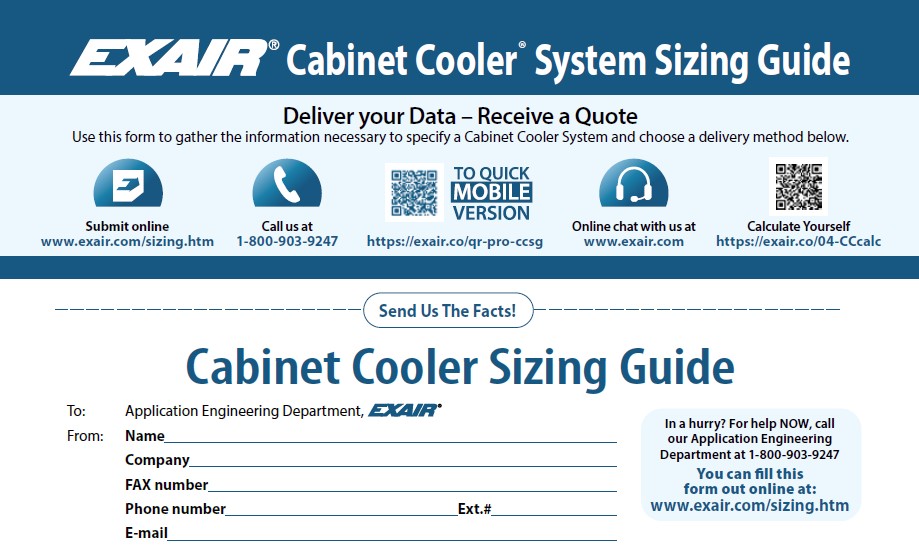
EXAIR’s Cabinet Cooler System Calculator simplifies this process. Enter your data online for an instant model recommendation, or submit the Sizing Guide to an EXAIR Application Engineer for assistance. For quick calculations, you can call EXAIR at 1-800-903-9247, and an engineer can estimate the heat load in minutes.

This NEMA 4 Dual Cabinet Cooler System protects a critical equipment panel on a hot roll steel line.

Second, select the Appropriate NEMA Rating

EXAIR Cabinet Coolers are designed to maintain the environmental integrity of your enclosure, with models available for different conditions. Choose a NEMA rating based on your application’s environment:

  • NEMA 12 (IP54): For indoor use, protecting against dust and oil. Ideal for general factory settings.
  • NEMA 4 (IP66): For indoor or outdoor use, offering dust, oil, and splash resistance. Suitable for wash-down areas or wet environments.
  • NEMA 4X (IP66): Same as NEMA 4 but made of corrosion-resistant stainless steel (Type 303 or 316). Perfect for food processing, pharmaceutical, or corrosive environments.
  • Hazardous Location (HazLoc): UL Classified for Class I Div 1, Class II Div 1, or Class III areas or ATEX Zones 2 & 22. Used in environments with explosive gases or dust, such as chemical plants or coal facilities. Must be paired with a purge and pressurization system.
  • High Temperature: For ambient temperatures of up to 200°F (93°C), such as near furnaces or in desert climates.

Ensure the Cabinet Cooler’s NEMA rating matches or exceeds your enclosure’s rating to maintain its integrity. For example, a NEMA 4X enclosure requires a NEMA 4X Cabinet Cooler.

From right to left: Small NEMA 12, Large NEMA 12, Large NEMA 4X

Third, choose the Operating System

EXAIR offers two operating modes to suit different cooling needs:

  • Thermostat-Controlled Systems: These are the most energy-efficient option, using a thermostat and solenoid valve to activate cooling only when the internal temperature exceeds the setpoint (preset at 95°F but adjustable). Includes a filter, cold air distribution kit, and solenoid valve (available in 120Vac, 240Vac, or 24Vdc). Ideal for enclosures with fluctuating heat loads or seasonal temperature changes.
  • Continuous Operating Systems: Provide constant cooling and positive pressure to keep out dust and debris. Best for applications requiring uninterrupted cooling or in extremely dirty environments. Includes a filter and cold air distribution kit.

For precise temperature control, consider adding an Electronic Temperature Control (ETC), which offers digital monitoring and easy temperature adjustments, especially useful in sensitive applications like pharmaceutical plants.

Fourth, Consider Additional Options

EXAIR provides accessories and features to tailor the Cabinet Cooler to your needs:

  • Non-Hazardous Purge (NHP): Delivers a 1 SCFM airflow to maintain positive pressure when cooling isn’t needed, keeping dust and debris out of the enclosure.
  • Side Mount Kits: Allow installation on the side of the enclosure if top mounting isn’t feasible due to space constraints for the NEMA 4 and 4X coolers.
  • High-Temperature Models: Designed for ambient temperatures between 125°F and 200°F (52°C–93°C).
  • Material Options: Standard models use aluminum, while NEMA 4X models offer Type 303 or 316 stainless steel for corrosion resistance.
  • Voltage Options: Solenoid valves for thermostat-controlled systems are available in 120Vac, 240Vac, or 24Vdc to match your electrical setup.

Final Tips for Success

  • Act Early: Install a Cabinet Cooler before heat-related failures occur, especially in summer or high-temperature environments.
  • Plan for Installation: Ensure all enclosure openings (e.g., fan vents) are sealed to maintain positive pressure and prevent contamination.
  • Monitor Performance: Use the ETC for real-time temperature monitoring in critical applications.
Inside, outdoors, high temperature, dirt/dust/humidity, corrosive and classified environments are no problem for EXAIR Cabinet Cooler Systems

Choosing the right EXAIR Cabinet Cooler involves calculating your heat load, selecting the appropriate NEMA rating, deciding between thermostat-controlled or continuous operation, and ensuring a reliable compressed air supply. By using EXAIR’s Sizing Guide or Calculator and consulting with myself or any one of our Application Engineers, you can confidently select a system that protects your electronics, minimizes downtime, and saves on maintenance costs.

Ready to cool your enclosures? Visit EXAIR.com to explore Cabinet Cooler options, use the Cabinet Cooler System Calculator, or contact an Application Engineer at 1-800-903-9247. Keep your electronics cool and your operations running smoothly with a EXAIR Cabinet cooler system.

Jordan Shouse, CCASS

Application Engineer

Send me an email
Find us on the Web 
Like us on Facebook
Twitter: @EXAIR_JS

You Have To Start Somewhere.

The school year is in full swing here in Cincinnati and all three of my daughters have different extracurricular activities they partake in. This fall, that equates to divide and conquer for my wife and me 4 nights of the week for practices then the weekends are also separate and conquer, but mainly on Saturday. This eats away at times we would typically use at home to get some walking in or even just generally getting stuff done. This schedule combined with working earlier has caused me to lose almost all workout desire. That is until I got to the first practice my oldest had which just happens to be held on my alma mater’s campus and is right next to Nippert Stadium.

When we arrived I noticed most parents were just hunkered down in their cars and watching movies or doom scrolling social media. I try to avoid doing that for 90 minutes straight if I can and so far I have. I started hitting the stairs at the University of Cincinnati’s Nippert Stadium with my 35-pound ruck on my back. While my goal is to be able to complete the standard they have for their 9/11 memorial event I also want to get back into the shape I was in when I did back-to-back GORUCK events and could crank out burpees without crying on the outside. After going up one column of stairs from the field to the concourse level I go across and down the next set until I have done every column of stairs that go from the concourse to the area directly. For their event, I have to complete two laps which will equate to the number of steps within one of the towers.

So to train, I started with seeing how many sets I could do without feeling like I was going to not be able to reach the top and walk to the car. Surprisingly, I was able to get about half of the stadium done. Then I still had another hour to kill, so I hydrated a bit and rucked on over to the track/soccer field where I could walk the track and watch co-ed intramural flag football games while I did laps. Finally, I threw in some ruck PT exercises as a cool down and ended back at the building her practice was in. When I got to work the next day I felt like I got beat with a sack of oranges from my waist down. Then, on Thursday the thought crossed my mind as I hadn’t slept much the night before to just relax, then I had a buddy ask if he could come do stairs with me, and so we did it again Thursday night.

So from now until the end of the school year, I will more than likely be rucking on or around UC’s campus and Nippert Stadium to ensure I get back into a reasonable condition without having to lose more time with my family. This isn’t always easy and doesn’t come without pain. That pain though comes with added energy and increases in my mental position as well, so I am open to more things.

The same thing can be said about an industrial compressed air system. If you just trudge through every day and don’t look at any part of your facility, it is going to cause some pain when you first start to look at it. The first step is to acknowledge that something needs to change, and you have to have that finished goal of more capacity and capability available. The best place to start on your compressed air system is at the start with mapping out the system and getting a base measurement of where you are at for consumption.. This is the first step in our 6 steps of compressed air optimization, and we can help with every step along the way, You just have to reach out to us, your accountability partner for efficient compressed air.

Brian Farno
Application Engineer
BrianFarno@EXAIR.com
@EXAIR_BF

Customized Cooling

Have you ever walked through a production facility and actually looked at and in electrical cabinets? If you did, you would find very few that are identical and even ones that are similar sizes; the internals can be drastically different. When I was in the metal cutting industry customizing, installing, and servicing CNC machines, the same model machine may have different drives for an extra option and can easily add additional heat load to the panel. Bring this up because it’s time we talk about how the dimensions of a panel are not enough to select the level of cooling needed.

Some manufacturers of air movers and “traditional” enclosure cooling method devices will use merely the dimensions of a panel to estimate a heat load and then treat the panel for the worst case scenario. Sometimes it may even be a worst-case scenario for that size of panel. I’m here to tell you from experience that’s not always the best option. This is why we like to have additional information, an “inside man” on the panel, if you will. We want to know exactly what kind of air temperatures we are seeing so that we can use that information combined with some math to determine an acceptable heat load that needs to be dissipated.

The information permits us to size the Cabinet Cooler system for your exact panel; even if you have two that are the same size but one of them has some additional drives or circuits running through it, we can account for that. The reason it is essential to size each panel that has anything different in it is that all devices have some level of efficiency. So the power they consume isn’t 100% converted into their intended function. This results in some level of heat generation. That means different internal components, and different heat loads, easy as that.

This is one of the reasons we took so much care when designing and refining our Cabinet Cooler Calculator. Each variable will impact the heat load and model selection for the Cabinet Cooler System. Some major factors, such as solar heat load and cabinet color, are even accounted for when panels are located outside. We even account for existing fans that will need to be removed to seal the panel. This is because all of these factors directly affect the amount of cooling needed.

Suppose you are looking to cool down some electrical cabinets throughout your facility and want to fully understand what heat load you may need to dissipate and maintain a safe operating environment; check out our Cabinet Cooler Calculator, or contact an Application Engineer today. In that case, we can size the system while we are talking on the phone with you.

Brian Farno
Application Engineer
BrianFarno@EXAIR.com
@EXAIR_BF