Turn it Down: Save Money by Reducing Compressed Air Pressure

If there’s one thing I’ve learned about compressed air, it’s that pressure is a lot like coffee. A little bit gets the job done, but too much just makes you jittery and costs you more than it should. The last step in our 6 Steps to Optimizing Compressed Air series is all about dialing that pressure back to where it actually needs to be. So why worry about pressure?

Compressed air is one of the most expensive utilities in your facility. For every couple of PSI you crank the system higher than necessary, your energy bill climbs right along with it. In most cases, your application doesn’t even need that extra pressure. It’s like using a fire hose to water a houseplant.

This is where pressure regulators come in. They’re simple devices, a knob, a spring, a diaphragm, but they’re doing some heavy lifting. Twist the knob, and the spring loads or unloads. That changes how much the diaphragm allows through, and suddenly you’ve got a steady, consistent downstream pressure without overfeeding your air tools or EXAIR products.

The real magic happens when you lower that setpoint. If your Super Air Knife is blowing water off parts just fine at 60 PSIG, why run it at 100 PSIG? Less pressure means less flow, and less flow means more savings. You’ll get the same result with a smaller demand on the compressor. That’s a win-win every plant manager can appreciate.

Now, before you start cranking down knobs all over the place, keep sizing in mind. Regulators need to be matched to the volume of air your application requires. If they’re undersized, you’ll experience droop, when the pressure drops off during demand spikes. EXAIR takes the guesswork out by offering properly sized regulators in kits with a lot of our products. We’ve already done the math so you don’t have to.

Turning down the pressure might be the last of the six steps to optimizing compressed air, but it’s one of the easiest changes to make and one of the fastest ways to save. A couple twists of the regulator could be all it takes to lighten the load on your compressor, cut operating costs, and keep your system running lean and efficient.

And if you’re not sure where to start, that’s what our Application Engineers are here for. Call us, chat with us, or shoot us an email. We’ll help you find the right pressure for your setup without the trial and error.

EXAIR is now partnering with EasyCAS by DirektIn software. This tool lets you actually measure and validate the savings you’re getting from steps like lowering pressure and implementing engineered solutions. No more guessing, you’ll have hard data showing how much air and money you’re saving.

Tyler Daniel, CCASS

Application Engineer

E-mail: TylerDaniel@EXAIR.com

X: @EXAIR_TD

EXAIR E-Vac Vacuum Generator Accessories: Overview

Vacuum systems are becoming more and more prevalent within manufacturing day by day. Vacuum powered lifts can make it easy to lift and move small objects like tiny coins to heavy steel plates. Vacuum chucks hold work pieces that could be marred by jaws or vises. And sealed vessels can be pressure tested or tested for leaks by pulling a vacuum on them. It’s pretty simple to pick out which vacuum generator that you need, but what about the accessories? There are so many different accessories to choose from such as mufflers, suction cups, hose, valves, and connections. The following is a quick overview of the different accessories that you can get from EXAIR along with your E-Vac vacuum generator.

Vacuum cups for E-Vac generators

Suction cups are a very common accessory that you need when using a vacuum system. Vacuum cups allow one to create a seal on the surface of the object that you wish to pick up and is what allows the system to lift objects. We offer four different kinds of vacuum cups to choose from stock; available are small and large Round, Oval, and Bellow styles. Round cups are more suited to being used on smooth, flat surfaces. Oval cups provide the most vacuum due to the larger surface area making them ideal for lifting heavy loads. The Bellows style is best suited for textured or uneven surfaces; the folds provide a collapsible area that allows the cup to compress and seal on an uneven surface.

EXAIR’s Standard and Straight Through Muffler

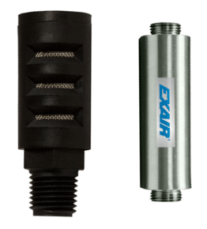
Next up is the mufflers; they muffle the sound generated by the E-Vac and quiet a working vacuum generator. There are two different types of mufflers from EXAIR that are available; these are the Standard and the straight through mufflers. The Standard muffler is designed to be attached to the discharge end of an in-line E-Vac and has a closed end. These are best suited for applications that are free from dust and debris. The straight through muffler is open all the way through and are more suited to applications were dirt, dust and debris is present. The straight through style also offers the best sound level reduction, up to 26 dBA.

Lastly the E-Vacs have an NPT threaded connection that will allow for a suitable connector to be properly installed. From here different connectors can be used to attach the various amounts of vacuum cups. The connectors provided are Push-In Connector Type Fittings of assorted styles available with our polyurethane tubing to make the installation and plumbing a cinch.

If you have any questions or want more information on EXAIR’s E-Vacs and their Accessories. Give us a call, we have a team of application engineers ready to answer your questions and recommend a solution for your applications.

Cody Biehle
Application Engineer
EXAIR Corporation
Visit us on the Web
Follow me on Twitter
Like us on Facebook

EXAIR Vacuum Generators and Accessories

So, you’re looking at picking out a vacuum generator for your application but don’t know what accessories you need? Well here is a little overview of EXAIR’s E-Vac system’s accessories that you have to choose from. The E-Vac has a variety of uses from pulling a vacuum on a chamber to lifting Concreate cinder blocks. Here at EXAIR we offer everything that you may need to get started; this includes mufflers, vacuum cups, hose, and fittings.

Vacuum cups for E-Vac generators

Every time I hear someone talking about trying to pick something up the first line that comes to mind is “The claaaaaaw.”. But sometimes a claw or gripper isn’t the answer for the solution; using a variety of vacuum cups one can practically pick up almost anything. We offer four different kinds of vacuum cups to choose from stock; available are small and large Round, Oval, and Bellow styles. Round cups are more suited to being used on smooth, flat surfaces. Oval cups provide the most vacuum due to the larger surface area making them ideal for lifting heavy loads. The Bellows style is best suited for textured or uneven surfaces; the folds provide a collapsible area that allows the cup to compress and seal on the uneven surface.

EXAIR’s Standard and Straight Through Muffler

Next up is the mufflers; EXAIR’s mufflers do just that, they muffle down the sound generated by the E-Vac. There are two different types of mufflers that are available; these are the Standard and the straight through mufflers. The Standard muffler is designed to be attached to the discharge end of an in-line      E-Vac and has a closed end. These are best suited for applications that are free from dust and debris. The straight through muffler is open all the way through and are more suited to applications were dirt dust and debris is present. The straight through style also offers the best sound level reduction, up to 26 dBA.

Lastly the E-Vacs have an NPT threaded connection that will allow for a suitable connector to be properly installed. From here different connectors can be used to attach the various amounts of vacuum cups. The connectors provided are Push-In Connector Type Fittings of assorted styles available with our polyurethane tubing to make the installation and plumbing a cinch.

If you have any questions or want more information on EXAIR’s E-Vacs and their Accessories. Give us a call, we have a team of application engineers ready to answer your questions and recommend a solution for your applications.

Cody Biehle
Application Engineer
EXAIR Corporation
Visit us on the Web
Follow me on Twitter
Like us on Facebook

Swivel Fittings: Adjusting Their Way Into Your Application

Ever had that spot that you needed to blow off but no matter how hard you tried you couldn’t reach the spot with piping? Well here at EXAIR we’ve got a solution for you; Introducing the swivel fitting! When blowing off various parts it is better to have an angled sweep of air rather than blowing directly across or directly down onto the part. EXAIR’s Swivel fittings provide a movement of 25 degrees from the center, meaning a total of 50 degrees.

EXAIR’s Swivel Fittings Adjusted
Regardless of size of the air nozzle we can provide a swivel fitting to fit all of our nozzles starting at an M4 Thread up to a 1” NPT. The M4 (4mm), M5 (5mm), and M6 (6mm) swivel fittings come with a Female NPT to screw the nozzle into and a Male NPT to attach to the swivel fitting to the pipe. For our 1/8” Fitting up to the 1” Fittings a male NPT is used to connect the Nozzle and a female NPT is used to connect to the pipe. The swivel fittings can easily be adjusted by either loosening or tightening the center hex nut.
EXAIR’s Family of Swivel Fittings
If the swivel fitting doesn’t give you the adjustment that you need, they can be coupled with our Stay Set Hoses to give extra adjustment and positioning. Our stay set hoses come in lengths of 6” all the way up to 36” and provide easy positioning for your application. Of course, these hoses can also be used without a swivel fitting. 
EXAIR’s Family of Stay Set Hoses
Swivel fittings are not used with just air nozzles, in many cases swivel fittings have been used with our smaller Air Amplifiers and our 3” Air Knifes.

For more information on EXAIR’s Swivel Fittings, Stay Set Hoses, or any EXAIR‘s Intelligent Compressed Air® Product lines, feel free to contact EXAIR and myself or any of our Application Engineers can help you determine the best solution.

Cody Biehle
Application Engineer
EXAIR Corporation
Visit us on the Web
Follow me on Twitter
Like us on Facebook