Using Accessories to Boost Your Tools

I was once on a local theater’s website, ordering tickets to an upcoming show that my wife and I were excited to see. I had the option to pay online and have a digital code emailed to me in lieu of a real live paper ticket. Can you believe they wanted to charge me almost $2 A TICKET for that?!? I adamantly refused (by that I mean I clicked the mouse extra hard on the “Will Call” button before completing my payment)…and saved that $4 (almost) for something REALLY important.

The night of the show, there was a 20-minute line at the Will Call window. Folks who had opted for the digital code were doing a quick scan with their smartphones and walking straight into the theater. I used the $4 I saved to partially pay for a $10 glass of wine from a concession kiosk in the lobby, as a peace offering for my lovely bride. That was indeed “something REALLY important.”

Another time, I was ordering a sump pump backup system for our house. I had the option of paying extra for the deluxe system, which came with all the fittings and a special tool to make installation a bit easier. Even though the ‘deluxe’ system adder was probably a bit more than the cost of the fittings from my local hardware store, I paid the “convenience fee” and got the deluxe system anyway. For the record, during the installation, I realized I would have bought an incorrect fitting at the local store which would have forced an emergency trip while I had the water turned off in my whole house. THAT was an inconvenience I was glad to have avoided.

Similarly, you can buy any EXAIR product with, or without, accessories that’ll make for simpler installation, improved performance, and to ensure it does what you want it to do. Some of these are product-specific, but many are suitable (and recommended) for use with any of our products:

Filter Separators

Good engineering practice calls for point of use filtration for any compressed air operated device. Even if you have the best intake & discharge filters on your air compressor, trace amounts of contaminants can sneak through, pipes can rust, and water vapor that the dryer doesn’t catch can condense. Particulates can build up and eventually clog the tight clearances in many engineered compressed air products, and if you’re using air for cleaning, drying, etc., keep in mind that whatever’s in your air will get on your product. Moisture isn’t always as big of a deal, but it can freeze inside Vortex Tubes, Spot Cooling Products, Cold Guns, and Cabinet Cooler Systems. That’s why we include Filter Separators in our Air Knife, Air Wipe, Static Eliminator Products, Line Vac, Adjustable Spot Cooler, Cold Gun, and Cabinet Cooler System Kits.

Automatic Drain Filter Separators come in sizes from 1/4 NPT to 1-1/4 NPT, for compressed air flows up to 400 SCFM.

Oil Removal Filters

These aren’t always needed, but we have them if your application calls for it. Some of the “usual suspects” are food & Pharma (see above “whatever’s in your air will get on your product”), blowoff prior to painting (the smallest amount of oil on the surface causes a phenomenon known as “fish eye” and it looks exactly like that sounds), or when your compressor is known to have oil carryover.

When properly installed downstream of an Automatic Drain Filter Separator (left,) an Oil Removal Filter (center) will provide clean, oil free air to the Pressure Regulator (right) and all downstream components.

Pressure Regulators

One of our Six Steps To Optimizing Your Compressed Air System is to control the air pressure at the point of use to minimize air consumption. In other words, find the supply pressure for your product that gets the job done, so you don’t use any more compressed air than you have to. Like the Filter Separators above, these come with many EXAIR Intelligent Compressed Air Product Kits.

Pressure Regulators “dial in” performance to get the job done without using more air than necessary.

Mounting Brackets and Coupling Kits

Most of our Filter Separators, Oil Removal Filters, and Pressure Regulators can be attached to a wall, panel, etc., with a Mounting Bracket, and can actually be attached to each other with a modular Coupling Kit. These parts simplify the installation, ensure they are oriented correctly, and minimize the chance for air leaks.

Filters (left) and Pressure Regulators (center) can be mounted using Brackets, and they can be connected together with Modular Couplers (right).

Silencing Mufflers

Many EXAIR products are engineered to develop a boundary layer of low velocity air flow that greatly reduces the sound level during operation. Other products use a venturi mechanism to draw a vacuum (Reversible Drum Vacs and E-Vac Vacuum Generators) or a Vortex Tube to generate cold air flow. The air flow from these products cannot be subjected to back pressure, and, without anything to mitigate the sound pressure generated by the rapid pressure drop as the air exits, they can be quite loud. For these, we have Silencing Mufflers that, except for the largest & most powerful of these products, reduce the sound level to be compliant with OSHA Standard 1910.95 Maximum Noise Exposure Limits.

From left to right… Reclassifying Mufflers offer the highest noise level reduction, eliminate oil mist, and come in sizes from 1/8 NPT to 1 NPT.
Sintered Bronze Mufflers are low cost and compact, with threads from #10-32 to 1-1/2 NPT.
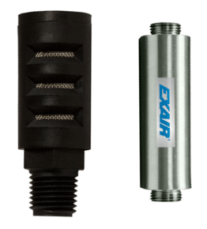
Straight Through Mufflers use an internal sleeve of sound reducing foam, with threads from ¼ NPT to ¾ NPT, with male threads on one end and female threads on the other.
Heavy Duty Mufflers have an aluminum shell and an internal stainless steel screen that keeps contaminants like rust from being ejected in a dangerous way.  We have them in ¼ NPT and ¾ NPT sizes.

Shutoff and Solenoid Valves

Another one of our Six Steps To Optimizing Your Compressed Air System is to turn off the compressed air when it’s not in use. For this, EXAIR offers manual ball valves, for operator control, and Solenoid Valves, to automate the process.

Solenoid Valves (left) are available for 120VAC, 240VAC, and 24VDC in sizes from 1/4 NPT to 1 NPT. We offer manual Ball Valves in sizes from 1/8 NPT to 1-1/4 NPT.

Swivel Fittings, Stay Set Hoses, and Magnetic Bases

EXAIR Super Air Nozzles are threaded for installation with common air pipe & hose fittings. If the pipe isn’t pointed in the exact right direction, a Swivel Fitting gives you 50°  of adjustability. If the pipe isn’t quite close enough to what you want to blow off, Stay Set Hoses come in lengths of 6″ to 36″, and when bent to aim the Air Nozzle, they ‘stay set’, as advertised, until they need to be moved. If a pipe doesn’t exist and you need to run an air hose from the nearest drop on the header, Magnetic Bases can support the Air Nozzle and a Stay Set Hose to get the air where you want it. They even have shutoff valves to turn them off when they’re not in use (that’s a good thing; see above).

Save installation time AND get your blowoff pointed in the right direction!

Hoses and Compressed Air Fittings

If you need one of the aforementioned air hoses to reach a Magnetic Base or to supply a Safety Air Gun, we have two diameters to choose from – 3/8″ ID (1/4 MNPT threads on the ends) and 1/2″ ID (1/2 MNPT threads on the end), and we can make them to any length you need. And, while our selection probably isn’t quite as comprehensive as your local piping supply shop, we stock a number of pipe nipples, Couplers, Reducers, Tees, and Elbows that are commonly used with our products. So – like my backup sump pump deluxe kit, we can put all the fittings you may require in the same box for you.

Contact an Application Engineer if you have ANY questions about how to properly supply compressed air to your EXAIR products.

At EXAIR, we’re here to make sure you get the most out of our products, and your compressed air system. If you need accessories to help with that, give me a call.

Russ Bowman, CCASS

Application Engineer
Visit us on the Web
Follow me on Twitter
Like us on Facebook

Pressure Drop and Compressed Air Piping

EXAIR has been manufacturing Intelligent Compressed Air Products since 1983. They are engineered with the highest of quality, efficiency, safety, and effectiveness in mind. Since compressed air is the utility for operation, the performance limitations can be defined by its supply. With EXAIR products and pneumatic equipment, you will need a way to transfer the compressed air from the source to the point-of-use. There are three main ways; pipes, hoses and tubes.

One of the largest systematic problems with compressed air systems is pressure drop.  If too large a pressure loss occurs, pneumatic equipment will not have enough power to operate effectively and efficiently.  The amount of pressure drop is based on restrictions, obstructions, and piping.  When air is forced into small areas, it will cause a high velocity.  The high velocity will create turbulent air flow which increases the pressure loss.  A restrictive type of pressure drop can be found in different forms, like small diameter pipes or tubing; or restrictive fittings like quick disconnects and needle valves, and undersized filters, regulators and valves. 

Why did I bring this up? Pressure drop… Pressure Drop is a waste of energy, and it reduces the ability of your compressed air system to do work. To cut waste, we need to reduce pressure drop.  If we look at the equation for pressure drop, we can find the factors that play an important role. Equation 1 shows an equation for pressure drop.

Equation 1:

From Equation 1, differential pressure is controlled by the flow of compressed air, the length of the pipe, the diameter of the pipe, and the inlet pressure. As you can see, the pressure drop is inversely affected by the inner diameter to the fifth power. So, if the inner diameter of the pipe is twice as small, the pressure drop will increase by 25, or 32 times.

It is very important to know the inner diameter of the supply lines to your pneumatic devices.  As an example, a model 110006 6” Super Air Knife will need a 3/8″ black, schedule 40 pipe that has an I.D. of 0.493″ (12.5 mm).  We use this pipe to flow 21 SCFM of compressed air at 100 PSIG through 50 feet of pipe.  What would be the pressure drop?  With Equation 1, we get a pressure drop of 1.28 * (21 SCFM/60) ^1.85 * 50 feet / ((0.493″)^5 * 100 PSIG) = 3.15 PSID.  Thus, you started with 100 PSIG, and at the end of the 50 ft. pipe, you will only have (100 PSI – 3.15 PSI) = 96.85 PSIG to use. 

Let’s look at a 3/8” hose and a 3/8” tube. The 3/8” hose has an inner diameter of 0.375” (9.5 mm), and the 3/8” tube has an inner diameter of 0.25” (6.4 mm). In keeping the same variables except for the diameter, we can calculate the pressure drop with the above equation. 3/8″ hose = 1.28 * (21 SCFM/60) ^1.85 * 50 feet / ((0.0.375″)^5 * 100 PSIG) = 12.4 PSID. 3/8″ tube = 1.28 * (21 SCFM/60) ^1.85 * 50 feet / ((0.25″)^5 * 100 PSIG) = 94 PSID.

As you can see, the 3/8” hose has a pressure drop 3.94 times higher than the 3/8″ NPT pipe. Also, the 3/8″ tube has a pressure drop 7.6 times higher than the hose. 

Diameters: 3/8″ Pipe vs. 3/8″ tube

At EXAIR, we want to make sure that our customers are able to get the most from our products. To do this, we need to properly size the compressed air lines. Within our installation sheets for our Super Air Knives, we recommend the in-feed pipe sizes for each air knife at different lengths. (You will have to sign in to the website to download).  We also have an excerpt about replacing schedule 40 pipe with a compressed air hose. We state; “If compressed air hose is used, always go one size larger than the recommended pipe size due to the smaller I.D. of hose”. Here is the reason. The 1/4” NPT Schedule 40 pipe has an inner diameter of 0.364” (9.2mm). Since the 3/8” compressed air hose has an inner diameter of 0.375” (9.5mm), the diameter will not create any additional pressure drop. Some industrial facilities like to use compressed air tubing instead of hoses. This is fine as long as the inner diameters match appropriately with the recommended pipe in the installation sheets. Then you can reduce waste from pressure drops and get the most from your EXAIR as well as all other pneumatic products.

With the diameter playing such a significant role in creating or mitigating pressure drop, it is very important to understand the type of connections to your pneumatic devices; i.e. hoses, pipes, or tubes. In most cases, this could be the reason for the under performance of your pneumatic products, as well as wasting money through operation of your compressed air system. If you would like to discuss further the ways to save energy and reduce pressure drops, an Application Engineer at EXAIR will be happy to help you.

John Ball
Application Engineer
Email: johnball@exair.com
Twitter: @EXAIR_jb

EXAIR E-Vac Vacuum Generator Accessories: Overview

Vacuum systems are becoming more and more prevalent within manufacturing day by day. Vacuum powered lifts can make it easy to lift and move small objects like tiny coins to heavy steel plates. Vacuum chucks hold work pieces that could be marred by jaws or vises. And sealed vessels can be pressure tested or tested for leaks by pulling a vacuum on them. It’s pretty simple to pick out which vacuum generator that you need, but what about the accessories? There are so many different accessories to choose from such as mufflers, suction cups, hose, valves, and connections. The following is a quick overview of the different accessories that you can get from EXAIR along with your E-Vac vacuum generator.

Vacuum cups for E-Vac generators

Suction cups are a very common accessory that you need when using a vacuum system. Vacuum cups allow one to create a seal on the surface of the object that you wish to pick up and is what allows the system to lift objects. We offer four different kinds of vacuum cups to choose from stock; available are small and large Round, Oval, and Bellow styles. Round cups are more suited to being used on smooth, flat surfaces. Oval cups provide the most vacuum due to the larger surface area making them ideal for lifting heavy loads. The Bellows style is best suited for textured or uneven surfaces; the folds provide a collapsible area that allows the cup to compress and seal on an uneven surface.

EXAIR’s Standard and Straight Through Muffler

Next up is the mufflers; they muffle the sound generated by the E-Vac and quiet a working vacuum generator. There are two different types of mufflers from EXAIR that are available; these are the Standard and the straight through mufflers. The Standard muffler is designed to be attached to the discharge end of an in-line E-Vac and has a closed end. These are best suited for applications that are free from dust and debris. The straight through muffler is open all the way through and are more suited to applications were dirt, dust and debris is present. The straight through style also offers the best sound level reduction, up to 26 dBA.

Lastly the E-Vacs have an NPT threaded connection that will allow for a suitable connector to be properly installed. From here different connectors can be used to attach the various amounts of vacuum cups. The connectors provided are Push-In Connector Type Fittings of assorted styles available with our polyurethane tubing to make the installation and plumbing a cinch.

If you have any questions or want more information on EXAIR’s E-Vacs and their Accessories. Give us a call, we have a team of application engineers ready to answer your questions and recommend a solution for your applications.

Cody Biehle
Application Engineer
EXAIR Corporation
Visit us on the Web
Follow me on Twitter
Like us on Facebook

EXAIR Vacuum Generators and Accessories

So, you’re looking at picking out a vacuum generator for your application but don’t know what accessories you need? Well here is a little overview of EXAIR’s E-Vac system’s accessories that you have to choose from. The E-Vac has a variety of uses from pulling a vacuum on a chamber to lifting Concreate cinder blocks. Here at EXAIR we offer everything that you may need to get started; this includes mufflers, vacuum cups, hose, and fittings.

Vacuum cups for E-Vac generators

Every time I hear someone talking about trying to pick something up the first line that comes to mind is “The claaaaaaw.”. But sometimes a claw or gripper isn’t the answer for the solution; using a variety of vacuum cups one can practically pick up almost anything. We offer four different kinds of vacuum cups to choose from stock; available are small and large Round, Oval, and Bellow styles. Round cups are more suited to being used on smooth, flat surfaces. Oval cups provide the most vacuum due to the larger surface area making them ideal for lifting heavy loads. The Bellows style is best suited for textured or uneven surfaces; the folds provide a collapsible area that allows the cup to compress and seal on the uneven surface.

EXAIR’s Standard and Straight Through Muffler

Next up is the mufflers; EXAIR’s mufflers do just that, they muffle down the sound generated by the E-Vac. There are two different types of mufflers that are available; these are the Standard and the straight through mufflers. The Standard muffler is designed to be attached to the discharge end of an in-line      E-Vac and has a closed end. These are best suited for applications that are free from dust and debris. The straight through muffler is open all the way through and are more suited to applications were dirt dust and debris is present. The straight through style also offers the best sound level reduction, up to 26 dBA.

Lastly the E-Vacs have an NPT threaded connection that will allow for a suitable connector to be properly installed. From here different connectors can be used to attach the various amounts of vacuum cups. The connectors provided are Push-In Connector Type Fittings of assorted styles available with our polyurethane tubing to make the installation and plumbing a cinch.

If you have any questions or want more information on EXAIR’s E-Vacs and their Accessories. Give us a call, we have a team of application engineers ready to answer your questions and recommend a solution for your applications.

Cody Biehle
Application Engineer
EXAIR Corporation
Visit us on the Web
Follow me on Twitter
Like us on Facebook