2 EXAIR Solutions For A Single Plastic Injection Molding Process

I was recently contacted by a manufacturer of precision gearing components looking for assistance in their plastic injection molding process. Their needs were two fold as they were looking for a more efficient way of delivering the plastic pellets to the hopper and a way to remove fine particulate and eliminate the static on the gears after the molding process.

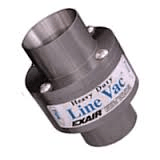
For the plastic pellets application, they were having an operator manually deliver the pellets to the feed hopper. I recommended they use our Light Duty Line Vac. The Light Duty Line Vac uses less compressed air than our other air operated conveyors and are ideal for moving material a short distance. We offer sizes from 3/4″ up to 6″ in aluminum construction. In this particular application, since the customer was only looking to move a few pounds a minute approximately 6′ vertically, I recommended our 2″ Light Duty Line Vac.
Light Duty Line Vac
Low cost, reliable way to move a small volume of material a short distance.

In the injection molding application, after the gears are molded they drop to a 12″wide conveyor where they travel side by side and pass under a print head. The customer currently had an operator that was using a blow gun to blow off any residual plastic fines but noticed they weren’t able to remove all of the particulate which caused irregularities when they tried to print their identification markings.

I recommended they use our 12″ Super Ion Air Knife in this process. The Super Ion Air Knife provides a high velocity, laminar sheet of ionized airflow across the entire length of the knife. Operating at 80 PSIG, it produces a velocity of 11,800 feet per minute (6” away), consumes only 2.9 SCFM per inch of knife and is capable of dissipating 5kV in 0.18 seconds. This would cover entire width of the conveyor, ensuring they are treating both gears, providing the needed static elimination and blow off to carry the fines away.

Super Ion Air Knife
Super Ion Air Knife – Available from 3″ up to 108″

For help with your application, please give us a call, we’d be glad to help.

Justin Nicholl
Application Engineer
justinnicholl@exair.com
@EXAIR_JN

On the lighter side

Well, it’s almost everyone’s favorite time of the year, swimsuit season!!!. I said ALMOST everyone. Which means that crash diets and “lighter” fare choices are in full swing. (I know I need to be incorporating these myself).

Sticking with this theme, I thought I would write this week’s blog on our Light Duty Line Vac. These units provide an alternative solution for conveying smaller volumes of material over a short distance.

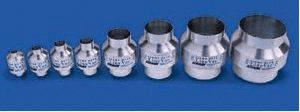
Available in eight common sizes, ¾” up to 6”, in aluminum construction, these units use less compressed air than our other Line Vac products. The Light Duty Line Vac also has no moving parts and requires no electricity to operate, making them virtually maintenance free!

Light Duty Line VacAir consumption is minimal, ranging from our smallest unit consuming 7.30 SCFM @ 80 PSI, up to our largest unit consuming 80.20 SCFM @ 80 PSI.  You can also control the conveying rate by regulating your compressed air supply pressure.

For even more control, you could add one of our Electronic Flow Control (EFC) which uses timing control and a photoelectric sensor to turn off your compressed air when there is no media/part present.

Image

To see our complete line of Air Operated Conveyors, visit our website www.EXAIR.com or if you need assistance with an application, please do not hesitate to contact an application engineer at 1-800-903-9247.


Justin Nicholl
Application Engineer
JustinNicholl@EXAIR.com
@EXAIR_JN

With so Many Vacuum Generator Choices, Which Do I Choose?

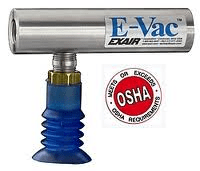
SAL                 HDLV                    E-vac

This is a very real question that we receive often from our customers. And that is why we have a full staff of Application Engineers, to answer just such a question. It is true that EXAIR has quite a variety of product that actually generates a “vacuum flow” of air. We have Air Amplifiers, Light Duty Line Vac, Line Vac, Heavy Duty Line Vac, Adjustable E-vac as well as Modular and In-Line E-vac products.  And that doesn’t even include our choices within the Industrial Housekeeping product group.

Back to the question at hand, how do I narrow my choices for which vacuum generator to use? The manner in which we approach such a question has to do with the application itself. We view the available range of product as a spectrum of choices from high volume, low vacuum (Air Amplifiers) air movers to low volume, high vacuum (In-Line E-vacs) air mover choices.

How do we navigate the choices?  It depends on the needs of the application. Allow me to give a few quick examples to give you an idea.

Example 1: The customer has a large air bag used in the trucking industry which is placed along-side a payload in order to reduce shifting during travel. The requirements of this application are that the bag be inflated and deflated in a reasonable time. The air pressure needed within the bag is considered quite low. So, in this case, we would gravitate toward using something along the lines of our Air Amplifier or Light Duty Line Vac which are more suited for this range of air moving applications where just air or perhaps light smoke or fumes may need to be transported.

Example 2: The customer has a shot blasting operation in which they need to collect the blast media back up into a central container for re-use or perhaps for recycling. In this scenario, the media itself actually needs to be moved and it is a rather dense, metal shot that needs a high velocity airflow to get it up and moving from point A to point B. Our Heavy Duty Line Vac is the perfect candidate for this kind of need as it delivers a good combination of high vacuum and high volume air movement to achieve goals of this nature.

Example 3: The customer has a reaction chamber in which they need to achieve -9” Hg (Mercury) vacuum in reasonably short time frame. Our Adjustable E-vacs work well to provide both high vacuum (even higher than HD Line Vac) and reasonably high (although lower than HD Line Vac) volume of vacuum flow. So, for applications where you have a large container on which a vacuum needs to be drawn or perhaps you have a large vacuum cup that is working with material that is considered very porous, these are the kinds of applications for which you would look at Adjustable E-vac.

Example 4: The customer has a set of 6 suction cups that are being used on a frame to pick-up a piece of window glass for placement into a window frame. With glass being a non-porous material, the customer only needs enough airflow to evacuate the area of the suction cup and hold on to the material tightly. This is the kind of application for which our In-Line E-vac would come in very handy to produce the low flow, high vacuum flow.

Where does your application fall within this spectrum of uses?  You aren’t sure?  Then contact our Application Engineering Department and speak with an Engineer today. We are glad to discuss with you and bring clarity to your application need.

Neal Raker, Application Engineer
nealraker@exair.com

Dust Removal With Super Ion Air Knife and Light Duty Line Vac

Cap De-duster

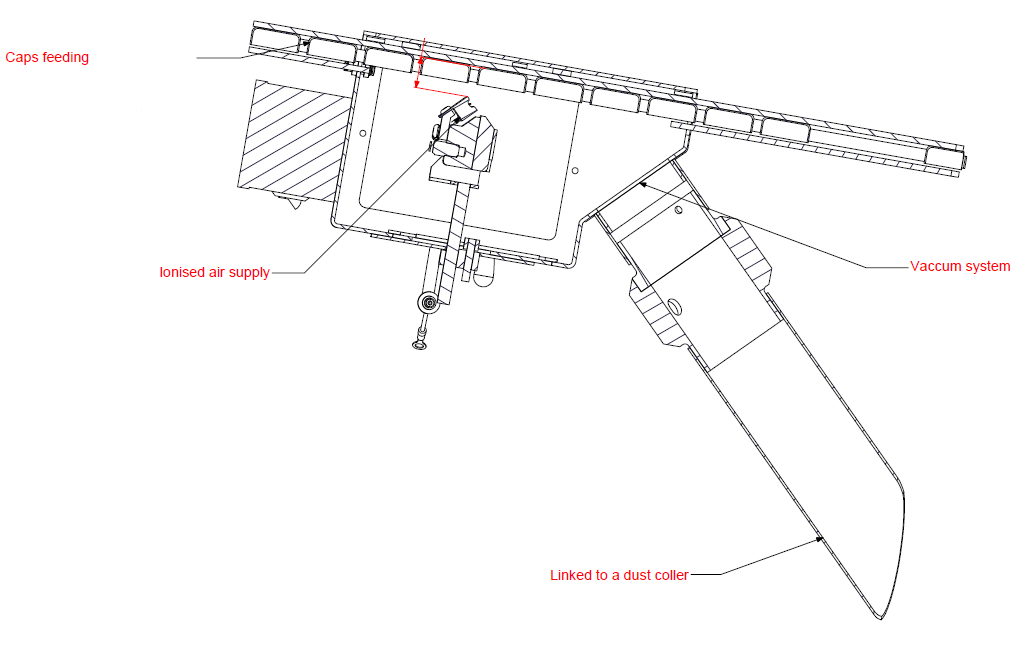
We always enjoy solving problems for the end users of our products.  Last fall I worked with a company in Lebanon needing to remove static dust from small caps as they travelled down a conveyor line.  We discussed the needs of the application, I made model number recommendations, and the system was installed.  Using a 3” Super Ion Air Knife and a Light Duty Line Vac, the end user was able to eliminate the static, remove the dust, and vacuum away the dust as needed.

Now, this same end user is aiming to repeat the application, only this time for a larger cap.  The setup is identical – the caps travel left-to-right on the conveyor track, they are blow off with ionized air from an EXAIR Super Ion Air Knife, and the dust is collected with a Light Duty Aluminum Line Vac.  The only revision to this system (and retroactively applied to the last) was to reposition the Super Ion Air Knife so that the caps spend more time in contact with ionized air.  This allows for increased throughput, should the application ever require increased production.

It’s great to solve problems for our customers.  It’s even better when the solution worked so well that it leads to repeat business.

If you have an application in need of an EXAIR device, but aren’t sure which one to use or where to start, contact an EXAIR Application Engineer.

Lee Evans
Application Engineer
LeeEvans@EXAIR.com
@EXAIR_LE

Audi Update:  The holiday break was slated as a perfect time to dive back into the engine concern on my latest project car, but, sadly, it didn’t happen.  Check my blog post next week for a full report.