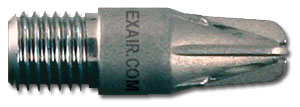
When selecting a blowoff solution, the direction of the airflow is crucial and is typically determined through experimentation. Once you identify the optimal angle for your engineered compressed air nozzle, it is essential to ensure its stability. This is where our Stay Set Hoses and Magnetic Bases prove invaluable, providing the necessary support to maintain the desired position.
Our Stay Set Hoses feature a memory function that prevents them from creeping or drooping unless physically adjusted, making them ideal for directing airflow precisely where needed. To ensure their longevity, it is important to adjust them correctly. Available in lengths ranging from 6 inches (15 cm) to 36 inches (91 cm), these hoses come with threaded connections, either with 1/4-inch NPT male threads on both ends or a combination of 1/8-inch NPT female and 1/4-inch NPT male threads. Constructed from reinforced synthetic rubber, they can handle a maximum pressure of 250 PSIG and operate effectively in temperatures of up to 158°F (70°C).
Mag Bases come with one or two outlets. Stay Set Hoses come in lengths from 6″ to 36″.
Our Mag Bases are designed for quick attachment to any solid steel surface, providing a robust pulling force of 100lb (45.5kg) to securely hold your blowoff device in place, whether positioned horizontally or vertically. They offer the convenience of easy relocation when adjustments are necessary. Available in three configurations—1-outlet, 2-outlet, and a 1-outlet swivel—these bases feature a 1/4 turn shut-off valve for straightforward control, ensuring efficient use of compressed air by preventing waste when not in use.
If you would like to investigate these products further or have questions about Mag Bases and Stay Set Hoses, or anything regarding EXAIR and our products, please do not hesitate to reach out. We would love to hear from you!
In most situations where an air nozzle is needed, you are looking to blow the chips or debris forward. There are certain applications where this is not practical, or even possible. If you are trying to clean out a blind hole, or a pipe where the end is blocked, or the length is too long that you cannot reach the other end, then EXAIR’s Back Blow Air Nozzle is the perfect solution. In this video I show the different options that we carry, and show how effective they are:
If you have an application you would like to discuss, then give us a call!
At EXAIR, we always recommend using the least amount of pressure to “do the job”. This helps to save money and save on compressed air. But some customers wish to use outdated methods, like open pipes, copper tubes, drilled pipes, etc. These methods are unsafe as well as waste money and compressed air. EXAIR has engineered nozzles to help enhance your blow-off devices. Here is a customer that I helped recently, to tell a story about the EXAIR Super Air Nozzles.
Blow off station
I received an email from an engineer who was looking at our Super Air Nozzles. The characters of the story were four blow-off lines that were made from 6mm ID copper tubes. (Reference picture above) The system was designed to blow out holes after machining. The engineer oversaw the task of optimizing 25 machining stations and this was the theme of the story. He purchased four Nano Super Air Nozzles, model 1110SS, for a trial. He was impressed with the performance, the low sound level and the design for safety. I would consider the Nano Super Air Nozzles as the protagonist. But, for the upper management in his company to sign off, he had to show cost savings and improvements. He asked me to help him to present this story in calculating the compressed air savings.
He gave me some additional details about their application to build the plot of the story. He was using compressed air about 50% of the time throughout an 8-hour day at a pressure of 80 PSIG. He asked me to find a happy ending to this story with the annual savings and the payback period. I did many of these calculations for other customers, and I was happy to help. It is sometimes easier to speak in terms of money for everyone to relate to a situation, especially management. (The numbers below can be adjusted to match your application and blow-off devices).
Knowns: Cost of compressed air: $0.25/1000 cubic feet of air (this is based on $0.08/Kwh electricity cost) Flow: 1110SS Nano Super Air Nozzle = 8.3 SCFM at 80 PSIG
A 6mm ID copper tube flow rate = 19.8 SCFM at 80 PSIG
The difference in compressed air flows from a 6mm tube to the Nano Super Air Nozzle is (19.8 SCFM – 8.3 SCFM) = 11.5 SCFM. At a 50% duty cycle, we get 11.5 SCFM * 0.5 = 5.75 SCFM (cubic feet/minute) of additional compressed air being used. Per year, the amount of compressed air wasted is: 5.75 Ft3/min * 60 min/hour * 8 hours/day * 250 days/year = 690,000 cubic feet per year.
With the cost to make compressed air at $0.25/1000 cubic feet, we are saving: 690,000 Ft3/year * $0.25/1000 Ft3 = $172.50 per year per nozzle.
From these values, we get the payback period for a model 1110SS Nano Super Air Nozzle to be just around 97 days.
The remaining life of the Super Air Nozzle will save the company a lot of money by using less compressed air. The calculations above are only for one nozzle. As discussed above with the engineer, they had 4 tubes/station and 25 stations in their plant. So, if you multiply each figure by 100, you can see the amount of money that can be saved; a total of $172.50 * 100 = $17,250 per year. The engineer presented the complete story to upper management, and it was an easy decision to replace the copper tubes with EXAIR nozzles.
The moral of the story is, don’t be fooled by the upfront low cost of a tube, pipe, drilled hole, or a substandard nozzle. The operational cost outweighs the acquisition cost every time. With the characters, plot, and the setting of this story, not going with an engineered solution will cost you a lot of money in the long run. With a mindset of taking total cost of ownership into account, another positive attribute is the improvement in safety. EXAIR engineered nozzles are designed to be OSHA compliant.
If you want help to write your own storybook, happy ending, you can contact an Application Engineer. We will be happy to assist you in finding a hero for your blow-off stories.
Scrape off, and blow away, stubborn debris with the Model 1244-48 Soft Grip Super Air Scraper.
EXAIR’s Soft Grip Super Air Scraper is an innovative safety air gun specifically engineered to tackle the most persistent debris encountered in industrial environments. Its patented design incorporates a scraping blade that enhances the effectiveness of powerful compressed air, facilitating the removal of various materials such as caulk, gaskets, sealants, adhesives, tape, paint, stickers, labels, grease, lubricants, and challenging metal chips or flakes. This tool is essential for maintaining cleanliness and functionality in machining tables, sub plates, and assembly stations.
Soft Grip Super Air Scraper
The corrosion-resistant steel scraper is designed to be used with a 2″ Flat Super Air Nozzle and a 3/4″ extension, ensuring the strength and durability needed for even the most demanding cleaning tasks. Extensions for the Soft Grip Super Air Scraper range from 6″ to 72″ in length, making it easier to clean table tops, access hard-to-reach areas inside machines, and reach floors or other distant surfaces. Additionally, Chip Shields are available to enhance the cleaning process.
EXAIR Model 1210 Soft Grip Safety Air Gun
The Soft Grip Safety Air Gun is designed for prolonged use without causing fatigue. Its ergonomic structure ensures that the hand remains in a comfortable position, while the large trigger allows for operation using one or multiple fingers. Constructed from durable cast aluminum, this air gun is built to withstand tough industrial environments and features a handy hanger hook for convenient storage.
The 2″ Super Air Scraper is a patented nozzle designed to effectively remove stubborn debris from various surfaces, including work areas and machinery. Featuring a flat, 2″ corrosion-resistant scraper blade, this nozzle provides the necessary leverage to dislodge fixed debris, allowing the air to efficiently clear it away from the surface.