
Compressed Air System Optimization – Where Do Receiver Tanks Fit?

SixSteps

The 5th step in the 6 steps to optimizing your compressed air system highlights the use of intermediate storage of compressed air near the point of use. Secondary, or intermediate Receiver tanks are installed in the distribution system to provide a source of compressed air close to the point of use, rather than relying on the output of the compressor.

Compressed air receiver tanks are an integral part to many compressed air distribution systems. Compressed air is stored at a high pressure after drying and filtration, but just upstream of point of use devices. The receiver tank is charged to a pressure higher than what is needed by the system, creating a favorable pressure differential to release compressed air when needed.

Think of a compressed air receiver tank as a “battery”. It stores the compressed air energy within a system to be used in periods of peak demand, helping to maintain a stable compressed air pressure. This improves the overall performance of the compressed air system and helps to prevent pressure drop.
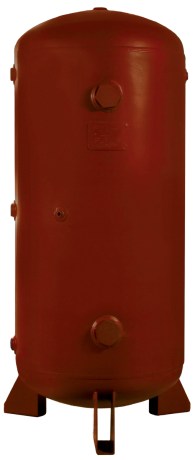
receiver_tank

They can be strategically placed to provide a source of compressed air to intermittent high volume compressed air applications. Rather than having to pull from the compressor, a receiver tank can be sized to provide the short-term volume of air for a particular application. In a previous post, we’ve highlighted how to calculate the necessary receiver tank based on the air consumption and duration of the application.

EXAIR offers from stock a 60-gallon receiver tank designed specifically for these higher-usage intermittent types of applications. Model 9500-60 can be installed near the point of high demand so that you have an additional supply of compressed air available for a short duration. The tank comes with mounting feet and is designed to stand up vertically, saving floor space. The tank meets American Society of Mechanical Engineers (ASME) pressure vessel code.

Just this past Spring, EXAIR hosted a live webinar where we discuss how to size, install, and implement secondary storage in your plant’s distribution system. If you missed it, check it out here on our website hosted by my colleague, Russ Bowman.

If you have an application in your facility that’s draining your compressed air system, a receiver tank could be the ideal solution. Give us a call and one of our Application Engineers will be happy to help evaluate your process and determine the most suitably sized receiver tank.

Tyler Daniel, CCASS
Application Engineer
E-mail: TylerDaniel@EXAIR.com
Twitter: @EXAIR_TD

Critical Components of Your Compressed Air System

In any manufacturing environment, compressed air is critical to the operation of many processes. You will often hear compressed air referred to as a “4th utility” in a manufacturing environment. The makeup of a compressed air system is usually divided into two primary parts: the supply side and the demand side. The supply side consists of components before and including the pressure/flow controller. The demand side then consists of all the components after the pressure/flow controller.

The first primary component in the system is the air compressor itself. There are two main categories of air compressors: positive-displacement and dynamic. In a positive-displacement type, a given quantity of air is trapped in a compression chamber. The volume of which it occupies is mechanically reduced (squished), causing a corresponding rise in pressure. In a dynamic compressor, velocity energy is imparted to continuously flowing air by a means of impellers rotating at a very high speed. The velocity energy is then converted into pressure energy.

Still on the supply side, but installed after the compressor, are after coolers, and compressed air dryers. An after cooler is designed to cool the air down upon exiting from the compressor. During the compression, heat is generated that carries into the air supply. An after cooler uses a fan to blow ambient air across coils to lower the compressed air temperature.

When air leaves the after cooler, it is typically saturated since atmospheric air contains moisture. In higher temperatures, the air is capable of holding even more moisture. When this air is then cooled, it can no longer contain all of that moisture and is lost as condensation. The temperature at which the moisture can no longer be held is referred to as the dewpoint. Dryers are installed in the system to remove unwanted moisture from the air supply. Types of dryers available include: refrigerant dryers, desiccant dryers, and membrane dryers.

Also downstream of the compressor are filters used to remove particulate, condensate, and lubricant. Desiccant and deliquescent-type dryers require a pre-filter to protect the drying media from contamination that can quickly render it useless. A refrigerant-type dryer may not require a filter before/after, but any processes or components downstream can be impacted by contaminants in the compressed air system.

Moving on to the demand side, we have the distribution system made up of a network of compressed air piping, receiver tanks when necessary, and point of use filters/regulators. Compressed air piping is commonly available as schedule 40 steel pipe, copper pipe, and aluminum pipe. Some composite plastics are available as well, however PVC should NEVER be used for compressed air as some lubricants present in the air can act as a solvent and degrade the pipe over time.

Receiver tanks are installed in the distribution system to provide a source of compressed air close to the point of use, rather than relying on the output of the compressor. The receiver tank acts as a “battery” for the system, storing compressed air energy to be used in periods of peak demand. This helps to maintain a stable compressed air pressure. It improves the overall performance of the system and helps to prevent pressure drop.

Finally, we move on to the point-of-use. While particulate and oil removal filters may be installed at the compressor output, it is still often required to install secondary filtration immediately at the point-of-use to remove any residual debris, particulate, and oil. Receiver tanks and old piping are both notorious for delivering contaminants downstream, after the initial filters.

Regulator and filter

In any application necessitating the use of compressed air, pressure should be controlled to minimize the air consumption at the point of use. Pressure regulators are available to control the air pressure within the system and throttle the appropriate supply of air to any pneumatic device. While one advantage of a pressure regulator is certainly maintaining consistent pressure to your compressed air devices, using them to minimize your pressure can result in dramatic savings to your costs of compressed air. As pressure and flow are directly related, lowering the pressure supplied results in less compressed air usage.

EXAIR manufactures a wide variety of products utilizing this compressed air to help you with your process problems. If you’d like to discuss your compressed air system, or have an application that necessitates an Intelligent Compressed Air Product, give us a call.

Tyler Daniel, CCASS

Application Engineer
E-mail: TylerDaniel@EXAIR.com
Twitter: @EXAIR_TD

Compressor Image courtesy of Tampere Hacklab via Creative Commons License

Installing a Secondary Receiver Tank

Picture by Clker-Free-Vector licensed by Pixabay

We often run into situations where a customer does not have enough compressed air volume to implement a solution. This leaves three possible options. 1) Abandon the project all together and continue to feel the pain the problem creates. 2) Install a larger compressor, with associated expense. 3) Install a secondary, or “point of use” receiver tank to store the compressed air volume local to the application, to be available immediately without having to rely on the distribution system for storage capability. This 3rd option is a cost-effective solution customers often use to mitigate the impact of installing a new compressed air consuming product onto the system.

Large demand events on a compressed air system can leave the system short on air. This can result in a system pressure drop which is undesirable. Utilizing a secondary receiver tank to mitigate the impact of larger volume consuming events is a common and useful strategy that many compressed air professionals will recommend and pursue. In this kind of scenario, the receiver tank acts much like a capacitor in a camera flash. A camera battery charges a capacitor which then dumps its charge into the flash bulb when you take a photo for a notably bright flash which is what one generally wants from their camera flash.

In this same way, a receiver tank acts like the capacitor to “dump” the air volume needed to make a compressed air device work at its design pressure and flow for some prescribed period of time. In situations like this, the high demand does need to be an intermittent one so that the tank can then re-charge from the compressor system and be ready for the next air use event. This means that certain calculations need to be made to ensure that the receiver tank is sized properly to provide the desired effect.

How do you size a receiver tank? Here’s the calculation to determine the proper size:

Let’s consider an example of an Air Amplifier solution. A customer wants to blow on hot metal parts coming out of an oven to cool them down as an “air quench”. We evaluate the application and determine that (2) 2″ Super Air Amplifiers will provide the right amount of flow. Those units are going to operate at 60 PSIG to provide the desired effect. (2) 2″ Super Air Amplifiers will consume 24.5 SCFM @ 60 PSIG. Each batch of parts comes out of the oven at a rate of one batch every 5 minutes. They want to provide the necessary cooling for a total of 30 seconds to have the air quench effect. So, every 5 minutes, the Air Amplifiers will be blowing for 1/2 minute. Each “on” event consumes 12.25 Standard Cubic Feet of air. We then have 4 minutes, 30 seconds left to re-plenish the tank.

The last piece of information we need to know is the system pressure for the compressed air header feeding the tank. The system pressure is 120 PSIG. And so, our calculation looks like this:

V = 0.5 min. x 24.5 rate of flow x (60 PSIG + 14.5 PSIA)
120-60

V = 913
60

V = 15.2 ft.3

There are 7.48 gallons to a cubic foot, so our receiver tank in this example would be
15.2 ft.3 x 7.48 = 114 gallons.

Given the fact that receiver tanks are made in certain, standard sizes, a 120 gallon tank or two, 60 gallon tanks piped in upstream of the compressed air load would be appropriate for this application.

As a further note to the example, the refill rate to the tank(s) would need to be a minimum of 2.72 SCFM to get the volume replenished in time for the next event. This is less than 1 HP of industrial air compressor to maintain such a flow rate to refill the tank.

With some reasonably simple math to determine tank size, and a willingness to pursue this kind of air delivery solution, you can implement that compressed air solution at a fraction of the cost compared to a new compressor.

EXAIR LLC
Visit us on the Web

Cover Photo by dkeissling and licensed by Pixabay

Secondary Receiver Tanks: Why Use Them and How to Size Them

Secondary receiver tanks can be strategically placed throughout the plant to improve the “ebbs and flows” of pneumatic demands.  The primary receiver tanks help to protect the supply side when demands are high, and the secondary receiver tanks help pneumatic systems on the demand side.  The purpose of secondary air storage is for dedicated end-use systems or for additional capacity at the end of distribution lines.  Essentially, it is easier and more efficient for compressed air to travel from a nearby source rather than traveling through long lengths of pipe.  With any high-demand events, it is beneficial to have additional storage.

As a comparison, I would like to relate a pneumatic system to an electrical system.  The receiver tanks would be like capacitors.  They store pressurized air like a capacitor stores energy from an electrical source.  If you have ever seen an electrical circuit board, you will notice many capacitors of different sizes throughout the circuit board.  The reason for this is to have a ready source of energy to increase efficiency and speeds with the ebbs and flows of electrical signals.  The same can be said for a pneumatic system with secondary receiver tanks.

To cover a current application, I had a customer that was looking at a model 1122108; 108” (2,743mm) Gen4 Super Ion Air Knife Kit.  The application was to remove static and debris from insulated panels for large refrigerated trailers.  They were worried about how much compressed air that it would use; and they were considering a blower-type system.  I went through the negative aspects of blower-type systems like loud noise levels, capital expense, high maintenance cost, large footprint, and ineffectiveness with turbulent air flows.  But, when you are limited to the amount of compressed air, it may seem difficult to get the best product for your application.  In looking at it another way, I asked him if the process was intermittent; and it was.  The cycle rate was 2 minutes on and 10 minutes off.  I was able to recommend a secondary tank to help ease the high demand for their compressed air system.

To calculate the volume size for your secondary receiver tank, we can use Equation 1 below.  It is the same for sizing a primary receiver tank, but the scalars are slightly different.  The supply line to this tank will typically come from a header pipe that supplies the entire facility.  Generally, it is smaller in diameter, so we have to look at the air supply that it can feed into the tank.  For example, a 1” NPT Schedule 40 pipe at 100 PSIG (7 bar) can supply a maximum of 150 SCFM (255 M3/hr) of air flow.  This value is used for Cap below.  The C value is the largest air demand for the machine or equipment that will be using the tank.  If the C value is less than the Cap value, then a secondary tank is not needed.  If the Cap is below the C value, then we can calculate the smallest tank volume that would be needed.  The other value in the equation is the minimum tank pressure.  In most cases, a regulator is used to set the air pressure for the machine or area.  If the specification is 80 PSIG (5.5 bar), then you would use this value as P2P1 is the header pressure that will be coming into the secondary tank.  With this collection of information, you can use Equation 1 to calculate the minimum tank volume

Equation 1:

V = T * (C – Cap) * (Pa) / (P1-P2)

Where:

V – Volume of receiver tank – Imperial (ft3) or SI (M3)

T – Time interval (minutes)

C – Air demand for system – Imperial (SCFM) or SI (M3/min)

Cap – Supply value of inlet pipe – Imperial (SCFM) or SI (M3/min)

Pa – Absolute atmospheric pressure – Imperial (PSIA) or SI (Bar)

P1 – Header Pressure – Imperial (PSIG) or SI (Bar)

P2 – Regulated Pressure – Imperial (PSIG) or SI (Bar)

For this customer above, I am still getting more details about their system.  But we went from a “we don’t have enough compressed air” to a “we can use a better solution with the Super Ion Air Knife”.  If you find that your compressed air system needs a boost for your pneumatic process, we may be able to recommend a secondary receiver for your system.  EXAIR does offer 60 gallon tanks, model 9500-60, to add to those specific areas.  If you have any questions about using a receiver tank in your application, you can contact an Application Engineer at EXAIR.  We will be happy to help.

John Ball
Application Engineer
Email: johnball@exair.com
Twitter: @EXAIR_jb