Environmental Impacts: Be Efficient. 

Since the establishment of EXAIR in 1983, customer satisfaction has always been the cornerstone of our business model.   This may seem like common practice, but here at EXAIR, we like to go the extra mile.  We have over a 99.9% on-time delivery with thousands of products in stock.  We offer free expert technical help from our Application Engineers, as well as within EXAIR Blog writings and application search library.  We have an Efficiency Lab to report on comparison results with safety and compressed air saving.  We also offer a 30-day unconditional guarantee on our cataloged products for you to try.   So, what more can EXAIR do for you?

Compressors use large amounts of electricity to produce compressed air and are considered the fourth utility in most manufacturing plants.  EXAIR manufactures engineered products that can save compressed air and increase energy savings.  With that, EXAIR was able to partner with Energy Star.  “Energy Star is a government-backed symbol of energy efficiency, helping to save money and to protect the environment through energy-efficient products and practices.” This commitment by EXAIR to reducing energy, increasing safety for workers, and protecting the environment for future generations are effective ways to sustain a business value.

When large amounts of energy can be saved, electricity-producing companies take notice.  Electrical suppliers started a rebate program for using engineered nozzles in their facilities.  Similar to other energy-saving rebates, like LED light bulbs and high-efficiency furnaces, the EXAIR engineered nozzles now fall into that same category.  If your electrical provider supports this program, the total cost to purchase and implement the EXAIR Super Air Nozzles is greatly reduced.  Even if a rebate program has not yet been implemented in your area, the idea of saving energy makes it very practical and environmentally sound.

The NC Clean Energy Technology Center created a website to consolidate all the electrical companies that offer rebates for efficient products and programs.  The website is www.dsireusa.org.  “DSIRE is the most comprehensive source of information on incentives and policies that support renewable and energy efficiency in the United States.”  EXAIR engineered products fall into this category, so if a rebate can be applied to our products, it will be located on that site.

Another energy-saving tip from Energy Star refers to waste from leaks.  They recommend a leak prevention program to help improve energy savings.  As part of that program, EXAIR does offer an Ultrasonic Leak Detector.  To tell a common success story about the Ultrasonic Leak Detector, an EXAIR customer had a 50-horsepower air compressor.  It started to overwork, overheat, and occasionally shut down.  They thought that they would need to buy a larger air compressor to keep the plant running.  In discussing that a company without a leak prevention program could have as much as 30% waste, they decided to purchase an Ultrasonic Leak Detector.  They checked every fitting and connection in the facility.  When they finished checking the compressed air system, they found a total of 91 leaks.  Not only did this save on energy waste, but it also saved money by fixing the leaks and not expanding the capital expenses in the company.

With EXAIR being backed by Energy Star, EPA, and rebate programs, together, we can save energy, improve the environment, and reduce compressed air usage.  If you would like to discuss how EXAIR can work for you, you can contact an EXAIR Application Engineer.

John Ball
Application Engineer
Email: johnball@exair.com
Twitter: @EXAIR_jb

Photo: Lightbulb by TheDigitalArtistPixabay Content License

Compressed Air System Optimization – Where Do Receiver Tanks Fit?

SixSteps

The 5th step in the 6 steps to optimizing your compressed air system highlights the use of intermediate storage of compressed air near the point of use. Secondary, or intermediate Receiver tanks are installed in the distribution system to provide a source of compressed air close to the point of use, rather than relying on the output of the compressor.

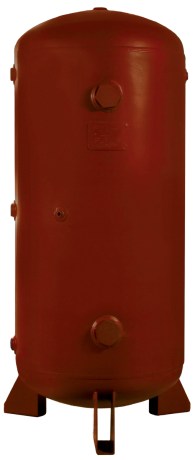
Compressed air receiver tanks are an integral part to many compressed air distribution systems. Compressed air is stored at a high pressure after drying and filtration, but just upstream of point of use devices. The receiver tank is charged to a pressure higher than what is needed by the system, creating a favorable pressure differential to release compressed air when needed.

Think of a compressed air receiver tank as a “battery”. It stores the compressed air energy within a system to be used in periods of peak demand, helping to maintain a stable compressed air pressure. This improves the overall performance of the compressed air system and helps to prevent pressure drop.

receiver_tank

They can be strategically placed to provide a source of compressed air to intermittent high volume compressed air applications. Rather than having to pull from the compressor, a receiver tank can be sized to provide the short-term volume of air for a particular application. In a previous post, we’ve highlighted how to calculate the necessary receiver tank based on the air consumption and duration of the application.

EXAIR offers from stock a 60-gallon receiver tank designed specifically for these higher-usage intermittent types of applications. Model 9500-60 can be installed near the point of high demand so that you have an additional supply of compressed air available for a short duration. The tank comes with mounting feet and is designed to stand up vertically, saving floor space. The tank meets American Society of Mechanical Engineers (ASME) pressure vessel code.

Just this past Spring, EXAIR hosted a live webinar where we discuss how to size, install, and implement secondary storage in your plant’s distribution system. If you missed it, check it out here on our website hosted by my colleague, Russ Bowman.

If you have an application in your facility that’s draining your compressed air system, a receiver tank could be the ideal solution. Give us a call and one of our Application Engineers will be happy to help evaluate your process and determine the most suitably sized receiver tank.

Tyler Daniel, CCASS
Application Engineer
E-mail: TylerDaniel@EXAIR.com
Twitter: @EXAIR_TD

Basics of Compressors

Single Stage Portable Air Compressor

What is an air compressor?  This may seem like a simple question, but it is the heartbeat for most industries.  So, let’s dive into the requirements, myths, and types of air compressors that are commonly used.  Like the name implies, air compressors are designed to compress air.  Unlike liquids, air is a compressible gas, which means that it can be “squished” into a smaller volume by pressure.  With this stored energy, it can do work for pneumatic systems.

There are two main types of air compressors, positive displacement and dynamic.  The core component of most air compressors is an electric motor that spins a shaft.  Positive displacement uses the energy from the motor and the shaft to change volume in an area, like a piston in a reciprocating air compressor or like rotors in a rotary air compressor.  The dynamic types use the energy from the motor and the shaft to create a velocity with an impeller like centrifugal air compressors.  This velocity converts to a rise in pressure.

How do they work?  Most air compressors are driven by an electric or gas motor.  The motor spins a shaft to push a piston, turn a rotor, or spin a vane.  At the beginning of the air compressor, we have the intake where a low pressure is generated from the displacement to bring in the surrounding ambient air.  Once trapped, Boyle’s law states that when the volume decreases, the pressure increases.  For the dynamic type, the velocity and design will increase the air pressure.  The higher pressure will then move to a tank to be stored for pneumatic energy.  The amount of power required is dependent on the amount of air that needs to be compressed. 

Compressed air is a clean utility that is used in many ways, and it is much safer than electrical or hydraulic systems.  But most people think that compressed air is free, and it is most certainly not.  Because of the expense, compressed air is considered to be a fourth utility in manufacturing plants.  For an electrical motor to reduce a volume of air by compressing it, it takes roughly 1 horsepower (746 watts) of power to compress 4 cubic feet (113L) of air every minute to 125 PSI (8.5 bar).  With almost every manufacturing plant in the world utilizing air compressors much larger than 1 horsepower, the amount of energy needed to compress a large volume of air is extraordinary.

Let’s determine the energy cost to operate an air compressor to make compressed air by Equation 1:

Equation 1:

Cost = hp * 0.746 * hours * rate / (motor efficiency)

where:

Cost – US$

hp – horsepower of motor

0.746 – conversion KW/hp

hours – running time

rate – cost for electricity, US$/KWh

motor efficiency – average for an electric motor is 95%.

As an example, a manufacturing plant operates a 100 HP air compressor in their facility.  The cycle time for the air compressor is roughly 60%.  To calculate the hours of running time per year, I used 250 days/year at 16 hours/day for two shifts.  So operating hours equal 250 * 16 * 0.60 = 2,400 hours per year.  The electrical rate at this facility is $0.10/KWh.  With these factors, the annual cost for operating the air compressor can be calculated by Equation 1:

Cost = 100hp * 0.746 KW/hp * 2,400hr * $0.10/KWh / 0.95 = $18,846 per year in just electrical costs.

So, what is an air compressor?  The answer is a pneumatic device that converts power (using an electric motor, diesel or gasoline engine, etc.) into potential energy stored as pressurized air.  Efficiency in using compressed air is very important.  EXAIR has been manufacturing Intelligent Compressed Air Products since 1983.  We are able to save you money by reducing the amount of compressed air you use.  If you need alternative ways to save money when you are using your air compressor, an Application Engineer at EXAIR will be happy to help you.  We even have a Cost Savings Calculator to find the annual savings and payback period; and you will be amazed at how much money can be saved. 

John Ball
Application Engineer
Email: johnball@exair.com
Twitter: @EXAIR_jb

Photo: Technical Illustration of a portable single-stage air compressor by Brain S. Elliot.  Creative Commons CC BY-SA 4.0

EXAIR Products Qualify for Energy Rebates

The use of compressed air can be found in almost any industry and is often referred to as a “fourth utility” next to water, gas and electric. The generation of compressed air accounts for approximately 1/3 of all energy costs in an industrial facility, in many cases, it’s the largest energy user in an industrial plant. With an average cost of $ 0.25 per every 1,000 SCF used, compressed air can be expensive to produce so it is very important to use this utility as efficiently as possible.

Many utility companies recognize the benefit of using engineered products to reduce compressed air usage, like the ones manufactured by EXAIR, and offers rebate incentives for making a switch. Duke Energy, who supplies power to sections of North Carolina, South Carolina, Ohio, Kentucky, Indiana and Florida offers several “Smart $aver Rebates” that focus around the generation and use of compressed air. (State and Location Dependent)

Duke Energy’s Smart Saver Program

However the best place to look at your states available programs is the DSIRE database. DSIRE is the most comprehensive source of information on incentives and policies that support renewable energy and energy efficiency in the United States. Established in 1995, DSIRE is operated by the N.C. Clean Energy Technology Center at N.C. State University. Follow the link above to read about the history of DSIRE, the partners on the project, and the research staff that maintains the policy and incentive data in DSIRE.

The Process is pretty easy! Visit https://www.dsireusa.org/ and type in your Zip Code!

After you get your results, search some key words, Like “Industrial” “Energy” “Commercial” “Energy Efficiency” “Compressed air”

Here you can see the two Programs that came up for 46077, you can then click the program name and it will take you a information page with the programs website and information!

Here at EXAIR, much of our focus is to improve the overall efficiency of industrial compressed air operating processes and point of use compressed air operated products. If you’d like to contact one of our application engineers, we can help recommend the proper engineered solution to not only save on your compressed air usage but also assist with possible energy rebates available in your area.

Jordan Shouse
Application Engineer

Send me an Email
Find us on the Web 
Like us on Facebook
Twitter: @EXAIR_JS

Money Seed Creative Commons Images from Pictures of Money, Attribution 2.0 Generic (CC BY 2.0)