
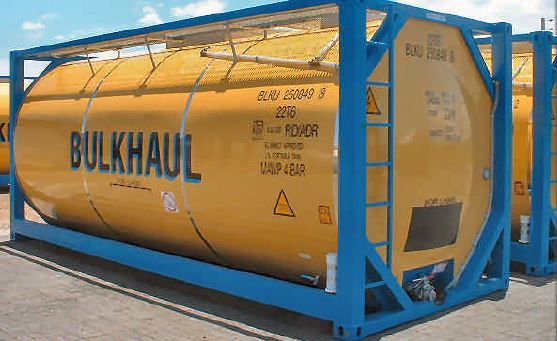
Vortex Tube Thaws Steam Connections on Bulk Liquid Sea Containers

Bulk container

Vortex Tube applications for cooling are many and a wide variety. Heating applications though, do tend to be a bit more elusive. That being said, I thought I would highlight a recent application where vortex tubes were used to thaw out steam lines that are used to heat up fluids in bulk sea containers.

We have all seen them running up and down the expressways, the large, bulk liquid containers that have the multi-modal capability to be on a ship, a train or a truck going down the road. I personally never thought about what the users of these tanks must do in order to get the liquid inside up to certain temperatures to allow the material inside to flow easily. I live in the Midwest area of the US, so we get really cold weather for only a few weeks during the year. In the Northern climates though, these bulk container users must have ways to thaw out the product before it can be used. To do this, these bulk containers are equipped with steam lines. Steam is used to heat the liquid inside to get it up to temperature. Once the steam is connected to the lines and circulating, all is well. But before they can get to that point, the steam connections on the tank are usually plugged with ice from condensate from previous use. The previous method was to simply snake a steam line up inside the heater lines to warm them up, but that presented a further problem. That same condensate ends up rolling out the pipe and dripping on the ground, re-freezing and creating a huge slip hazard.

 Steam connections

Above are the typical 1” BSP steam connections found on the bulk tanks.

In order to eliminate the slip hazard, the customer began looking for another method to supply a hot gas to these steam lines to thaw them out. In comes EXAIR with our Vortex Tube selection. The idea is to replace the mini steam line with the hot air output flow from a vortex tube to thaw out the connections. Since the customer has compressed air utility in plentiful supply on site, this makes for a very convenient way to warm up the pipes with a relatively “dry gas”. That being the dry compressed air supplied in the facility. The customer ended up using (2) model 3225 Vortex tubes with Cold Flow Mufflers, to provide the hot air for the steam connections. In fact, the diameter of the hot tube for the vortex tubes was the perfect size to simply slide up inside the steam pipes and hang there until the pipes were free of the problematic ice. There was still some small amount of liquid that re-froze from within the steam pipes, but it was certainly much more manageable than the mess the customer was dealing with previously.

Neal Raker, Application Engineer
nealraker@exair.com

Cooling Efficiently

Last week, I had the opportunity to work with a customer who was trying to cool a thermoformed film from 85° C (185° F)  down to room temperature, 21° C (69.8° F) or low enough for the package to be handled by an operator. This container was 270 mm X 170 mm X 100 mm (10.63″ x 6.69″ x 3.94″)


In applications like this, the customer often calls in with the idea of using a Vortex Tube to produce the cold air.  There are two reasons to use a different product than a vortex tube in this application. First, a vortex tube is only going to cool a small area, so to cool anything this size would take several vortex tubes.  Second, the cold air is going to mix with the ambient air very quickly. When the ambient air mixes with the cold air from the vortex tube, the air will lose the cold temperature generated by the vortex tube. To counter act this mixing, we have had customers create an insulated container to hold cold air from a vortex tube close to a product, similar to a cooling tunnel. This works in some applications, but my customer had a continuously moving line. He did not have time to stop the line and install insulation around each product.  He also didn’t have the length of conveyor needed to put a cooling tunnel over the line.

Super Air Knife Promo

Instead of using the vortex tube, I suggested that he use a 12” (305 mm) Super Air Knife to cool the thermoformed container. The 12” Super Air Knife moves significantly more air than a vortex tube over the surface of the part. Thanks to the 40:1 amplification ration of the Super Air Knife, it creates more cooling to the product and use less compressed air than a series of Vortex Tubes.  By mixing a large volume of free ambient air, that is the same temperature he needs to cool the part to, and a small amount of compressed air over the product they can easily cool their part to close to ambient so the operator can handle the part. The best benefit for this customer was they would not need change their manufacturing line.  The air knife is the best choice when cooling a very hot, fairly flat, large surface part to a temperature close to ambient. If you need to cool a product to a temperature lower than room temperature, then a vortex tube would be a great product to do the job.

Dave Woerner
Application Engineer
DaveWoerner@EXAIR.com
@EXAIR_DW

Cooling An Overheating Pneumatic Positioner

Pneumatic positioner

What can you do when the pneumatic positioner in your high temperature application is overheating?  Call EXAIR!

Or email (and call), as was the case in this application.  An end user in an overseas power plant uses a pneumatic positioner in their steam bypass system.  A pneumatic positioner can best be correlated to a PWM (Pulse Width Modulated) linear actuator.  It will take a supply signal of various forms and provide an output to an actuator or valve, most often to regulate pressure/flow.  So, why not just use a pressure regulator?  Because a pneumatic positoner can be programmed to respond differently to different inputs, and it can function in real time.  Meaning, that when the supply signal reaches a certain threshold the output action can be preset, adding precision to a pneumatically controlled application.  And, as application needs change, the adjustments can be automated.

Some pneumatic positioners are pneumatically controlled (the input signal is a compressed air pressure), but most are electronic.  The end user in this case was using an electrically controlled unit that was experiencing shutdown due to the high ambient temperatures.

When cooling in an application like this it is important to consider the needs (and restrictions) of the application.  To blow ambient air was not an option because of the high ambient temperature, so a Super Air Amplifier, Super Air Knife, or Super Air Nozzle weren’t viable options.  And, the pneumatic positioner was exposed to ambient conditions, with no intent to place within an enclosure.

The lack of an enclosure ruled out a Cabinet Cooler, but a Vortex Tube based solution was still possible.  When considering the heat load and required cooling capacity, the end user determined that with less than 200 BTU/hr. of cooling, the application should run flawlessly. This customer also expressed they may have fluctuations in there pressure supply, and ambient temperatures which would create the need to provide a larger Btu/Hr Vortex Tube in order toake up for lower pressures and increased temperatures. Our smallest Vortex Tube is capable of producing 550 Btu/Hr and was recommended for a successful application.

If you have an application problem in need of compressed air solutions, call an EXAIR Application Engineer.

Lee Evans
Application Engineer
LeeEvans@EXAIR.com
@EXAIR_LE

Minor Adjustments, Advice From An Expert Source

It’s not every day that we hear a customer say that our products aren’t consuming ENOUGH air, but that’s exactly what happened to me yesterday. I received a call from one of our long-standing customers who was experiencing reduced air consumption with our Model # 3202 Vortex Tube. The Vortex Tube uses compressed air to create a stream of cold air and a stream of hot air, providing a temperature range from -50°F to +260°F and cooling capacity up to 10,200 Btu/hr. Also, these units have no moving parts and are virtually maintenance free, making them the ideal choice for a variety of industrial spot cooling applications.

Vortex Tubes

This particular customer has been purchasing this model for several years, so they are pretty familiar with the performance and operation of the unit. They advised they were used to seeing air consumption at approximately 60 liters/minute or 2 SCFM (exactly what the Model # 3202 is designed to consume at 100 psig inlet pressure) but were starting to experience about a 50% drop to 30 liter/minute or 1 SCFM. We discussed the common troubleshooting:

  • Low supply pressure? (measuring at the inlet of the Vortex Tube during operation)
  • Compressed air inlet temperature? (warmer than ambient air – reducing performance)
  • Reduced cold flow? (possible clog from contaminants in the compressed air supply)
  • Unit seeing any back pressure? (up to 2 PSIG is acceptable, 5 PSIG will reduce approximately 5°F)
  • Over-tightened Cold Cap or Cold Muffler? (is it too tight?)

The customer advised they were using a push-to-lock fitting, where they drilled out the center and then would install it in the Cold Cap of the Vortex Tube. Their operator would hold the body of the Vortex Tube, by the air inlet, then take a wrench and thread the fitting into the ¼” NPT female opening on the Cold Cap. Without realizing, the operator was also turning the Cold Cap which was causing it to become over-tightened.  This in turn would reduce the consumption of the unit because it would shrink the internal air chamber.

Vortex Tube Exploded View


I made the suggestion to my customer to slightly loosen the Cold Cap and see if that didn’t fix the consumption issue. They called me back about an hour later and were very pleased to advise that now the unit was “working great!”.

We want to help you maximize our products, while optimizing your compressed air system. If you have a similar performance issue or would like to discuss your application, please contact us.

Justin Nicholl
Application Engineer
justinnicholl@EXAIR.com
@EXAIR_JN