EXAIR Ion Air Gun in Photo Printing Industry

In the high-precision world of photo printing, even tiny specks of dust or static can ruin a perfect print. From professional labs to industrial photography printers, quality and consistency are everything. That’s where the EXAIR Ion Air Gun steps in, a tool that’s quietly revolutionizing how photo printers manage static charges, clean surfaces, and ensure flawless prints.

While it might be a “perfect” application for a Super Ion Air Knife, the Ion Air Gun works better if the product is stationary.

The Challenge: Static and Contamination in Photo Printing

Photo printing — whether inkjet, laser, or large-format — is highly sensitive to the environment. Two of the biggest issues that professionals face are:

Static electricity: As paper moves rapidly through printers, it can accumulate static. This attracts dust, causes paper jams, and leads to print defects.


Particulate contamination: Even microscopic dust or fiber can show up as marks, dots, or streaks on glossy prints.

Traditional air blowers or manual wiping often redistribute dust rather than removing it — and they do nothing to neutralize static charge.

The EXAIR Ion Air Gun is engineered to solve both static and contamination problems in one tool. Here’s how it stands out:

Active Static Neutralization

The gun emits a stream of positive and negative ions that neutralizes static charges on surfaces instantly. This helps:

  • Reduce paper jams
  • Prevent dust attraction
  • Improve media handling through print engines

By eliminating static, prints come out cleaner and production runs flow more smoothly.

Ionized Clean Air Blast

Instead of just pushing air around, the ion air gun combines ionization with a strong, focused airflow. This:

  • Removes dust and debris from paper or film
  • Prepares surfaces before printing
  • Cleans out nooks and crannies where particles hide

The result? Cleaner prints with fewer re-runs and less waste.

In the competitive world of photo printing, attention to detail defines success. The EXAIR Ion Air Gun offers a practical, effective solution to two persistent problems — static and contamination. Whether you’re running small-batch professional prints or large industrial photo runs, it can help ensure every print meets the highest standard.

Jordan Shouse, CCASS

Application Engineer / Sales Operations Engineer

Send me an email
Find us on the Web 

From Field to Market: How EXAIR Helps Streamline Vegetable Processing

Homonyms are words that are pronounced and spelled the same but have different meanings.  In this blog, I will cover the word lettuce.  One meaning is the leafy vegetable and the other is money.  And I like to save both.  I have an agriculture application that I would like to share where EXAIR was able to supply different products to help save lettuce. 

PowerStream Liquid Nozzle

When vegetables come from the field, they need to be cleaned and packaged for delivery to grocery stores.  The first thing that they need to do is to wash the leaves to remove dirt, compost, and bugs.  They had drilled pipes to spray water onto the leaves, using a lot of water. They were looking to do it more economically. The vegetable packing house purchased the EXAIR PowerStream Liquid Nozzles, model DL8075SS, to do the washing.  These stainless steel nozzles were mounted on a manifold to spray water onto the lettuce leaves.  With the PowerStream nozzles, we can break the water into smaller droplet sizes to increase coverage and reduce water requirements.  Thus, saving money.

The next step would be to dry the lettuce.  They were using a blower-powered air knife, but they could not remove all the insects as it was not powerful enough.  Also, by blowing hotter air which was created by the blower, lettuce would start to brown much quicker.  To improve, they purchased a model 110036SS Stainless Steel Super Air Knife.  The Super Air Knife is an efficient, powerful way to blow compressed air.  With a 40:1 amplification ratio, it will draw in 40-parts of ambient air to 1-part compressed air.  From our Super Air Knife, we blow ambient temperature air, add mass to give a much higher force to remove the water and the insects, and save on compressed air consumption. 

To reduce spoilage, you must have the proper equipment.  For this company, they were able to improve their process to increase production.  And by utilizing less water and less compressed air, they were able to increase profit.  If you would like to improve your processes in packing houses, EXAIR has a variety of products that can help you.  You can contact an Application Engineer to discuss.  For the company above, more lettuce out the door meant more lettuce in their pockets. 

John Ball
Application Engineer
Email: johnball@exair.com
Twitter: @EXAIR_jb

Photo of Vegetables by akadarceePixabay content license.

Video Blog: EXAIR Safety Air Gun Cradle

Keeping your Safety Air Gun right where you need it can make everyday tasks faster and tidier. EXAIR’s Model 5920 Air Cradle is a simple, magnetic loop designed to hold a Safety Air Gun (or a similarly sized tool) within easy reach on any strong magnetic surface. Whether you’re working at a machine center, assembly station, shipping area, or general shop bench, the Air Cradle keeps your air gun accessible while helping maintain a more organized workspace.

The design is straightforward and practical. A strong magnet secures the loop to metal surfaces so the Safety Air Gun can hang safely and conveniently when not in use. This reduces clutter, keeps tools from being misplaced, and makes it easier for operators to grab the gun and get right back to work. For shops that rely on safety guns for blowoff, cleaning, or drying tasks throughout the day, having that tool right where it belongs adds both convenience and productivity.

Don’t allow your operators to just toss your premium air guns around on the floor. Give them a space to keep them secure and stored for many years of useful life!

Tyler Daniel, CCASS

Application Engineer

E-mail: TylerDaniel@EXAIR.com

Basics of Static Electricity

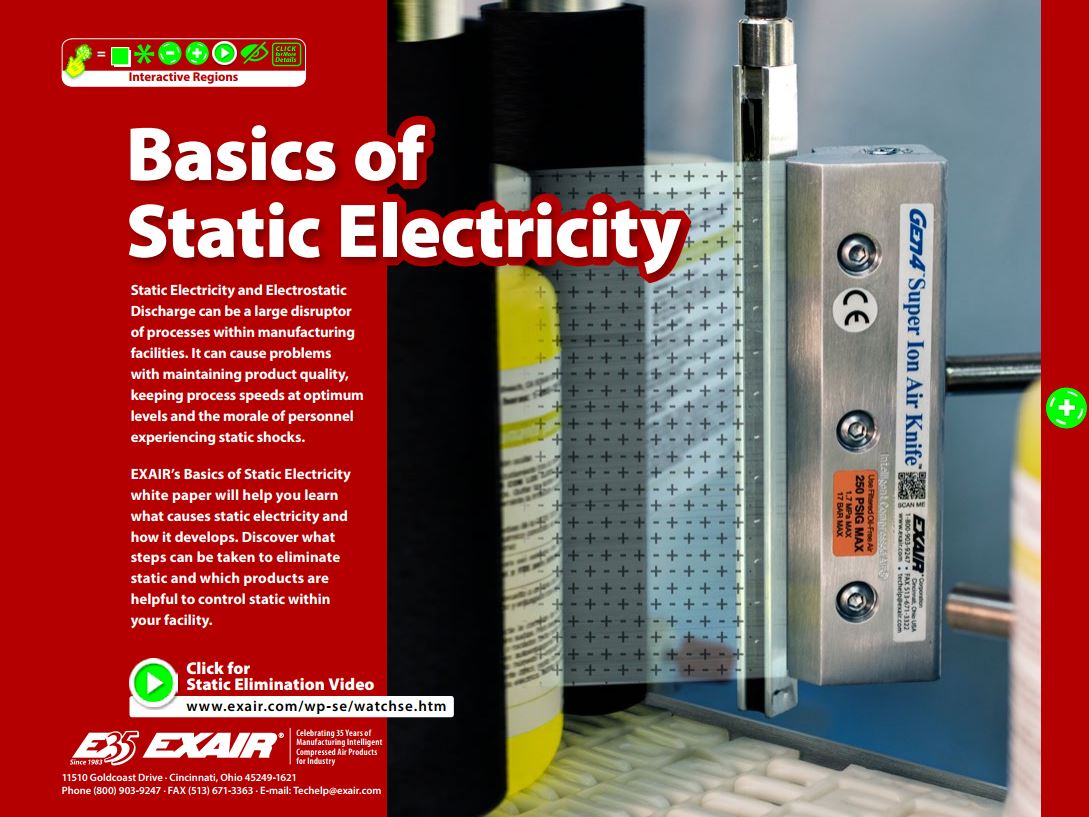
On a molecular level, the outer electrons surrounding the nucleus can be removed and transferred between atoms, leading to an imbalance of electrical charge known as static electricity. When an atom gains an extra electron, it becomes negatively charged, while the loss of an electron results in a positively charged atom. In non-conductive materials such as plastic, paper, rubber, and glass, these electrons cannot return to their original atoms. There are three primary methods through which static electricity can be generated, resulting in this phenomenon.

Contact — When objects collide, electrons can be transferred between their surfaces, with the amount of electrons exchanged depending on the specific triboelectric materials involved. In the case of plastic bottles or trays coming into contact on conveyor belts, static electricity can be generated quite easily.

Friction — When two materials are peeled apart, the electrons may not return to their original molecules, resulting in the creation of static electricity. This effect is especially prevalent with adhesive tapes and protective films, which possess larger surface areas that facilitate charge buildup. For example, peeling the backing from labels can generate a static charge that may malalign the labels or cause jams during the application process.

Separation — Static forces are often generated when two non-conductive surfaces are rubbed together, leading to the accumulation of electric charges. The friction created as these materials slide against each other increases the static charge, exemplified by the phenomenon observed when a balloon is rubbed on hair. With each additional rub, the static force intensifies, enabling the balloon to adhere to surfaces like walls. This effect is also evident when layers of material are stacked or when they move over rollers, highlighting the significance of friction in generating static electricity.

The generation of static electricity is influenced by the degree of contact, detachment, and friction between surfaces; increased interaction leads to a higher static charge. Even after static is discharged from a surface, it can accumulate through the same processes. Therefore, effective control of static electricity depends on both the treatment methods employed and the specific locations designated for its removal.

Humidity is another critical factor in static charge generation. Issues related to static electricity are often more pronounced during the winter months when the air tends to be drier. Lower relative humidity facilitates the easier and more potent development of static charges, which is why winter is commonly referred to as “static season.” A familiar example of this phenomenon occurs when one walks across a carpet and experiences a static shock upon touching a metal object, such as a door handle.

If you are experiencing static issues, or anything regarding EXAIR and our products, please do not hesitate to reach out. We offer a full line of Static Elimination products to suit your needs!

Jason Kirby
Application Engineer
Email: jasonkirby@exair.com
Twitter: @EXAIR_jk