Take the Steps: Installing Intermediate Storage

Air compressors depend on electricity to generate compressed air, making it essential to enhance the efficiency of your compressed air system. EXAIR offers six straightforward steps that can assist in lowering electrical expenses, minimizing overhead, and boosting profitability. This blog will focus on the fifth step, which involves the intermediate storage of compressed air close to the point of use.

Intermediate storage plays a vital role in managing pressure variations that can arise during production processes. When materials are transferred from one stage to another, sudden changes in pressure can negatively affect the quality of the product. By incorporating intermediate storage, manufacturers can create a buffer that helps stabilize pressure fluctuations. This stabilization ensures that the materials remain consistent before they move on to the next stage, thereby preserving their quality and integrity. Ultimately, this careful handling supports better overall outcomes in the final product, leading to higher customer satisfaction.

In some cases when only one or a few applications need air sporadically, using a properly sized storage receiver can be very helpful. Placing this storage receiver near the point where air is needed most can improve efficiency. It is essential to include a check valve and metering valve with the storage receiver. The check valve ensures that air does not flow back, while the metering valve controls the rate of refilling which is another strategy for reducing overall load on a compressor.

Receiver tanks play an important role in providing compressed air for tasks that require a lot of air for a short time. By placing these tanks in the right locations, users can ensure a steady supply of air without always depending on the compressor. This setup allows for more efficient operations during peak demand periods. Properly sizing the tanks is crucial, as it ensures they can deliver the right amount of air when needed. Overall, receiver tanks enhance the performance of compressed air systems and help meet varying demands effectively, and with a more consistent result.

Step Five of our Six Steps To Optimizing Your Compressed Air System: Use intermediate storage near the point of use.

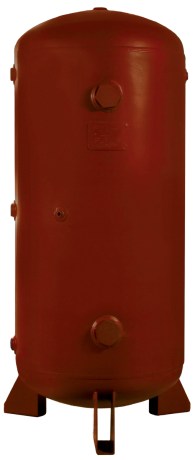
EXAIR provides a 60-gallon receiver tank that is ready for immediate use. This tank is designed for applications that require a lot of air for short periods. The model 9500-60 can be placed close to where you need extra compressed air. By having this tank nearby, you can ensure that there is enough air supply when demand increases. This setup helps maintain efficiency and performance in your operations.

If you have any questions about intermediate storage, or you need assistance with any of EXAIR‘s products, please do not hesitate to reach out.

Jason Kirby
Application Engineer
Email: jasonkirby@exair.com
Twitter: @EXAIR_jk

How Compressed Air Storage Can Help You Handle any High Demand Event

You designed your compressed air system to handle the volume you need for your plant, but your continued growth has started to tax that system with some high intermittent demand.

Managing high intermittent demand in the compressed air system requires evaluation of several elements of your system:

  1. Air compressor controls.
  2. System master controls.  
  3. Piping and air velocity.
  4. Storage: wet, dry, and at points of use.
  5. Identifying and examining large air users.
  6. Designing with flexibility and the future in mind.

Today I’m going to cover #4, more specifically installing a secondary storage tank!

Utilizing a secondary receiver tank to mitigate the impact of larger volume-consuming events is a common and useful strategy that many compressed air professionals will pursue. In this kind of scenario, the receiver tank acts much like a capacitor in a camera flash. A camera battery charges a capacitor which then dumps its charge into the flash bulb when you take a photo for a notably bright flash, which is what one generally wants from your camera flash.

In this same way, a receiver tank acts like a capacitor to “dump” the air volume needed to make a compressed air device work at its design pressure and flow for some prescribed period of time. In situations like this, the high demand does need to be an intermittent one so that the tank can then re-charge from the compressor system and be ready for the next air use event. This means that certain calculations need to be made to ensure that the receiver tank is sized properly to provide the desired effect.

How do you size a receiver tank? Here’s the calculation to determine the proper size:

Let’s consider an example of an Air Amplifier solution. A customer wants to blow on hot metal parts coming out of an oven to cool them down as an “air quench”. We evaluate the application and determine that (2) 2″ Super Air Amplifiers will provide the right amount of flow. Those units are going to operate at 60 PSIG to provide the desired effect. (2) 2″ Super Air Amplifiers will consume 24.5 SCFM @ 60 PSIG. Each batch of parts comes out of the oven at a rate of one batch every 5 minutes. They want to provide the necessary cooling for a total of 30 seconds to have the air quench effect. So, every 5 minutes, the Air Amplifiers will be blowing for 1/2 minute. Each “on” event consumes 12.25 Standard Cubic Feet of air. We then have 4 minutes, 30 seconds left to replenish the tank.

The last piece of information we need to know is the system pressure for the compressed air header feeding the tank. The system pressure is 120 PSIG. And so, our calculation looks like this:

V =  0.5 min. x 24.5 rate of flow x (60 PSIG + 14.5 PSIA)
120 PSIG – 60PSIG
V =  913
60 PSIG
V = 15.2 ft.3

There are 7.48 gallons to a cubic foot, so our receiver tank in this example would be
15.2 ft.3 x 7.48 = 114 gallons.

Given the fact that receiver tanks are made in certain, standard sizes, a 120 gallon tank or two, 60 gallon tanks piped in upstream of the compressed air load would be appropriate for this application.

As a further note, for example, the refill rate for the tank(s) would need to be a minimum of 2.72 SCFM to get the volume replenished in time for the next event. This is less than 1 HP of industrial air compressor to maintain such a flow rate to refill the tank.

With some reasonably simple math to determine tank size, and a willingness to pursue this kind of air delivery solution, you can implement that compressed air solution at a fraction of the cost compared to a new compressor.

With some reasonably simple math to determine tank size, and a willingness to pursue this kind of air delivery solution, you can implement that compressed air solution at a fraction of the cost compared to a new compressor.

If you have any questions please reach out! We have a full team of Applications Engineers in the office M-F!

Jordan Shouse
Application Engineer

Send me an email
Find us on the Web 
Like us on Facebook
Twitter: @EXAIR_JS

The Case – And The Math – For Intermediate Storage

If you use compressed air, you may have encountered this issue:

  • An operator hooks up a new compressed air operated device.
  • When they start using it, your compressed air header pressure drops.
  • This affects the operation of one, several, or ALL air-operated devices in the facility.
  • You might have gotten lucky, and it ONLY affected the operation of only one device in that particular area.

The simple solution – and one adopted by many users – is to increase header pressure. Let’s say the header pressure was 100psig, and the sudden startup of the new device caused it to drop to 85psig, when one (or several, or ALL) of the other loads needed at least 90psig. Sometimes algebra is required for calculations involving compressed air operations, but this isn’t one of them. If a 15psi drop caused the problem, adding 15psi to your header pressure will solve it. That’s just basic arithmetic.

Since most industrial air compressors are capable of generating pressures well above the 100psig you’re currently running at, all you need to do is turn up the pressure, right? Depending on the control scheme of your compressed air system, there are a number of ways to do that. So that solves your problem, and everything will be just fine…until someone checks the electricity bill. Thing is, increasing the discharge pressure makes the compressor work harder, meaning it’ll cost more to operate. There are formulas for that – all you need is your electricity bill and some compressor performance data – but there’s a fairly accurate thumb-rule which states that, for every 2psi change in compressor discharge pressure, there’s a change in power consumption of approximately 1%. Let’s say you increased discharge pressure to 120psig, just to be safe. That’s a 20psi increase, so you just increased the power consumption (and hence the operating cost) of your compressor by about 10%. To add insult to injury, you also just increased the flow out of those leaks in your system…you may have even started some new ones…and THAT’S costly as well.

Another solution is intermediate storage. Placing a properly sized Receiver Tank in the vicinity of critical loads on your compressed air system will prevent the adverse effects of those pressure drops upon energizing, by making sure they don’t happen in that particular part of the compressed air system. And, you don’t have to raise your header pressure (and compressed air costs) to do it. So, there’s the case for intermediate storage – now let’s do the math, and figure out how much we need, using this equation:

Let’s calculate the receiver size needed to protect a critical load that uses 5 SCFM @90psig, minimum. Because it’s critical, we want to ensure the Receiver Tank alone can keep system pressure above 90psig for at least one minute:

An EXAIR 60 Gallon Receiver Tank (Model 9500-60) would provide this level of protection. It’s 20″ in diameter and just over 50″ tall, so it doesn’t take up a lot of floor space. It comes with a drain valve and connections for compressed air flow in & out, a pressure gauge, a relief valve, etc.

Step Five of our Six Steps To Optimizing Your Compressed Air System: Use intermediate storage near the point of use.

Compressed air isn’t free. It isn’t even cheap. There are some very interesting methods for improving performance without adding cost to produce compressed air as described above. If you’d like to find out how EXAIR can help you get the most out of your compressed air system, give me a call.

Russ Bowman, CCASS

Application Engineer
Visit us on the Web
Follow me on Twitter
Like us on Facebook

Compressed Air System Optimization – Where Do Receiver Tanks Fit?

SixSteps

The 5th step in the 6 steps to optimizing your compressed air system highlights the use of intermediate storage of compressed air near the point of use. Secondary, or intermediate Receiver tanks are installed in the distribution system to provide a source of compressed air close to the point of use, rather than relying on the output of the compressor.

Compressed air receiver tanks are an integral part to many compressed air distribution systems. Compressed air is stored at a high pressure after drying and filtration, but just upstream of point of use devices. The receiver tank is charged to a pressure higher than what is needed by the system, creating a favorable pressure differential to release compressed air when needed.

Think of a compressed air receiver tank as a “battery”. It stores the compressed air energy within a system to be used in periods of peak demand, helping to maintain a stable compressed air pressure. This improves the overall performance of the compressed air system and helps to prevent pressure drop.

receiver_tank

They can be strategically placed to provide a source of compressed air to intermittent high volume compressed air applications. Rather than having to pull from the compressor, a receiver tank can be sized to provide the short-term volume of air for a particular application. In a previous post, we’ve highlighted how to calculate the necessary receiver tank based on the air consumption and duration of the application.

EXAIR offers from stock a 60-gallon receiver tank designed specifically for these higher-usage intermittent types of applications. Model 9500-60 can be installed near the point of high demand so that you have an additional supply of compressed air available for a short duration. The tank comes with mounting feet and is designed to stand up vertically, saving floor space. The tank meets American Society of Mechanical Engineers (ASME) pressure vessel code.

Just this past Spring, EXAIR hosted a live webinar where we discuss how to size, install, and implement secondary storage in your plant’s distribution system. If you missed it, check it out here on our website hosted by my colleague, Russ Bowman.

If you have an application in your facility that’s draining your compressed air system, a receiver tank could be the ideal solution. Give us a call and one of our Application Engineers will be happy to help evaluate your process and determine the most suitably sized receiver tank.

Tyler Daniel, CCASS
Application Engineer
E-mail: TylerDaniel@EXAIR.com
Twitter: @EXAIR_TD