CAGI CCASS Certificate Awarded To Our Own John Ball!

I blogged in October 2023 about our 4th team member who had passed the Compressed Air And Gas Institute’s Certified Compressed Air System Specialist test. Once Neal Raker received his CCASS certification, it was only a matter of time before the next one of our International Application Engineers, John Ball, was going to take the plunge, so to say.

John has studied, written content revolving around, and demonstrated his knowledge in the compressed air field for many years before he came to EXAIR and has continued his education ever since, doing the necessary due diligence of studying for and obtaining his CCASS certification. As with Neal, Russ, and Tyler all obtaining this, what kind of value does that add for you our customers, and content consumers?

Certainly, it means you can rely on us to actually know what we are talking about when we make a recommendation to you on a phone call, chat or e-mail. It also means that the content of our informal videos, presentations, and blogs is well researched. We hold ourselves to a higher standard, and we must ensure we continue to improve our knowledge through continuing education or else we will not be able to maintain these types of certifications. Our goal is to help in such a way that you will want to come back for more! When we say our people are our most valuable resource, investing in continuing education is one way we walk the walk.

If you want to experience our help first hand, please contact one of our Application Engineers and give us a try. We would be happy to listen and verify your thought process for an application or perhaps walk you through a few scenarios based on multiple, possible solutions. Many times, there’s more than one right answer. We encourage you to bounce your ideas off of us. Contact an Application Engineer today.

Brian Farno
Application Engineer
BrianFarno@EXAIR.com
@EXAIR_BF

CAGI Certification Times 4

The CAGI CCASS is a professional credential offered by the Compressed Air and Gas Institute (CAGI) to represent mastery in all things compressed air system-related, such as system design, compressed air supply and distribution, energy efficiency, system components, and more. To achieve this credential, individuals must attain not only a certain level of education but complete specified training, testing, and professional experiences all pertaining to the comprehensive knowledge of compressed air systems. Neal Raker is our fourth team member to achieve this certification. So what does this mean for you, our customers, and loyal blog readers?

It means that our staff of Application Engineers are continually improving themselves and looking for ways to ensure our readers, customers, and potential customers that we are the leading experts in the industry regarding engineered solutions for point-of-use compressed air. We continue to educate ourselves and then share our knowledge through various avenues. This can include blogs such as this one, informal videos that are published here, on our YouTube Channel and on our website, articles through various publications, and even our webinars.

These topics range from eliminating waste from one of the most expensive utilities to system designs that prevent pressure drops and lack of supply for point-of-use applications. They can go in-depth or stay high level in order to get just a general understanding of the topic at hand.

If you would like to test our knowledge or see what kind of information we can share with you on your facilities’ compressed air usage, contact an Application Engineer today.

Brian Farno
Application Engineer
BrianFarno@EXAIR.com
@EXAIR_BF

Compressed Air System Optimization – Where Do Receiver Tanks Fit?

SixSteps

The 5th step in the 6 steps to optimizing your compressed air system highlights the use of intermediate storage of compressed air near the point of use. Secondary, or intermediate Receiver tanks are installed in the distribution system to provide a source of compressed air close to the point of use, rather than relying on the output of the compressor.

Compressed air receiver tanks are an integral part to many compressed air distribution systems. Compressed air is stored at a high pressure after drying and filtration, but just upstream of point of use devices. The receiver tank is charged to a pressure higher than what is needed by the system, creating a favorable pressure differential to release compressed air when needed.

Think of a compressed air receiver tank as a “battery”. It stores the compressed air energy within a system to be used in periods of peak demand, helping to maintain a stable compressed air pressure. This improves the overall performance of the compressed air system and helps to prevent pressure drop.

receiver_tank

They can be strategically placed to provide a source of compressed air to intermittent high volume compressed air applications. Rather than having to pull from the compressor, a receiver tank can be sized to provide the short-term volume of air for a particular application. In a previous post, we’ve highlighted how to calculate the necessary receiver tank based on the air consumption and duration of the application.

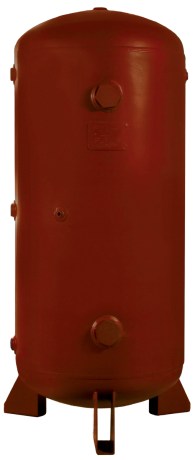
EXAIR offers from stock a 60-gallon receiver tank designed specifically for these higher-usage intermittent types of applications. Model 9500-60 can be installed near the point of high demand so that you have an additional supply of compressed air available for a short duration. The tank comes with mounting feet and is designed to stand up vertically, saving floor space. The tank meets American Society of Mechanical Engineers (ASME) pressure vessel code.

Just this past Spring, EXAIR hosted a live webinar where we discuss how to size, install, and implement secondary storage in your plant’s distribution system. If you missed it, check it out here on our website hosted by my colleague, Russ Bowman.

If you have an application in your facility that’s draining your compressed air system, a receiver tank could be the ideal solution. Give us a call and one of our Application Engineers will be happy to help evaluate your process and determine the most suitably sized receiver tank.

Tyler Daniel, CCASS
Application Engineer
E-mail: TylerDaniel@EXAIR.com
Twitter: @EXAIR_TD