Founder’s Day 2025

EXAIR celebrates Founder’s Day each year on February 22nd (or the closest working day) in order to commemorate the birthday of our founder, Roy Sweeney.  He founded the company in 1983 and drove EXAIR to become the strong, successful and innovative company that it has over the years.  Roy led EXAIR for 33 years.  Today would have been his 91st birthday. EXAIR has a long average tenure and many of us in the building remember working side by side with Roy. It’s hard to believe that he’s been gone for almost nine years, but his commitment to helping others lives on through all of us.

We make this day a celebration and a day to mark our ongoing commitment to the service of others, in keeping with the values that Roy and his wife Jackie felt (and feel) very strongly about.  They both worked hard to support many social causes and events here in Cincinnati and set a great example of what being engaged in your community looks like. We continue to look outside our company, outside ourselves and outside our immediate surroundings, to do what we can to improve the world around us.  And we urge others to do the same.

Our day includes a company meeting to recognize Roy, his generosity, and the genesis of Founder’s Day. We take the opportunity to highlight and encourage our entire team to find a place to volunteer that is close to their heart. We are diligent to have resources available for all to research volunteer opportunities and learn about the vast needs of others. Roy Sweeney was also a veteran so having lunch catered by Misison BBQ, who themselves donate to our military and local first responders, also honors Roy.

This year we have selected these organizations, who help our local communities, to receive donations as part of our Founder’s Day celebration:

DAV
Supporting disabled American veterans and their families.

Freestore Foodbank
Supplies 33 million meals per year to those in need.

Lighthouse Youth and Family Services
Supporting their Safe and Supported program for LGBTQ youth.

Cincinnati Works
Partners with all willing and capable people living in poverty to assist them in advancing to economic self-sufficiency through employment.

Wave Pool
Wave Pool is a contemporary art fulfillment center where experimental art connects the community and creates change.

Bethany House
Helps homeless and at-risk families with solutions to achieve housing stability and long-term self-sufficiency.

To further encourage ourselves to participate and engage with our communities, EXAIR has also established an Employee Volunteer Program that enables every full-time employee with at least 90 days of service to volunteer with organizations of their choice during the normal work week with full pay by EXAIR.  It is important to be as open as we can to allow any of us to choose a volunteer opportunity that resonates with each of us. We urge everyone to work collectively with organizations in our community to improve the lives of those in need.

As we celebrate Founder’s Day today, we wish Roy a happy birthday.  We miss him.  We remember what he and Jackie did (and do) for all of us and for countless others.  And we pledge to continue his commitment to helping those who need it.

Happy Founder’s Day 2025 from everyone at EXAIR!

Sincerely,
Kirk Edwards, President

The Story Behind Decibels

While ‘sound’ has been around (almost quite literally) forever, our units of quantifying it are relatively new. Most of us are familiar with the word ‘decibel’ and know that it has something to do with how ‘loud’ a sound is. The word ‘decibel’ originated, however, as a unit to quantify the loss of the strength of a signal as it traveled through telephone and telegraph wires. From the invention of the telegraph in the 1840’s, miles and miles (and miles) of cable started crisscrossing the country, and eventually the world. The unit they used to quantify signal loss back then was known as a “mile of standard cable” or “MSC”. And it was just that: the loss of signal energy as it traveled through one mile of standard (approximately 19 gauge wire back then) cable.

In 1924, Bell Telephone Laboratories introduced a new unit: the Transmission Unit (TU) which changed the math from linear to logarithmic. One TU was defined such that the number of TUs was ten times the base-10 logarithm of the ratio of measured power to a reference power. In 1928, the Bell folks proposed using a new word they’d coined: ‘decibels’, instead of TU’s, in honor of the founder of their technology and namesake of their company, Alexander Graham Bell.

While the decibel is still the commonly accepted unit of measure for signal loss in cable, it also became popularized as a unit to quantify sound pressure level, since that’s a logarithmic measurement as well, of the ratio of actual sound pressure being applied (determined by the frequency & amplitude of the sound waves hitting your eardrum) to a base level of sound pressure (the low threshold of hearing for a typical person…what we might informally call “complete silence”.)

There are two ways to determine sound pressure level: you can do the math, or you can use a device that measures it, like the EXAIR Model 9104 Digital Sound Level Meter. These will tell us how ‘loud’ a sound (or the overall sound in a given space) is.

In contrast to the 98dBA sound level from this array of nozzles, the sound pressure level from an EXAIR Super Air Knife is only 69dBA.

This is important because too much of ANYTHING is likely to be detrimental, and sound pressure level is absolutely in that category. Exposure to extraordinarily loud sounds, even momentarily, can irreversibly damage your hearing. And constant exposure to moderately loud sound levels can do it too.

In the United States, the Occupational Safety and Health Administration (OSHA) published Standard 1910.95(a) to identify the maximum allowable noise exposure by hours, and sound level. The proper use of hearing protection is mandated if personnel are exposed to levels in excess of these limits for a given period of time:

Working in areas that exceed these levels will require hearing protection.

When I was little, my Dad had to get hearing aids as a result of occupational noise exposure, so I know first-hand what an impact has on one’s quality of life – and that of the people they spend a lot of time around. It’s one of the big reasons that I always talk about how quiet EXAIR engineered compressed air products are, compared with air blowoffs that aren’t designed to attenuate sound pressure levels.

The ability to hear well is a wonderful gift, and one worth preserving. If you have to work in a loud environment, get some good ear plugs or ear muffs. They make them now with noise-canceling features, so you can still hear people talk while wearing them. If you have questions about whether the environment is “too loud”, it very well might be. Take measurements. If they’re higher than the OSHA limits above, consider the source and whether it can be mitigated, or even eliminated. And if the source is from compressed air blow offs, EXAIR can definitely help – give me a call.

Russ Bowman, CCASS

Application Engineer
Visit us on the Web
Follow me on Twitter
Like us on Facebook

Static Elimination For Cleanrooms: The Intellistat Ion Air Nozzle

Cleanrooms (sometimes written as two words: “clean rooms”, and historically called “White Rooms” or “Dust-Free Rooms”) are engineered spaces where specialized equipment and procedures are used to maintain a very low concentration of contaminants. While certain levels of cleanliness are desirable for many processes, certain ones can be catastrophically affected by contamination. In the 1960’s, a physicist working for Sandia National Laboratories named Willis Whitfield pioneered the modern cleanroom. His designs focused on continuous filtration of the air inside. This was a real game changer for a number of industries like electronics, pharmaceuticals, semiconductors, and all kinds of scientific research facilities. They can be small – like a dedicated enclosure in a larger building or shop where one or two people perform benchtop testing, assembly, etc. They can also be enormous, like one of the earliest cleanrooms: a 70,000 square foot space at an RCA facility not far from here, in Cambridge, Ohio, where they made control equipment for some of the earliest intercontinental ballistic missiles in the U.S. military’s arsenal.

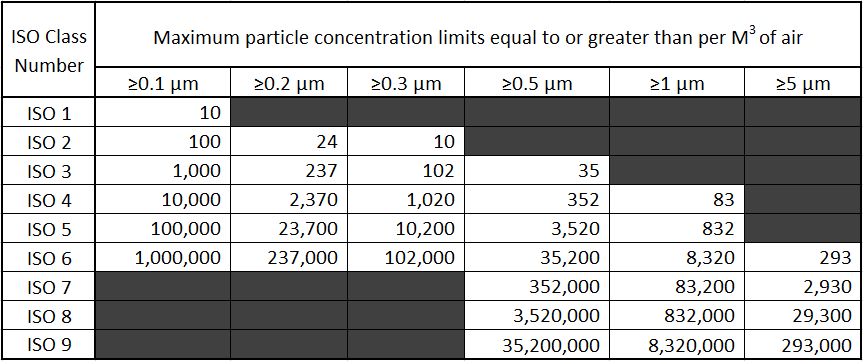
It should come as no surprise that equipment used in cleanrooms must comply to some demanding standards & specifications. To that end, ISO (The International Organization for Standardization) created ISO Standard 14644-1. It identifies nine Class Numbers, based on allowable particulate concentrations in a given volume of air. Here’s how it breaks those down:

Basically, the lower the Class Number, the cleaner the air. ISO 1 is often used in semiconductor manufacturing. Medical device manufacturers and pharmaceutical facilities typically specify ISO 5 & 7.

Equipment used inside a cleanroom must be designed, and operated, so as to not increase particulate concentration limits above these limits. You wouldn’t want to use steel tools that are prone to rust, or electric tools with carbon brushes in the motors, for example.

EXAIR’s Intellistat Ion Air Nozzle was designed with these considerations in mind. They were tested by a third part independent laboratory and are classified for use in ISO Class 5 (or below) cleanrooms. This has made them especially popular in pharmaceutical laboratory use, as well as:

  • A local eyeglass & camera lens manufacturer uses them to ensure precision measurement instruments’ readings aren’t affected by any residual static charge caused by the grinding process.
  • A company that makes overlays for medical devices (IV pump controllers, patient monitoring devices…pretty much anything with pushbuttons you might find in a hospital room or a doctor’s office exam room) uses them to maintain compliance with their customers’ standards.
  • A number of food production facilities around the country use them to remove static from processed foods, and packaging containers, during filling operations.
  • A manufacturer of packaging machinery includes them on filling machines servicing the food and pharmaceutical industries.
Order before March 31, 2025 and receive a FREE AC Sensor with any qualifying Static Eliminator purchase.

Whether they’re in a cleanroom or not, the compact design, ease of installation & operation, air use efficiency, and quiet operation make them ideal for a range of static elimination applications. If you’d like to find out more the Intellistat Ion Air Nozzle (or its handheld version, the Intellistat Ion Air Gun), give me a call.

Russ Bowman, CCASS

Application Engineer
Visit us on the Web
Follow me on Twitter
Like us on Facebook

CE Compliance Explained

At EXAIR, we guarantee that our products meet the highest of standards, and adhere to all product requirements and regulations. UL certification is optional in the United States, whereas CE certification is required for products marketed within the European Economic Area (EEA). The CE marking, derived from the French term “Conformité Européenne,” indicates that a product complies with European Union health, safety, and environmental standards, thereby ensuring the safety of consumers.

CE marking is required for over 20 categories of products, such as construction materials, gas appliances, toys, measuring devices, mobile phones, and elevators. A comprehensive list of these product types, subject to mandatory CE marking, can be found on the European Commission’s website.

What the CE mark says about your product:

  • It complies with all relevant product directives and regulations in the European Union.
  • You have checked and identified all the laws that apply to it.
  • It conforms to all the applicable health, safety, and environmental laws.
  • It is legally compliant enough to sell anywhere in the European Union.
  • It meets the laws’ essential requirements, and you can prove it with documentation.
  • You can provide the EU Authorities at their request with a legally correct and complete Technical File that demonstrates conformity.
  • You have given legal assurance, and you take full legal responsibility for any failings and their consequences.

The CE markings on a product guarantee its eligibility for sale in any EU member state, irrespective of its country of origin. This certification has also gained recognition as a standard in various other regions globally, although it primarily holds significance within Europe. When you observe the small ‘CE’ symbol on our products, it signifies their high quality and adherence to stringent standards. This assurance means that your investment is well justified.

If you have any questions about how our products meet CE or other specifications, or you need assistance with any of EXAIR‘s products, please do not hesitate to reach out.

Jason Kirby
Application Engineer
Email: jasonkirby@exair.com
Twitter: @EXAIR_jk