Batting Practice

The First Day of Spring yesterday ushered in the first “real” practice for my son’s baseball team. The coach’s teenage son (and built-in assistant coach) participated in a baseball workshop over the winter, where they studied Albert Pujols’ batting technique, and developed a regimen around it. They broke it up in a series of exercises, targeting the motions of the individual body parts, that, when combined, will produce in these boys the slugging prowess of the future Hall of Famer. But, when they’re running through the motions individually, it’s very entertaining to watch…when they’re all lined up next to the coach’s son doing them, it looks like a Broadway dance routine…and 12-year old boys HATE to dance. They also hate it when their dads laugh at them for dancing.

Time will tell if all of this pays off…the coach himself is going out on a limb here, deviating from typical Knothole hitting practices that go back to at least the 1970’s, when I was a struggling young ball player. To be honest, my best bet for getting on base was to lean in and take a pitch to the ribs (that area of my body was larger than most kids’ anyway). Regardless of the outcome, though, nothing beats watching a good Knothole baseball game, so I’m really looking forward to the next few months.

I hope it works, but I suppose if he sees it not working at all, the coach can still go back to the tried & true “basics” come mid-season. It’s always nice to have options when your best laid plans don’t quite hit the mark in the real world. At EXAIR, that’s where our 30-Day Unconditional Guarantee comes in to play. As much as we can learn about your application, it may come down to a decision to try something out and see if “looks good on paper” can get to “mission accomplished.”

I can’t wait to see these guys start slugging home runs off of unsuspecting pitchers here in a few weeks. One way or the other.  It’s been a long winter…play ball!

Russ Bowman
Application Engineer
EXAIR Corporation
(513)671-3322 local
(800)923-9247 toll free
(513)671-3363 fax
Web: http://www.exair.com
Blog: http://blog.exair.com/
Twitter: twitter.com/exair_rb
Facebook: http://www.facebook.com/exair

Basketball Madness

Basketball is dominating conversations around the water cooler, TV programming is being preempted by playoffs, and office pools are circulating around. Lest we forget, we still have work to do.

For the month of a March EXAIR is offering some promotions to help you get that work done. Featured this month are our industrial vacuums; Reversible Drum Vac , Chip Trapper, Chip Vac, and Heavy Duty Dry Vac. With the purchase of any of these products you will receive a free Vac U Gun which is a popular hand held vacuum.

Also since we are not out of the static electricity season yet, the promotion on static eliminators has been extended to March 31.  With the purchase of a static eliminator you will receive a free AC sensor.

In addition to the promos, EXAIR has published a new catalog featuring a host of new products that will help you more effectively and efficiently use compressed air.

If you need more than the data offered in the catalog, EXAIR has a staff of engineers that will answer all your technical questions. None of whom are currently leading our office basketball pool. Just let ’em help you with compressed air stuff, I wouldn’t trust them with picking your brackets.

Joe Panfalone
Application Engineer

Phone (513) 671-3322
Fax   (513) 671-3363
Web: http://www.exair.com
Twitter: http://www.twitter.com/exair_jp
Facebook: http://www.facebook.com/exair

Pies Are Round…Cakes Are Square!

So, it’s Pi Day…you math aficionados (read: geeks, and yes, I include myself among you) know what I’m talking about. For everyone else, today is March 14th, or 3/14, or 3.14, which is the mathematical constant that is the ratio of a circle’s circumference to its diameter. Pi is commonly rounded off to nearest hundredth, although, as an irrational number, its decimal representation never ends, and never repeats. Over the centuries, computing Pi to a higher number of digits has been the fascination and passion of the prominent mathematicians of the day. In the 16th Century, Ludolph van Ceulen devoted the greater part of his life to calculating Pi to 35 decimal digits. He was so proud of his accomplishment that he had the digits engraved on his tombstone.

In the 21st Century, mathematicians have used computer programs to calculate Pi to mind-boggling accuracy: the current record stands at 5 trillion decimal digits. I’m not sure of who needs it to be that accurate, or what they’d use it for, but it reminded me of a funny story I heard from a friend’s father.

My friend Bill’s dad worked as an engineer for an aircraft engine manufacturer, and was involved with the first computer aided drafting program that they implemented. A fabricator came to him one day, and asked him how accurately he could plot the dimensions for an irregularly-shaped piece they needed to make out of sheet metal. He said he could easily get it to 0.001” accuracy, so he and the fabricator worked together to produce the drawing. When it came time to cut out the part, the fabricator proudly escorted my friend’s dad down to the shop floor, where he saw his drawing – with dimensions reported to the nearest thousandth of an inch – next to the piece of sheet metal, which they had laid out the dimensions on…using a tape measure and chalk. Then, they cut the part out. By hand. With an acetylene torch.

Perhaps since Pi Day is near the beginning of springtime in North America, the Application Engineers at EXAIR could also proclaim it the Official Start Date of Cabinet Cooler Season. If you have an electrical enclosure that requires cooling, we can help. If it’s existing equipment, we just need a few key dimensions and temperatures. If it’s a new application, we can work with any data you can provide. We won’t be calculating to the thousandth of anything, but we’ll get you the appropriately sized system for your enclosure.  To do this, we’ll be using algebra and geometry, but, unfortunately, no ∏.  Nor will we be applying trigonometry, but here’s a little something that I’m sure that true participants in Pi Day celebrations will appreciate:

Russ Bowman
Application Engineer
EXAIR Corporation
(513)671-3322 local
(800)923-9247 toll free
(513)671-3363 fax
Web: http://www.exair.com
Blog: http://blog.exair.com/
Twitter: twitter.com/exair_rb
Facebook: http://www.facebook.com/exair

Understanding the OSHA Directive – 30 PSI Dead end Pressure

When using compressed air for cleaning OSHA has issued a directive STD 01-13-001 – STD 1-13.1 that states ”

“the downstream pressure of the air at the nozzle (nozzle pressure) or opening of a gun, pipe, cleaning lance, etc., used for cleaning purposes will remain at a pressure level below 30 psi for all static conditions. The requirements for dynamic flow are such that in the case when dead ending occurs a static pressure at the main orifice shall not exceed 30 psi.This requirement is necessary in order to prevent a back pressure buildup in case the nozzle is obstructed or dead ended.”

The reason for concern is should the nozzle come into contact with the skin, the pressure is not sufficient enough to pierce the skin and cause a blood embolism. There a couple of methods to achieve this. One is using a pressure regulator and reduce the pressure to 30 psi. At this low of pressure the nozzle becomes less than effective for most cleaning purposes. Another Commercial design is side drilled holes into the nozzle. While this provides a degree of safety, it does nothing for noise abatement or efficiency.

A more superior method is having the safety feature permanently designed in like the EXAIR Super air nozzles. In this diagram you see that the orifices are embedded down in between the fins thus preventing blockage. Another feature of this design is as the air exits the orifices, a vacuum is created between the fins drawing in ambient air and adding it to the blow off stream of air. This slower moving outer entrained air stream reduces the sound levels, thus this design provides both safety and efficiency.

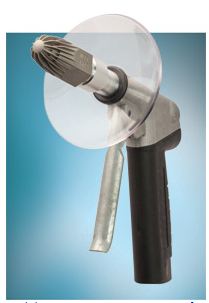
To further improve on safety a protective chip shield can be added to protect workers from flying debris and prevent splash back. Between the highly efficient, safe nozzle and the protective chip shield you can provide your workers with the tool they need for effective safe blow off.

Feel welcomed to call us here at the factory and ask to speak with one of our application engineers and they will fill you in on all the details.

Joe Panfalone
Application Engineer
Phone (513) 671-3322
Fax (513) 671-3363
Web: www.exair.com
Twitter: www.twitter.com/exair_jp
Facebook: http://www.facebook.com/exair