October – The Month of Change

For sports fans, October means divisional play offs and the world series. For politicians it means the contest to get elected. To the students of phenology, it marks a change in plant and animal life cycles.  For most of us, it’s the beauty of the fall colors knowing that winter is on its way and the end of daylight savings time.

So you can see October marks the end of an era the ushering in of a new age. So what can we expect as we pass through the demarcation of October? Well there is always football and basketball. For the skiers, the outlook is for more snow this winter. For those of us in manufacturing, it means the season for static electricity and all the associated problems it brings to the manufacturing process.

We all have experienced the pain of getting shocked after walking across the carpet. Think what that does to the electronics on sophisticated computerized manufacturing systems. Static electricity also attracts dust.   In the packaging industry, foreign particulate has to be removed from the product before it is  sealed up. With more and more plastic products being used in the auto industry, attraction ruins paint finishes, gets entrapped in sealed bezels, and presents a hazard to the operators.

As the low humidity of wintry days approach, static will become more and more of an issue.

EXAIR has a complete line of products to help you through the season of static electricity. We have ion air cannons, ion air knives, ion air blow guns, ion air wipes, ion bars, points, and meters . Call one of our application engineers to help you pick out the right product for your application. 1-800-903-9247

Joe Panfalone
Application Engineer
Phone (513) 671-3322
Fax   (513) 671-3363
Web: www.exair.com
Twitter: www.twitter.com/exair_jp
Facebook: http://www.facebook.com/exair

Sizing Pneumatic Piping Properly is Important

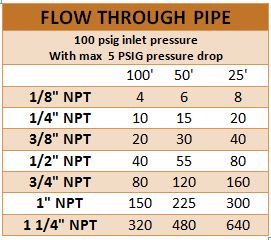
When designing a pneumatic system, the flow requirements and the system’s ability to transfer that flow, is imperative. Pipe size and frictional losses within the system are the critical factors that limit flow.

Probably the easiest way to visualize this is to put it in terms of electricity. The longer the cord, the more resistance and consequently capable of less amperage. The more amperage required the larger gauge wire is required. The same applies to air flow. The longer the pipe the more the resistance and the less flow of air it is capable of. The greater the volume of airflow demand the larger a pipe is required.

The following table will provide a quick reference guide. For a list of tables for pressure drops  click here

For a more thorough dissertation Click here 

EXAIR has a staff of engineers that will be happy to provide you with technical support.

Feel welcomed to call them at 1-800-903-9247

Joe Panfalone
Application Engineer
Phone (513) 671-3322
Fax   (513) 671-3363
Web: www.exair.com
Twitter: www.twitter.com/exair_jp
Facebook: http://www.facebook.com/exair

The Last Of The Compressed Air Challenge Seminar Blogs (for now)

Last week, Lee Evans, Brian Farno, and I attended a seminar entitled “Fundamentals of Compressed Air Systems,” sponsored by the Compressed Air Challenge. Lee and Brian have already written great pieces on what we learned, and Joe Panfalone (even though he didn’t even go) has gotten in on the action too – leaving me to search desperately through my notes for something relevant to discuss. Here’s my initial takeaway: If your blog is published on Wednesday, try to attend the seminar you wish to write about on Tuesday, not Thursday.

One thing that my associates left me, though, was the subject of inappropriate uses of compressed air. According to the Compressed Air Challenge folks, 70% of the savings to be realized lie in measures on the “demand” side of your system. A big chunk of this is the aforementioned inappropriate uses, which were defined as applications that could be performed using alternate methods. The assumption is that these alternate methods are less costly from a compressed air usage standpoint – which is not always the only factor to consider:

*The floor needs to be swept at the end of the shift. It takes 10 minutes with a broom, or 5 minutes with a Super Blast Safety Air Gun (for instance, the Model 1214, which uses 91 SCFM @80psig). Let’s assume labor at a cost of $50/hr, and compressed air at a cost of $0.25/1000 SCF (Standard Cubic Feet):

-Broom: $4.17 labor (10 minutes @$25/hr) = $4.17
-Air: $2.19 labor (5 minutes @$25/hr) + $0.11 compressed air = $2.19

Other situations require a little more data, and math, to quantify. For instance, if vacuum is required for lifting, pick and place, mounting, etc., a central vacuum pump may have lower operating costs than those associated with the compressed air needs of E-Vac Vacuum Generators. When you factor in initial capital cost and maintenance expenses, the E-Vac still compares favorably, though, despite the potentially higher operating cost. I say “potentially,” because a system’s vacuum pump is often located some distance from the farthest point of use. That means it’s spending energy not only to provide vacuum to the remote points of use, but also to overcome the line loss in those lengths of piping. E-Vacs don’t have this problem, as they can be easily installed at the point of use, and sized appropriately.

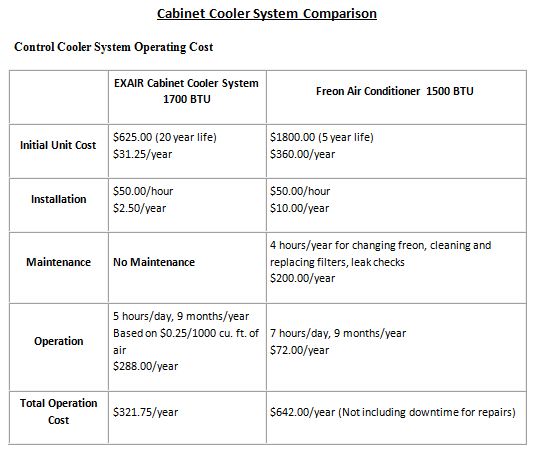
The last (and I thought, most highlighted) inappropriate use they covered was cabinet cooling. It was explained that even though a vortex tube cooler may cost less, the air consumed will cost more than the electricity required by a refrigerant-based unit. Now, we don’t dispute that…the following comparison shows as much:

Then, the instructor went a bit further (pre-empting a question from Brian, Lee, and I) to validate cabinet cooling as an appropriate use, but only when: the environment was not conducive to a refrigerant-based unit (high ambient temperatures, dusty/dirty/aggressive atmosphere, etc.), AND thermostat control was used. They took great pains to not promote any particular brands of equipment in the presentation of the seminar, but the photo they used to illustrate this was unmistakably an EXAIR NEMA 4 Cabinet Cooler with Electronic Temperature Control. That was worth the price of admission for me.

If you have questions about whether you’re using your compressed air appropriately, or even to its maximum efficiency, give us a call. If we can’t find the answer mathematically from the data available, we can gather the data in our Efficiency Lab. Math doesn’t lie, and neither will we.

Russ Bowman
Application Engineer
EXAIR Corporation
(513)671-3322 local
(800)923-9247 toll free
(513)671-3363 fax
Web: http://www.exair.com
Blog: http://blog.exair.com/
Twitter: twitter.com/exair_rb
Facebook: http://www.facebook.com/exair

Six Steps to Optimizing Your Compressed air Systems

With the advent of the “Green Movement”, there is a heightened awareness of energy costs. Compressed air is expensive but an essential commodity that cannot be eliminated.  Its use though can be monitored and reserved for those applications that make the most sense. Here are 6 steps to take to make the most efficient use of your compressed air.

click on picture for more information

Measure air consumption to find the sources that use the most compressed air
You can use a flow meter or go by the manufacturer’s air consumption specifications. When you have identified your major sources of air usage, you need to evaluate more efficient alternatives like engineered air nozzles and jets.

Find and fix leaks in your compressed air system
Plants that aren’t maintained can easily waste up to 30% of their compressor output through leaks that go undetected. In plants with high noise levels, it is very difficult to locate leaks by merely listening for them. Most plant noise is in the normal audible range of human hearing while air escaping from a small orifice is ultrasonic. A  leak detector  will pinpoint leaks that you normally you would not be able to hear. Testing the various unions, pipes, valves and fittings can be done quickly and effectively at distances up to 20′ (6.1m) away!

Replace inefficient blow guns, air nozzles, and open pipe with engineered compressed air products
While open and drilled pipe are cheap to make, their inefficient use of compressed air is quite costly. The difference between the cost to operate an engineered nozzle vs. an open pipe are extremely dramatic.

Turn off compressed air when not in use

click on picture for mor information

Overall consumption can be reduced by intermittently turning the air on and off between cycles or between parts coming down a conveyor. For part ejection from a press operation, the air only needs to be on when the ram is in the open position. For parts traveling down a conveyor there is no sense in blowing air between the spacing of parts. Using a computerize flow control such as an electronic flow controller which is a photoelectric senor with a timing controller that limits compressed air use by turning it off when no part is present.

Click on picture for more information

Use intermediate storage of compressed air near the point of use.
A common mistake when low on air is to crank up the pressure at the compressor. That is a very costly mistake. Increasing system pressure by 10 PSI results in a 5% increase in energy. A better method is to install a storage tank at or near the point of use. This will store compressed air for those peak durations without having to increase the system pressure.

Control the air pressure at the point of use to minimize air consumption.

Click on picture for more information

The more pressure you put onto an orifice the greater the volume of air will pass through it. EXAIR highly recommends using a pressure regulator. Start off a low setting and increase the pressure until it just gets the job done. That way you are only using the amount of air required for the application.

If you would like some assistance in your compressed air energy conservation give one of our application engineers a call at 1-800-903-9247.

Available 8AM-5PM EST

Joe Panfalone
Application Engineer
Phone (513) 671-3322
Fax (513) 671-3363
Web: www.exair.com
Twitter: www.twitter.com/exair_jp
Facebook: http://www.facebook.com/exair