EXAIR’s Knowledge Base

At EXAIR, we are dedicated to equipping our customers with the essential tools to address challenges and train their personnel through a diverse range of offerings, collectively referred to as the Knowledge Base. This resource is organized by various criteria to provide practical, experience-based solutions.

In our Knowledge Base, you will discover case studies that showcase how we have assisted customers in enhancing their processes, reducing compressed air consumption to save costs, and improving worker safety. Additionally, we provide a categorized list of frequently asked questions by product line, a collection of calculators designed to estimate potential savings, and various application examples to illustrate our impact.

We offer a collection of previously recorded webinars that you can access for free at your convenience. These sessions cover a range of topics, including the differences between inefficient and engineered nozzles, static generation, and methods for identifying and repairing leaks. Additionally, our video library features product demonstrations, informal content, and practical tips for maximizing the use of our products. We also provide Application Assistance and an Efficiency Lab, which facilitates tailored recommendations and performance comparisons.

Alongside the extensive resources found in the Knowledge Base, EXAIR boasts a team of skilled Application Engineers who possess expertise across a diverse range of industries and processes. It is likely that one of our engineers has encountered a similar application, and we are eager to assist you in finding the most effective solution.

If you have questions about our Knowledge Base, or anything regarding EXAIR and our products, please do not hesitate to reach out.

Jason Kirby
Application Engineer
Email: jasonkirby@exair.com
Twitter: @EXAIR_jk

Heat Transfer (Conduction, Convection, Radiation)

Thermal energy moves from warmer regions to cooler ones through conduction, convection, and radiation. Objects continuously lose heat until they achieve thermal equilibrium, meaning they reach the same temperature as their environment. For instance, a steaming mug of tea will gradually cool until it matches the temperature of the room.

But how that mug looses that heat is what this blog is all about.

CONDUCTION:

Thermal energy moves through solids mainly via conduction. This phenomenon happens when two solid items with varying temperatures come into contact, enabling heat to transfer from the warmer object to the cooler one. For instance, in the scenario of a hot coffee mug resting on a cold table, the thermal energy shifts from the mug to the table beneath it.

CONVECTION:

Convection refers to the movement of fluids, whether they are liquids or gases, and can occur naturally or be induced by external forces. Fluids can either absorb or release heat, depending on their temperature. Natural convection happens due to variations in density; for instance, steam rises from the top of the mug as the steam rises, colder air is cycled in.

RADIATION:

While the coffee emits infrared radiation as it loses heat, this process is generally less significant compared to conduction and convection in the context of a cup of coffee. This type of heat loss can be felt by holding your hand near a warm coffee cup as shown.

No matter how the heat is transferred to an object, if it needs to be cooled there is a good chance that one of our Application Engineers has approached a similar issue and can help. To discuss, contact us, and we will walk through the best method to eliminate the heat from within your application.

Jordan Shouse
Application Engineer

Send me an Email
Find us on the Web 
Like us on Facebook
Twitter: @EXAIR_JS

It’s Getting Hot In Here!

Okay, if you did not finish the song lyrics when reading the title, it’s okay, we can still be friends. In all actuality, the temps are warming up here in the MidWest as we prepare for our false Spring as indicated by the freezing temps and snow we received earlier this week. There is one thing that has stayed constant and that is the methods of heat generation.

1 – Kettle-convection-conduction-radiation

Heat generation is a result of energy conversion. The conversion of energy to do work, whether it is actual voltage going through a transformer that operates a neon sign to light up the roadside sky or energy from a hydraulic ram that is compacting recycled paper into a bundle and the hydraulic fluid is being pressed in and out of cylinders from a pump, all of it will have some form of a heat byproduct. This heat then gets transferred and how it is transferred can be helpful to know.

2 – Energy Transfer – Heat

At the molecular level, atoms store the energy that will cause electrons to enter into an excited state and rapidly switch between shells. When the electron returns to a lower shell (closer to the nucleus), energy is released; the energy released is then absorbed by atoms at a lower energy state and will continue until the thermal energy is equal between the two objects. Heat has four fundamental modes of transferring energy from surface to surface, and they are as follows:

Advection
Advection is the physical transport of fluid from point A to point B, which includes all internal thermal energy stored inside. Advection can be seen as one of the simpler ways of heat transfer.

Radiation
Radiation is the transfer of thermal energy through empty space and does require a material between the two objects. Going back to how thermal energy is released from atoms when the electron returns to a lower energy shell, the energy is released in the form of light ranging from infrared light to UV light. Energy in the form of light can then be absorbed by an object in the form of heat. Everyone experiences radiation transfer every day when you walk outside; the light from the sun’s radiation is what keeps this planet habitable.

Conduction
Conduction can also be referred to as diffusion and is the transfer of energy between two objects that have made physical contact. When the two objects come into contact with each other, thermal energy will flow from the object at the higher temp to the object at the lower temp. A good example of this is placing ice in a glass of water. The temperature is much lower than the room temperature. Therefore, thermal energy will flow from the water to the ice.

Convection
Convection is the thermal energy transfer between an object and a fluid in motion. The faster the fluid moves, the faster heat is transferred. This relies on the specific heat property of a molecule to determine the rate at which heat will be transferred. When a molecule has a lower specific heat, it takes faster motion and larger volumes to achieve the full effect of convection transfer. Convection is used in modern ovens to get a more even heat throughout the food while cooking.

No matter how the heat is transferred to an object, if it needs to be cooled there is a good chance that one of our Application Engineers has approached a similar issue and can help. To discuss, contact us, and we will walk through the best method to eliminate the heat you need to.

Brian Farno
Application Engineer
BrianFarno@EXAIR.com
@EXAIR_BF

1 – “Kettle-convection-conduction-radiation” by P.wormer is licensed under CC SA 3.0
2– “Energy Transfer – Heat” by Siyavula Education is licensed under CC BY 2.0

Compressed Air Use in the Medical Industry

EXAIR uses many different methods to connect with our customers.  We have our website, social media, blogs, publications etc. We like to share solutions to some of the most common pneumatic problems in industry.  EXAIR generates a large collection of application information where EXAIR products have already solved problems and improved processes. We organized them by Application and by Industry.  In this blog, I will show you how to use our Application database; specifically, for the Medical Industry.

Vortex-based products used to cool skin during air removal laser surgery

Compressed Air Systems are considered to be a fourth utility within industries because they use a large amount of energy.  Whether an air compressor that uses fuel for portable units or that uses electricity, it is important to use this system as efficiently as possible.  This would also apply to the automotive industry.  EXAIR has a library of different processes in which we have already improved these areas safely and efficiently.  If you are part of the automotive industry, it could benefit you to take a peek at the areas that we have already improved, established OSHA compliant safety measures, and saved money.

Drying medical Bins with the Super air Amplifier!

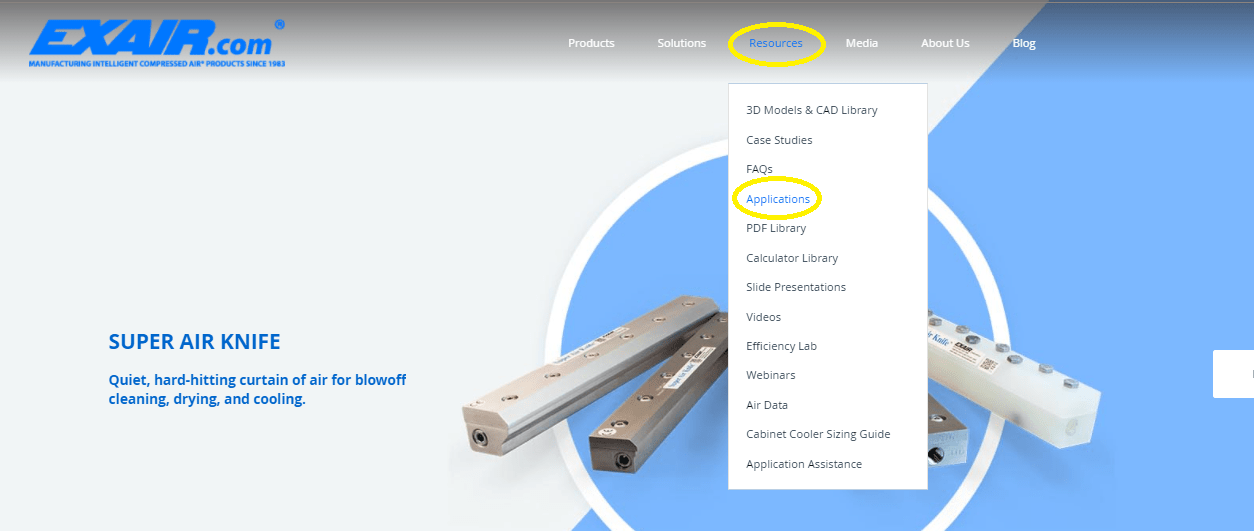
Here is how you can find this library.  First, log into EXAIR.com.  Click here: Log In.  Once you fill in the proper information, you can then retrieve tremendous amounts of resources about EXAIR products.   The Application database is under the Resources tab.  (Reference photo below).

EXAIR Application Data Base

Within the Application Search Library, we have over one thousand applications referenced.  In the left selection pane, we organized them in alphabetical order under two categories: Application and Industry.

Scroll down in the selection pane until you come to the sub-category: Industry.  Under this Sub-category, you will find three selections that are related to this blog: Medical, Health and Beauty, and Healthcare.  We have other applications as well that may relate to your specific processes if you scroll up and down the list. You will find many product applications that have already improved processes and solved problems.

Why is this important?  If you are a plant manager or owner, the value of the Application Database can improve your current processes with pre-qualified results.  Within the automotive industry, simple solutions can be found to address those “nagging” issues that you see every day.  For crisis situations and shutdowns, EXAIR categorized these applications in a way to reference quickly and easily.  And since EXAIR has a high volume of stocked items, we can get the parts to you very fast, so you can quickly be on your way to a solution.

In today’s market, companies are always looking for ways to cut cost, increase productivity, and improve safety.  EXAIR offers engineered products to do exactly that.  With the “been there and done that” solutions already described in the Application Database, you can have confidence in finding a way of solving pneumatic issues.  If you do not sign up at www.EXAIR.com and take advantage of these offerings, you will be missing out on a great tool to optimize your compressed air system.

Jordan Shouse
Application Engineer

Send me an Email
Find us on the Web 
Like us on Facebook
Twitter: @EXAIR_JS