
The Return of The Satisfied Customer

I love a good sequel. Sequels of sequels draw me in too – like the “Star Wars” saga, the whole “Planet Of The Apes“ franchise (including the 70’s TV shows & cartoons), and the “Back To The Future” & “The Godfather” trilogies.  And I can watch them over and over again.  In fact, my wife can’t figure out why, when I own “The Godfather” DVD box set, I’ll still watch the movies whenever they’re on cable.  Come to think of it, I don’t have a good explanation for that either…

In keeping with this penchant for continuing story lines, I had an experience yesterday that compelled me to tie together several other EXAIR blogs from this past week:  Lee Evans wrote an inspiring piece the other day on the virtues of helping someone in need.  Then, Joe Panfalone expertly nailed the familiar lament of the Application Engineer: the fact that we’re seldom privy to the results of our contributions to customers’ projects.  And right on the heels of that, Neal Raker detailed a recent experience where he was able to successfully offer advice on better living through improved housekeeping techniques…uh, don’t try that one at home, Neal!

Anyway, I got a call from a customer who was having a problem with his Reversible Drum Vac (RDV).  Seems it would pump FROM the drum just fine, but it wouldn’t develop an acceptable suction lift to vacuum his coolant INTO the drum.  He asked about getting a “rebuild kit” for the RDV.  I told him that there weren’t any moving parts, so the typical maintenance/upkeep plan for these pretty much consists of a periodic cleaning.  I sent him a great little .pdf presentation that we have available upon request, with step-by-step instructions on how to perform this cleaning and reassembly.  He sent me a quick note later that afternoon, to let me know that it worked, and they were now back in business, with just about a half an hour of labor invested.

So I was able to help someone in need, by recommending a simple procedure, and I found out that it worked to his satisfaction.   THAT was a good day.

It may sound cliché, but I don’t care: we’re proud of our service after the sale.  If you want installation advice, operational assistance, maintenance guidance, or just some “tips and tricks,” we’re happy to oblige.  Doesn’t even have to be our equipment.

I love a good sequel…”Return of The Satisfied Customer.”  Yeah; just like the Godfather movies, I’ll watch that one over and over again.

Russ Bowman
Application Engineer
EXAIR Corporation
(513)671-3322 local
(800)923-9247 toll free
(513)671-3363 fax
Web: www.exair.com
Blog: http://blog.exair.com/
Twitter: twitter.com/exair_rb
Facebook: http://www.facebook.com/exair

The Role of Proper Housekeeping Technique in Static Elimination Applications

I recently spoke with a customer who manufactures screw-top bottle caps made of plastic. The product was molded, ejected out the machine and onto a conveyor. The product traveled no more than 4 meters before being deposited into the final container in which it was shipped for end use. The customer had asked what static eliminators could do to help them with their problem. First, we needed to define the problem as the customer assumed we would already know what their problem was. In their case, the caps (closures) were picking up debris during their short conveyor ride to the shipping container. The problem could just as easily been that the product was discharging to an operator or perhaps blemishes forming due to static discharges among the finished product.

The “dirt” was described as small flakes of burned material that would drop out of the process. Other forms of “dirt” were small pieces of cardboard from containers used within the area. The customer had apparently done a little research into ionizers and asked whether we thought a static eliminator could help. After all, the caps were made of plastic and plastic is susceptible to generating static charge, right?

My first thought was yes, a static eliminator would be helpful in this application. However, the customer still needed to employ some reasonable level of housekeeping in his process to keep the occurrence of this contamination from being such a big problem in the first place. A quick look around the machine area where the parts were molded revealed a thick layer of all sorts of debris that could fall in with the product at any time. Obviously, cleaning up the processing area in this case yielded very good result and adding a static eliminating air knife to the application kept static fields low and kept the ‘dirt’ from sticking to the final product and the conveyor.

The point being that while the static eliminator equipment does do a good job at keeping static problems away, do not forget to employ simple but effective processes, such as improvement of housekeeping procedures to further aid in resolving the issue of ‘dirt” contamination in an application.

Neal Raker
Application Engineer

Customer Feedback

Being an application engineer for EXAIR is very gratifying. I get to talk with other engineers around the world and from all industries. In helping them with their applications I learn a lot about their industry whether it be medical, mining, transportation, manufacturing as well as others. EXAIR’s engineered compressed air products seemingly have limitless possibilities in most any industry.

I find it exhilarating to take a call from a customer with a problem, talk him through it, and make suggestions for a solution. The disappointing part is that most of the time I do not get to experience the results and understandably so. The customer has solved his problem and is off to the next challenge.

We would like to hear from you so we have put together a  CaseStudyForm which you can quickly fill out and email to us. That would make my engineering experience complete.

Joe Panfalone
Application Engineer

Phone (513) 671-3322
Fax   (513) 671-3363
Web: www.exair.com
Twitter: www.twitter.com/exair_jp
Facebook: http://www.facebook.com/exair
Summer Time = Vacation Time

I personally can’t believe I’m saying this but summertime is almost here.  With that comes vacations or the increasingly popular “Staycations”.  For myself I get to see a good friend from college get married as my vacation this year.   It will be the first time my wife and I have left our daughter for more than just one night.  With the vacation of course came a good amount of planning, both at home and at work.

At home we got lucky because our parents are going to take turns watching our daughter, house, and dogs.  (Can’t beat free baby/house/dog sitting.)  They’ll of course be eating it up because they get to spend so much time with their grand-daughter and getting to completely spoil her for several days.  For most people when they go on vacation they have to prepare the house for no one to be there during their vacation.  A few points we make sure to cover in the case no one will be home is to turn off the water at the main shut off, set the thermostat for around 80° F so the A/C isn’t running that much, get rid of as much food from the fridge as possible so there isn’t a loss in the case of a power outage.   We also stop the mail and the paper, and lastly we set a few lights to turn on and off so it still appears someone is home, this can be done through timers or trusted neighbors, which is what we use.  This makes sure that you aren’t wasting energy while you are gone and when you come back home everything is ready to go back to normal or in our case as close to normal it can get.

At work I have a similar checklist.  Make sure all my emails are taken care of that need to be, ensure the e-mail and voicemail messages are set correctly, clean the desk up, and make sure to log out of the computer so there is a lower risk of shenanigans involving my background image or desktop icons.  This makes sure than when I get back to the office I’m not spending time and energy trying to get to the point of caught up and working on new projects.

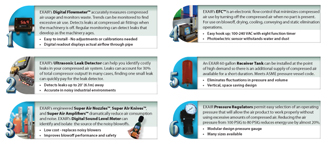
Preparing to leave for vacation is something you can very easily translate into how to prepare your compressed air system before you leave for a few days or even before you go home for the night.  You probably shut your compressor down so you can save money on your energy bill, the problem is if you don’t have a well maintained system you won’t have that stored air available when you come back.  If your system has leaks or if you are leaving a blow off on continuously even when the process is not needed then when you come in the next day or after a few days away the air isn’t there and you have to wait for the compressor to build up an initial charge to even begin work.  This not only causes additional work load on your compressor but it is down time that is easily avoidable.  With the help of our Six Steps to Compressed Air Optimization you can make sure you still have air in the storage tank when you get in on Monday rather than having to wait for the compressor.

So whether you are going on a vacation or just leaving for the day make sure you are doing everything you can to conserve, turn off those lights, seal up the leaks, and it will make the next time you come in that much easier.  Not to mention the savings you will see.

Brian Farno
Application Engineer
BrianFarno@EXAIR.com
Twitter: @EXAIR_BF