The E-Vac and The Basketball

crosstown classic

This Saturday is a big day for college basketball around here: the University of Cincinnati Bearcats will play the Xavier University Musketeers in their 81st matchup, in what is known as the Crosstown Classic. ESPN basketball analyst Jay Bilas once said “Cincinnati and Xavier have created a rivalry that is unparalleled when it comes to outright passion and civic division.” It’s so big, in fact, that the local TV station broadcasting the game in 1990 was one of the few stations in the country showing something other than the State of the Union address. THAT’S big.

I had the pleasure of assisting a caller with a big problem involving basketballs (and other inflatable sports balls) recently. They do custom printing on these sports balls, which need to be inflated to do the printing, but must be DEflated before shipping…this is especially important when there are a BUNCH of them…like when a vendor at, say, an event like the Crosstown Classic might be selling promotional basketballs with the Official Logo on them.

Anyway, they had rigged up a standard electric powered shop vacuum through a series of adapters to get to the needle that’s used to inflate/deflate the ball, but it took a while, didn’t fully the deflate the ball, and the electric motor burned up on them. Since a big part of their operation was inflating balls, they had compressed air available, and were interested in seeing if an E-Vac Vacuum Generator would work.

We supplied them with a Model 800008M In-Line Low Vacuum Generator E-Vac – these generate more vacuum flow than the High Vacuum models, and, since only needed to evacuate the air, this was ideal. They were able to easily adapt from the 800008M’s 3/8” NPT vacuum port to their needle, and it even made for a very convenient, quiet, hand-held operation.

I won’t be attending the Big Game this weekend – EXAIR’s family Christmas party is that day – but my support goes where my tuition money went: GO BEARCATS!

Russ Bowman
Application Engineer
EXAIR Corporation
(513)671-3322 local
(800)923-9247 toll free
(513)671-3363 fax
Web: www.exair.com
Blog: http://blog.exair.com/
Twitter: twitter.com/exair_rb
Facebook: http://www.facebook.com/exair

Stainless Steel Line Vac Conveys Egg Shells from Harvester to Waste Bin

IMG_0787

Our customer has a process where they de-cap eggs which are used in a variety of processes ranging from large scale bakery uses to medical uses for developing vaccines. The problem is they are left with a reasonable amount of egg shell waste that needs to be cleaned up after each cycle in the de-capping process. The previous method relied simply on friction and gravity to get the egg shell to go into the direction the customer wanted.

The problem with this method is that reliability was quite low. Egg shell would remain inside the egg, inside the tooling and pretty much everywhere around the de-capping process. The customer wanted to clean things up in the process a bit and increase the reliability that the shells go where they want them to which is a waste container about 5 meters away from the de-capper. The rate of shell flow was about 20 kilos per hour.

The customer made a search on the Internet for Air Vacuum conveyors and found EXAIR Corporation. After a short discussion to find out the specifics concerning rate of flow, distance, density of the product and available air pressure, we were able to make a suitable recommendation.

We ended up recommending EXAIR Model 6963 (1-1/2” Stainless Steel Line Vac kit). Having the full kit available allows the customer to install the Line Vac using included bracket for mounting as well as the air filter/separator and compressed air regulator with gauge to allow for accurate tuning of the air pressure to get just the right amount of suction from the Line Vac unit.

The customer purchased the recommended kit and installed on their machine. They have claimed the reliability has gotten to the point where the problem has nearly gone away. They still had some issues with the blades used, which they intend to sort out as a next step in their process of continuous improvement.

Neal Raker
Application Engineer
nealraker@exair.com

Continuous Improvement

I’m sure I have blogged about similar topics before but I’m going ahead with this anyway.   Have you ever bought something and after using it a few times say to yourself, I really wish they would have done this or I wish this had this feature.  I do that quite often, more often that my wife really cares for.  Normally it ends up with me being in the garage or the basement working on whatever it is for several hours and possibly even breaking whatever it was I was working on.  Well, I don’t just do that at home.

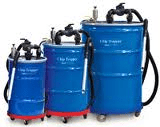
Two of our newest Industrial Housekeeping products were created from our own employees using them and seeing something that could make it better.   The easiest to see this with is our Chip Trapper System.

RDVFamily_300pxCT

Our Reversible Drum Vac Systems were around for a couple decades when someone decided to figure out a (patented) way to filter all the chips and solids out of the coolant we were processing.  So now, instead of just sucking the coolant out, we are able to filter the coolant and reuse it up to four times longer in our machines.

It is continuous improvements and being willing to listen to recommendations that make things like the Chip Trapper possible.  If you have one of our products and see a better idea, feel free to let us know, it may even be something that we could do on a custom basis for you.

Brian Farno
Application Engineer
BrianFarno@EXAIR.com
@EXAIR_BF

Four Weeks of Movember

Well November is over and shaving is back, but the beard and I had a good run and quite a bit of fun.  Here is the respectable picture with the beard.

Four Weeks of Movember

But while I shaved it off, I did try a couple of different looks.

One honoring our 21st President Chester A Arthur
CAA VS DAVE

To continue our highlight of Occupational Health Risks from earlier this Movember, OSHA has put out additional material on the dangers of noise, a serious threat to men’s and woman’s health in the workplace.  Sound is often over looked as a health risk, because its effects are not visible. The worst of the effects are typically not noticed until many years later, and it is very difficult or impossible to repair. According to OSHA’s website, The U.S. Bureau of Labor Statistics (BLS) publishes annual  statistics for occupational injuries (including hearing loss) reported by  employers as part of required record keeping. The BLS data show that hearing  loss represented 12% of the occupational illnesses reported in 2010.  This represents more than 18,000 workers who experienced significant loss of  hearing due to workplace noise exposure.

To curtail, noise relate hearing loss OSHA outlines a detailed plan include the following (3) Home Runs.

Three Significant Home Runs

  1. Get a handle on pneumatic and compressed air  devices and machine controls,
  2. Implement an Acoustical Maintenance Program  to maintain existing noise controls and keep  machinery in good working order, and
  3. Go all the way with machine guarding to  include the acoustical benefits (pennies on the  dollar).

These three items will provide the greatest noise reduction per dollar invested, and can even have a payback in dollars through energy savings and life expectancy of equipment.

Let’s just look at Home Run number one.  In most plants, compressed air can easily be responsible for 25-33% of plant’s noise problems.  Noise is generated by turbulent gases mixing at widely different velocities.  One of the easiest ways of curtailing noise is to install Air Knives or Air Nozzles on any open pipe or homemade blow devices that will eliminate turbulent flow.  This will have the added benefit of reducing air consumption and eliminate the risk of dead-ended compressed air onto human skin.

At EXAIR, we have done a variety of studies and testing to determine the noise level on all of our products, so that you could do a survey with a Sound Level Meter at quantify your noise reduction at every work station.  Any noise reduction can have a significant impact on hearing loss for employees, and their current and future quality of life.

Dave Woerner
Application Engineer
davewoerner@exair.com
@EXAIR_DW